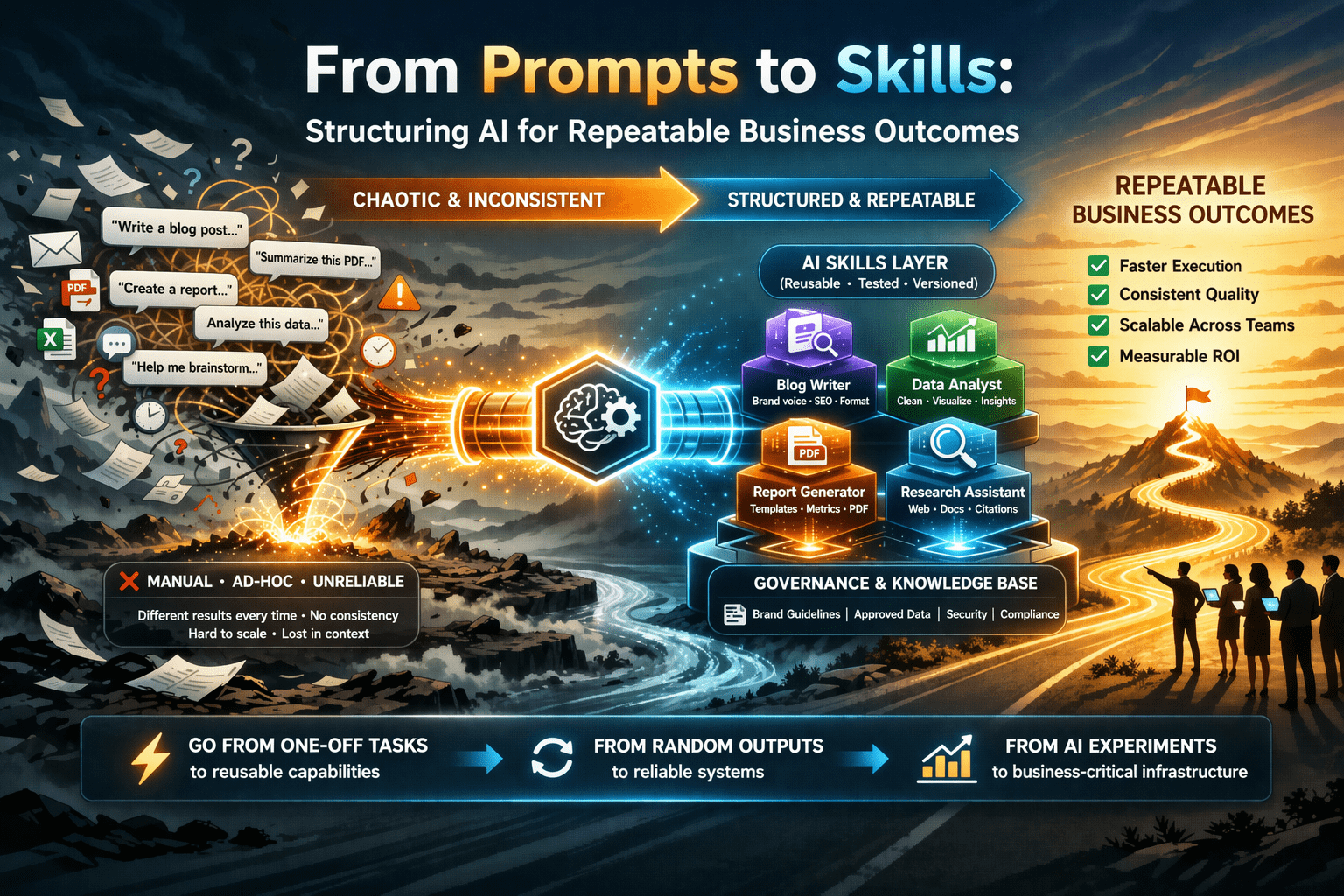
Prompts are how individuals get value from AI. Skills are how organizations do.
That distinction sounds simple. Its implications for enterprise AI strategy are significant. An organization that has invested in AI access and trained employees to use it effectively has built individual capability. That is valuable. It is not the same as building organizational capability — the kind that runs consistently regardless of who is invoking it, scales without adding training overhead, and produces outputs that meet defined quality standards every time.
The transition from prompts to Skills is the transition from individual AI utility to repeatable business outcomes. This is how enterprises make it.
Overview
Prompts are the starting point for AI use, not the destination for AI deployment. They require individual construction, produce variable outputs, and scale only as fast as the employees using them develop proficiency. Skills replace the prompt construction step with a structured capability that already knows what the task requires. The business outcome is repeatable because the capability is repeatable — not because individual employees have learned to prompt consistently.
- Prompts produce individual utility; Skills produce organizational capability
- The quality of a prompt-based output is bounded by the quality of the prompt; Skill output quality is bounded by the quality of the Skill design
- Moving from prompts to Skills requires identifying which tasks are structured enough to be built into a repeatable capability
- The transition is an organizational design decision as much as a technology decision
- Repeatable business outcomes require structured AI, not better individual prompting
The 5 Why’s
- Why do prompts fail to produce repeatable business outcomes at scale? Every prompt is a one-time construction. Even employees who have developed strong AI prompting skills produce variation across executions of the same task. That variation is acceptable for individual use. It is a structural problem for organizational operations that depend on consistency.
- Why is “better prompting” not a scalable solution to AI output variability? Better prompting requires training investment, produces diminishing returns as task complexity increases, and still leaves output quality dependent on individual execution in the moment. The problem is not employee capability. It is that prompts are the wrong mechanism for organizational-scale consistency.
- Why does structuring AI for repeatable outcomes require building at the capability level? Repeatable outcomes require repeatable processes. A repeatable AI process requires that the task requirements, quality parameters, and output structure are defined at the capability level — not reconstructed from a prompt each time. That is what Skill design does.
- Why is the transition from prompts to Skills a design decision, not just a technology upgrade? Building a Skill requires clarity about what the task is, what good output looks like, what inputs are required, and what edge cases the capability needs to handle. That clarity is an organizational design decision — it requires the business to define its AI-driven workflows explicitly rather than leaving them to individual interpretation.
- Why do repeatable business outcomes justify the investment in Skill development over sustained prompt training? Prompt training is an ongoing cost with variable results. Skill development is a one-time design investment that produces consistent returns across every execution for the life of the capability. For high-frequency tasks, the ROI comparison is straightforward.
The Transition From Prompts to Skills
Step 1: Identify Prompt-Dependent Workflows
The first step is identifying where in the organization AI is being used via prompts for tasks that run repeatedly. These are the tasks where employees have developed their own prompting approaches — some effective, some less so — and where output quality varies as a result.
Indicators of prompt-dependent workflows include:
- Employees sharing “good prompts” for common tasks
- Significant variation in AI output quality for the same task across different employees
- Training sessions focused on how to prompt AI for specific use cases
- Employees spending time refining prompts before getting usable outputs
Each of these signals a task that is a candidate for Skill development.
Step 2: Define the Task Explicitly
Skill development requires explicit task definition — which is more rigorous than prompt construction. A prompt describes what the user wants in a given moment. A Skill definition specifies what the task always requires: the inputs, the processing logic, the output format, the quality criteria, and the edge cases the capability needs to handle.
This step often surfaces ambiguity that prompt-based usage has obscured. When the task definition requires explicit answers to questions like “what does complete output look like?” and “what should happen when the input is incomplete?” the organization is forced to define its AI-driven workflows with a precision that general prompting never required.
Step 3: Build the Skill Around Defined Quality Parameters
The Skill is built to meet the quality parameters defined in Step 2 — not to be a general-purpose AI capability with task instructions prepended. The distinction matters because it determines how the Skill behaves when inputs vary, when edge cases appear, and when the task requires handling something the initial design did not explicitly anticipate.
Skills built around defined quality parameters handle variation consistently because the quality standard is part of the capability design. Skills built as saved prompts with better packaging handle variation the way any prompt handles it — inconsistently.
Step 4: Deploy as Operational Infrastructure
A completed Skill is deployed as operational infrastructure — accessible to every employee who performs the relevant task, without requiring them to understand AI prompting to use it effectively. The Skill handles the task. The employee provides the input and reviews the output.
Deployment at the infrastructure level means the Skill runs as a standard part of the workflow, not as an optional AI enhancement that some employees use and others skip.
What Changes When Prompts Become Skills
- Output consistency — Skill outputs conform to defined quality parameters across every execution, regardless of who invokes the capability
- Employee time allocation — the time previously spent constructing and refining prompts redirects to reviewing Skill outputs and handling the judgment layer
- Organizational AI capability — AI capability becomes an organizational asset, not an individual one that walks out the door when a proficient employee leaves
- Measurable ROI — structured Skill executions produce trackable outputs that make AI investment ROI calculable against a defined baseline
- Onboarding efficiency — new employees access organizational AI capability through Skills without requiring AI proficiency training before they can contribute
Where Prompts Still Belong
Not every AI use case should be built into a Skill. Prompts remain the right mechanism for:
- Exploratory or one-off tasks — tasks that do not repeat frequently enough to justify Skill development investment
- Highly contextual work — tasks where the requirements vary significantly with context in ways that cannot be captured in a structured capability
- Creative and judgment-intensive work — tasks where the value comes from the individual’s direction and expertise, not from consistent execution of a defined process
The transition from prompts to Skills is not a wholesale replacement. It is a structural decision about which tasks are defined enough, frequent enough, and consistency-sensitive enough to operate at the Skill level.
A Simple Prompt-to-Skill Transition Assessment
Your organization is ready to move specific workflows from prompts to Skills if:
- Employees run the same AI-assisted task repeatedly with prompt construction each time
- Output quality varies enough across employees that standardization would produce measurable value
- The task can be defined explicitly enough to build structured quality parameters into a capability
- The task runs at sufficient frequency that Skill development ROI justifies the design investment
- AI adoption has plateaued because prompt-based usage has not translated into consistent operational change
These are the conditions where the transition produces clear, measurable return.
Final Takeaway
The ceiling on prompt-based AI value is real and predictable. Prompts produce individual utility that varies with individual proficiency. They do not produce organizational capability that runs consistently, scales without training overhead, and delivers repeatable business outcomes across every employee who needs it.
Claude Skills break through that ceiling. The transition from prompts to Skills is not a feature upgrade — it is a structural shift from individual AI use to organizational AI infrastructure. It requires explicit task definition, deliberate capability design, and deployment as standard operational practice. The organizations that make that transition produce AI returns that compound over time. Those that stay at the prompt layer produce returns that plateau.
Make the Transition From Prompts to Skills With Mindcore Technologies
Mindcore Technologies works with enterprise teams to identify prompt-dependent workflows, define the task requirements that make them Skill candidates, and build the structured capabilities that turn them into repeatable business operations — with measurement frameworks that demonstrate the return from day one.
Talk to Mindcore Technologies About Building Claude Skills From Your Existing Workflows →
Contact our team to map your current prompt-dependent AI usage and identify which workflows are ready for Skill-level deployment.