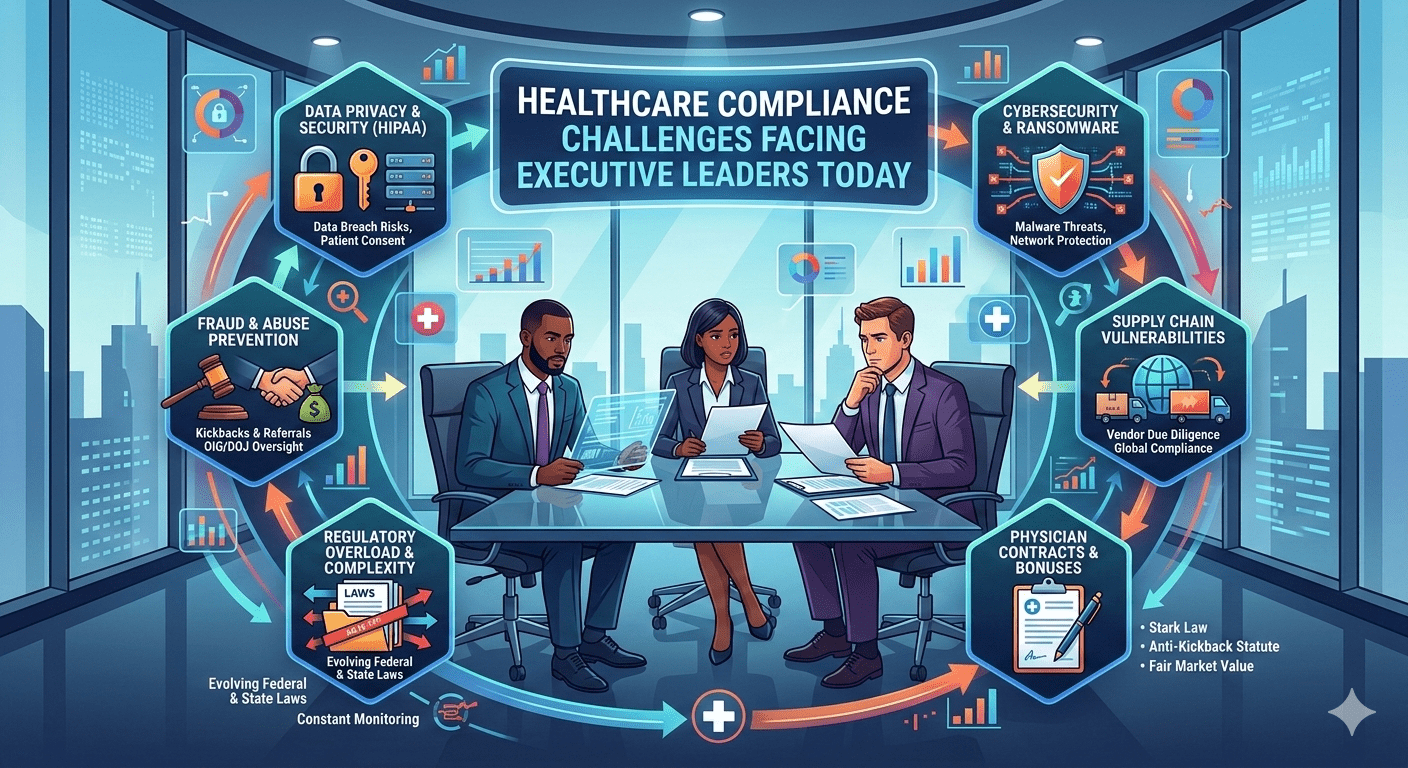
Healthcare compliance is no longer confined to IT departments. Regulatory failures now reach the executive level. Chief Executive Officers, Boards of Directors, Chief Information Officers, and Chief Information Security Officers are increasingly held accountable when systemic weaknesses lead to breaches or audit failures.
Enterprise healthcare organizations operate within a complex regulatory landscape that includes HIPAA enforcement, state privacy laws, cyber insurance scrutiny, and contractual obligations with third-party vendors. Compliance failures are rarely caused by a single technical mistake. They are usually the result of structural gaps in oversight, infrastructure design, and enforcement consistency.
The foundation for solving these governance risks begins with structured Healthcare Compliance Solutions, as outlined in The Complete Guide to Healthcare Compliance Solutions for Enterprise Organizations, where compliance becomes embedded in architecture rather than treated as policy documentation.
Expanding Executive Accountability
Regulatory enforcement has shifted toward systemic evaluation.
• OCR investigations now assess governance practices
Leadership oversight is evaluated, not just technical failures.
• Board reporting requirements have increased
Cybersecurity metrics must be presented regularly.
• Cyber insurance carriers demand proof of safeguards
Premiums depend on documented enforcement.
• Public breach disclosures increase reputational risk
Brand trust can collapse after regulatory findings.
Executive leaders must therefore demand architectural visibility and structured reporting.
Governance Gaps That Create Compliance Exposure
1. Lack of Centralized Compliance Dashboards
Fragmented reporting undermines executive oversight.
• Disparate logging systems
Make it difficult to assess real-time exposure.
• Manual compliance reporting
Introduces inconsistency and delay.
• Limited anomaly visibility
Reduces early detection capability.
Centralized monitoring, as emphasized in Enterprise Healthcare Cybersecurity: A Comprehensive Guide for 500+ Employee Organizations, strengthens executive visibility.
2. Overreliance on Policy Without Enforcement
Policies without technical enforcement create audit risk.
• RBAC defined but not consistently applied
Leads to privilege creep.
• Encryption policies without verification mechanisms
Leaves gaps in PHI protection.
• Incident response plans not tested regularly
Weakens operational readiness.
Operational enforcement principles are structured in The Ultimate HIPAA Compliance Checklist for Healthcare Executives, which translates policy into daily controls.
3. Vendor Governance Blind Spots
Third-party exposure often goes underreported.
• Incomplete Business Associate Agreement tracking
Creates contractual vulnerabilities.
• Limited vendor access monitoring
Expands PHI exposure.
• Irregular vendor security reassessments
Allows evolving risks to go unnoticed.
Vendor governance integration is also a core component of How to Choose the Right HIPAA Compliance Solution for Your Healthcare Organization.
4. Flat Network Architecture and Lateral Risk
Infrastructure weaknesses create systemic exposure.
• Lack of segmentation
Allows attackers to move freely.
• Centralized credential compromise risk
Increases breach scope.
• Unprotected backup systems
Threaten recovery capabilities.
Architectural modernization strategies are examined in ShieldHQ vs Traditional Healthcare Security: Comparing Enterprise Solutions, where containment reduces regulatory fallout.
Regulatory and Insurance Pressures
Executive leaders must also address financial implications.
• Cyber insurance audits require evidence of MFA enforcement
Weak authentication increases premiums.
• State privacy laws add layered compliance obligations
Expand exposure beyond HIPAA.
• Public reporting obligations increase legal scrutiny
Elevate executive accountability.
These pressures demand integration between infrastructure and governance reporting.
Executive-Level Compliance Strategy
Enterprise leaders should implement structured oversight rhythms.
• Quarterly compliance briefings
Review monitoring data and risk posture.
• Annual formal risk assessments
Document evolving exposure.
• Quarterly access control audits
Validate RBAC enforcement.
• Vendor risk reassessment cycles
Review third-party exposure annually.
• AI-driven monitoring dashboards
Provide real-time executive visibility.
These governance mechanisms directly align with architectural standards described in How Enterprise Healthcare Organizations Build Audit-Ready Infrastructure.
Common Executive Mistakes
• Treating compliance as an IT-only issue
• Approving cybersecurity budgets without linking to regulatory safeguards
• Ignoring vendor access risks
• Failing to demand centralized reporting dashboards
• Overlooking segmentation weaknesses
These gaps increase systemic vulnerability.
Building Executive Confidence Through Architecture
Executive leaders gain defensibility when:
• Monitoring is centralized and automated
• Encryption enforcement is verifiable
• Vendor risk is documented
• AI anomaly detection reduces blind spots
• Compliance dashboards are structured and consistent
Technical strategy must support governance visibility, a principle expanded in Healthcare Compliance Solutions: What CTOs and CIOs Need to Know.