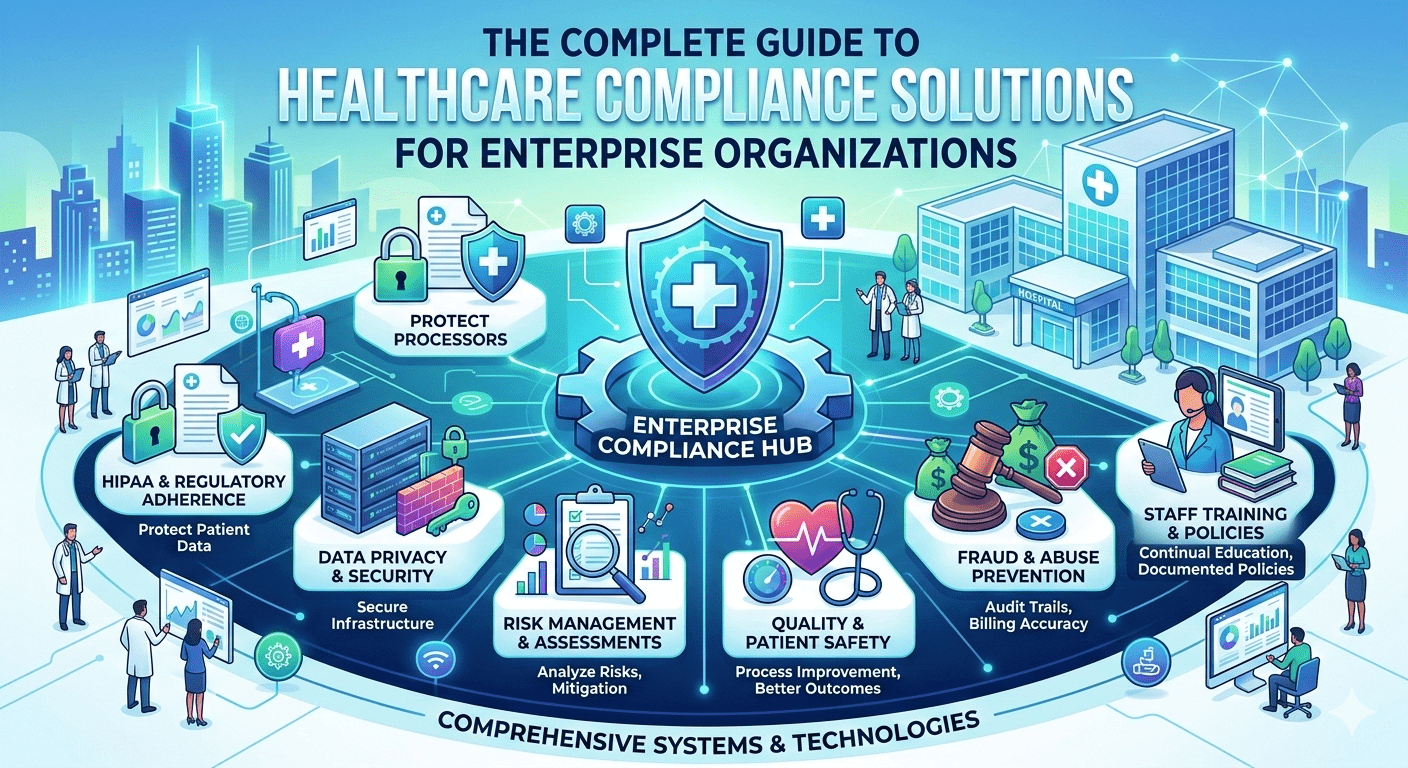
Healthcare compliance is no longer a simple checklist exercise. Enterprise healthcare organizations operate across hospitals, specialty clinics, telehealth platforms, research departments, and third-party billing providers. Every digital integration expands exposure. Every remote device increases risk. Compliance must therefore move beyond policy documentation and become embedded within infrastructure architecture.
Modern Healthcare Compliance Solutions must enforce encryption, identity governance, monitoring, vendor oversight, and automated documentation continuously. Without this systemic integration, organizations remain exposed to regulatory findings, data breaches, and executive liability.
Enterprise cybersecurity architecture directly impacts compliance sustainability. As detailed in Enterprise Healthcare Cybersecurity: A Comprehensive Guide for 500+ Employee Organizations, segmentation, centralized monitoring, and phishing-resistant authentication determine whether an incident becomes contained or catastrophic.
What Enterprise Healthcare Compliance Really Requires
Compliance sustainability depends on layered enforcement mechanisms working together across infrastructure layers, clinical systems, and cloud environments.
• Centralized monitoring systems
Aggregate logs from cloud platforms, endpoints, on-premise servers, EHR systems, and clinical applications into a unified visibility framework. Continuous log correlation ensures threat detection before regulatory impact.
• Healthcare data encryption enforcement
Protect PHI at rest and in transit across all environments, including backups, disaster recovery systems, and remote endpoints. Encryption must be enforced by policy and validated automatically.
• Role-Based Access Control (RBAC)
Restrict PHI exposure strictly according to job responsibilities. Enforce least privilege, automate provisioning and de-provisioning, and eliminate orphaned accounts.
• AI-driven anomaly detection
Identify unusual login patterns, abnormal data transfers, privilege escalation attempts, and lateral movement instantly. Behavioral baselining reduces dwell time and strengthens compliance defensibility.
• Vendor governance integration
Monitor third-party access pathways, enforce Business Associate Agreements, and segment vendor connectivity to prevent systemic exposure.
Selecting and implementing these safeguards correctly requires a structured evaluation process, as discussed in How to Choose the Right HIPAA Compliance Solution for Your Healthcare Organization. Risk assessments, control mapping, and architectural validation must precede deployment.
Why Executive Leadership Is Now Directly Exposed
Healthcare compliance failures now escalate to executive accountability. Board members expect structured compliance dashboards with measurable KPIs. Cyber insurance providers require documented safeguard enforcement and proof of ongoing monitoring. Regulators evaluate systemic weaknesses, not isolated technical errors.
These governance realities are examined in Healthcare Compliance Challenges Facing Executive Leaders Today, where oversight gaps often translate directly into regulatory consequences and reputational damage.
Compliance architecture must therefore provide:
• Real-time visibility
Executive dashboards that surface risk posture, control health, and anomaly alerts in near real time.
• Structured documentation
Centralized repositories that maintain policies, control evidence, remediation logs, and audit trails.
• Automated reporting
Continuous generation of compliance reports aligned to HIPAA Security Rule requirements and internal governance standards.
• Audit-ready log retention
Immutable, time-synchronized logs retained according to regulatory timelines and secured against tampering.
Without this automation, organizations struggle to demonstrate continuous enforcement during regulatory reviews.
Building Compliance That Survives Audits
Audit survival depends on system design, not last-minute preparation. Sustainable compliance requires embedded validation mechanisms.
• Conduct annual risk assessments
Document evolving threat exposure, infrastructure expansion, and control gaps across facilities and cloud platforms.
• Perform quarterly compliance reviews
Validate safeguard enforcement consistency and identify drift in configuration, access control, or encryption posture.
• Encrypt all PHI systems
Ensure every environment storing or transmitting PHI enforces strong encryption standards without exception.
• Centralize compliance dashboards
Improve executive oversight and reduce reporting fragmentation across subsidiaries or departments.
• Segment networks
Reduce breach scope, isolate sensitive workloads, and prevent lateral movement across clinical environments.
These infrastructure components are expanded in How Enterprise Healthcare Organizations Build Audit-Ready Infrastructure and operationalized through The Ultimate HIPAA Compliance Checklist for Healthcare Executives, which translates architecture into enforceable executive action steps.
Architecture Matters: Traditional vs Modern Models
Flat networks and perimeter-only security models cannot sustain enterprise compliance. Once breached, flat environments allow lateral movement across systems containing PHI, research data, and billing information.
As explained in ShieldHQ vs Traditional Healthcare Security: Comparing Enterprise Solutions, containment-driven architecture isolates sensitive workloads, encrypts communications, and limits blast radius. Compliance becomes enforceable by design rather than dependent on reactive remediation.
Technical leadership alignment is equally critical. Strategic infrastructure modernization is outlined in Healthcare Compliance Solutions: What CTOs and CIOs Need to Know, where cybersecurity investment directly supports regulatory defensibility and long-term operational resilience.
Compliance Must Be Engineered — Not Documented
Enterprise healthcare organizations cannot rely solely on policies, training manuals, or annual attestation forms. Compliance must be embedded within infrastructure, automated through monitoring systems, and validated continuously through telemetry.
When compliance is engineered:
• Breach containment improves
• Audit preparation becomes procedural rather than reactive
• Insurance underwriting strengthens
• Executive exposure decreases
• Patient trust is reinforced
Compliance must be engineered — not documented.