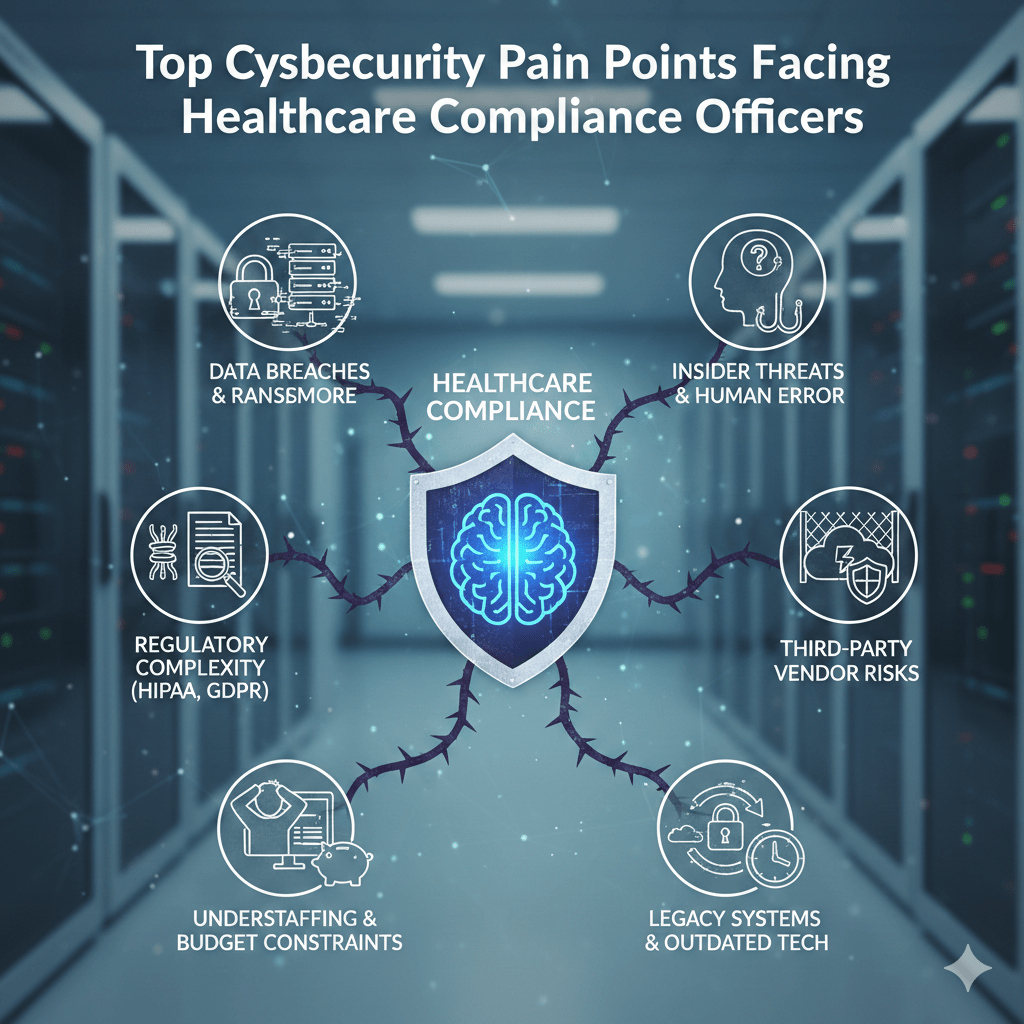
Healthcare compliance officers operate at the intersection of regulation, technology, and executive accountability. They are expected to maintain HIPAA alignment, prepare for audits, manage vendor exposure, coordinate with IT teams, report to leadership, and respond to incidents. Yet in many enterprise environments, they lack centralized visibility and automated enforcement tools.
The reality is simple: compliance officers cannot defend what they cannot see.
Enterprise healthcare systems require structured, enforceable Professional Cybersecurity Solutions for Healthcare Enterprises: Executive Guide that reduce operational strain rather than increase it. When infrastructure is fragmented, compliance officers become reactive instead of strategic.
Pain Point 1: Fragmented Monitoring and Reporting Systems
One of the most common challenges is decentralized visibility.
• Logs stored across multiple platforms
Require manual aggregation before audits.
• Inconsistent anomaly detection coverage
Creates blind spots.
• Manual compliance reporting processes
Increase error risk.
• Delayed executive reporting cycles
Reduce governance confidence.
This fragmentation often stems from traditional architectures discussed in Enterprise Healthcare Security: Professional vs. Traditional Approaches, where monitoring was reactive and perimeter-focused.
Pain Point 2: Credential Compromise and Identity Governance Weaknesses
Compliance officers frequently struggle with identity management gaps.
• Overprivileged user accounts
Increase PHI exposure.
• Delayed privilege revocation upon role changes
Create orphaned access.
• Weak MFA enforcement policies
Enable phishing-based compromise.
• Limited login anomaly monitoring
Reduce early detection capability.
Identity discipline must align with strategies described in Healthcare Cybersecurity Strategy for 500+ Employee Organizations, where large workforces increase authentication risk exponentially.
Pain Point 3: Vendor and Third-Party Risk Exposure
Vendor integration is one of the most persistent compliance stressors.
• Incomplete Business Associate Agreement tracking
Creates contractual vulnerability.
• Broad vendor network access permissions
Expand exposure.
• Limited vendor activity monitoring
Reduce accountability.
• Irregular vendor reassessment cycles
Allow evolving threats to go unnoticed.
Vendor governance challenges are directly addressed in Professional Healthcare Security Providers: Executive Evaluation Guide, where structured evaluation frameworks improve oversight.
Pain Point 4: Flat Network Architecture and Lateral Risk
Compliance officers often discover architectural weaknesses only after incidents occur.
• Unsegmented internal networks
Allow lateral movement.
• Backup systems reachable from production networks
Increase ransomware impact.
• No workload isolation for high-risk systems
Expand breach scope.
Modern containment architecture, discussed in Enterprise Healthcare Compliance: Serious Solutions for Serious Challenge, reduces systemic exposure.
Pain Point 5: Executive Reporting Pressure
Compliance officers face increasing governance demands.
• Board-level cybersecurity briefings
Require clear, concise dashboards.
• Cyber insurance compliance documentation
Must demonstrate enforceable safeguards.
• Regulatory inquiry response timelines
Demand structured documentation.
• Public breach disclosure risk
Heightens reputational stakes.
Compliance officers need automated dashboards and centralized visibility to meet these expectations effectively.
Pain Point 6: Manual Documentation Burden
Audit preparation often becomes overwhelming.
• Manual evidence collection processes
Delay audit readiness.
• Inconsistent log retention policies
Create documentation gaps.
• Outdated risk assessment files
Reduce defensibility.
• Fragmented policy version control systems
Complicate regulatory alignment.
Automation reduces documentation strain and improves consistency.
Pain Point 7: Scale-Driven Complexity in 500+ Employee Environments
As workforce size grows, complexity multiplies.
• Higher credential exposure risk
More users increase compromise probability.
• Expanded device inventory
Increase monitoring burden.
• Multiple facilities and cloud integrations
Complicate enforcement consistency.
These scalability pressures are central to Healthcare Cybersecurity Strategy for 500+ Employee Organizations, where enterprise size transforms risk dynamics.
How Professional Cybersecurity Solutions Reduce Compliance Strain
Professional security architecture reduces pain points by:
• Centralizing monitoring and compliance dashboards
• Automating anomaly detection
• Enforcing phishing-resistant identity governance
• Segmenting networks and isolating workloads
• Structuring vendor governance and reassessment cycles
• Automating documentation workflows
These capabilities build executive confidence and strengthen defensibility, themes expanded in Professional Healthcare Security Solutions: Building Executive Trust.
Key Takeaways
Healthcare compliance officers face significant operational strain due to fragmented monitoring systems, identity governance weaknesses, vendor exposure, flat network architecture, documentation burdens, and increasing executive reporting pressure. Enterprise healthcare organizations must implement professional cybersecurity architecture that centralizes visibility, enforces containment, automates monitoring, and integrates vendor governance to reduce compliance fatigue and strengthen regulatory defensibility.