

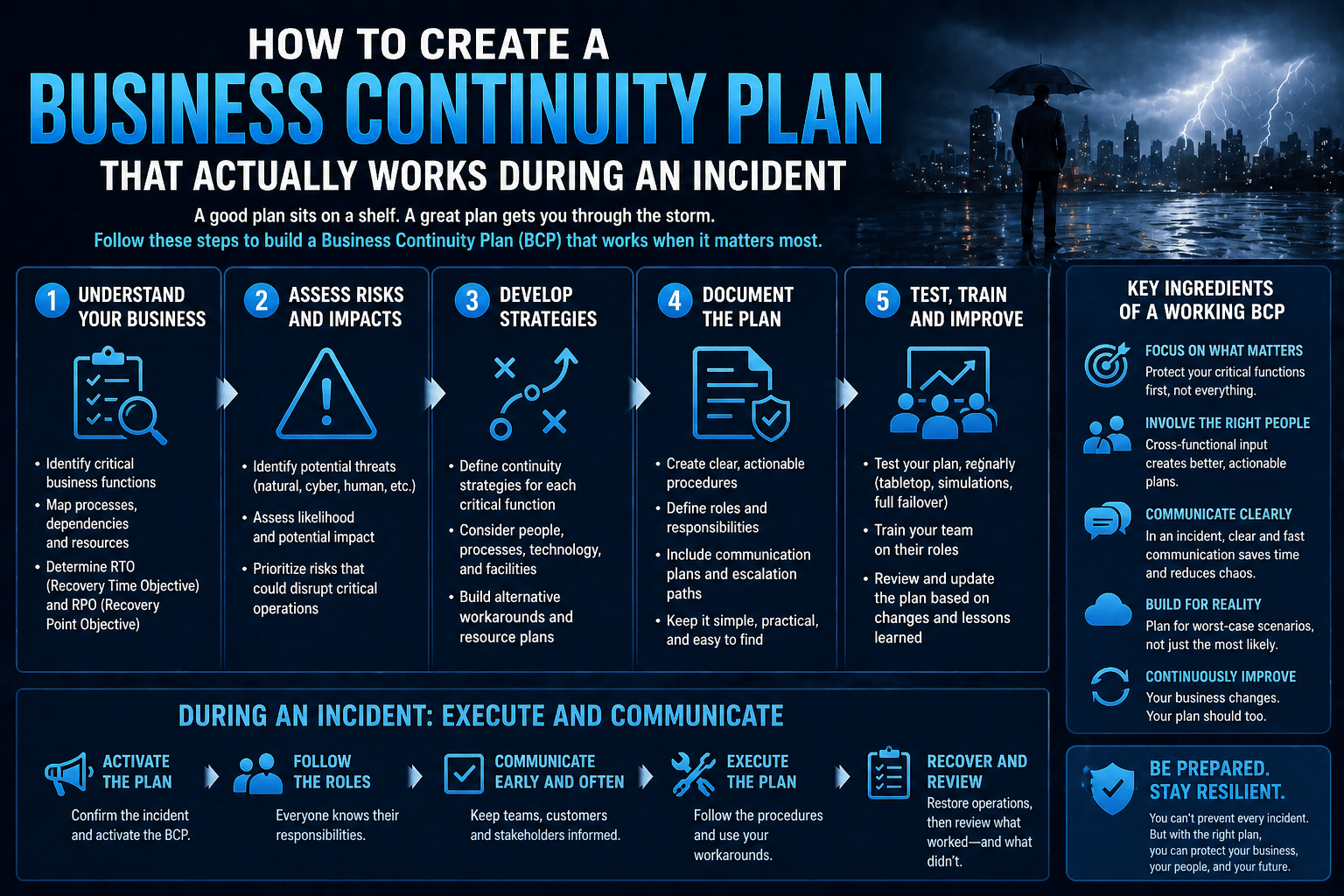
A business continuity plan (BCP) is only useful if it works when an incident actually happens — not in a tabletop exercise with full preparation time, but in the first hours of an actual outage, cyberattack, natural disaster, or facility loss when people are stressed, information is incomplete, and normal communication channels may not be available.
Most business continuity plans do not meet that standard. They are written carefully, reviewed once, filed, and never tested against realistic incident conditions. When an incident occurs, the plan is either not found, not followed, or not adequate for the actual scenario.
Building a business continuity plan that works during an incident requires a different approach: less documentation for its own sake, more operational clarity and tested procedures. For businesses in the Gulf South, where hurricane and flood events create real disruption scenarios, this is not a theoretical exercise. The plan needs to work.
For organizations with managed IT services in place, business continuity planning should be a joint effort between your IT provider and your leadership team — the IT components need to be technically designed and operationally tested.
Overview
A business continuity plan documents how the organization will maintain or recover critical operations when normal conditions are disrupted. An effective BCP identifies critical functions, defines the scenarios that could disrupt them, specifies recovery procedures, assigns clear ownership, and is tested regularly against realistic scenarios. It is a living operational document, not a compliance artifact.
- Critical function identification is the foundation — you cannot plan continuity without knowing what must continue
- Recovery time objectives (RTO) and recovery point objectives (RPO) define how fast and how complete recovery must be
- Clear ownership is the most important element — plans without named owners are not followed under pressure
- Testing is required — untested plans fail in ways that exercises reveal and production incidents exploit
- Gulf South businesses must address hurricane and flood scenarios explicitly
The 5 Why’s
- Why do most business continuity plans fail during actual incidents? Because they are written as compliance documents rather than operational procedures. A BCP that has never been tested does not reveal the gaps that only emerge under actual incident conditions: the person who owns a critical procedure is unavailable, the backup system requires a password nobody knows, the communication chain assumes phone service that is out. Testing reveals those gaps before they matter.
- Why is critical function identification the most important first step in BCP development? You cannot maintain what you have not identified. Many organizations discover during BCP development that different stakeholders have different views of what is truly critical — which creates the productive conflict necessary to prioritize correctly. Functions that are merely important are different from functions that must continue for the business to survive the incident window.
- Why are recovery time objectives and recovery point objectives so important to define before designing recovery procedures? RTO defines how quickly each critical function must be restored. RPO defines how much data loss is acceptable — how far back a recovery can roll before the loss is unacceptable. Those definitions determine what the recovery architecture needs to look like. A function with a 4-hour RTO requires different infrastructure than one with a 24-hour RTO. Designing recovery before defining objectives produces solutions that may not meet the actual need.
- Why is ownership assignment the single most important element of an actionable BCP? Plans that say “IT will restore the backup” do not work when an incident happens at 11 PM on a Saturday. Plans that say “Jane Smith is the primary, Marco Noriega is the backup, and both have the access and documented procedures to execute the restore” work. Every action in a BCP needs a named primary and a named backup. Everything else in the plan supports those ownership assignments.
- Why does a BCP need to address communication separately from operations? Incidents disrupt communication. A cyberattack may take email offline. A hurricane may take cell service out. A facility event may prevent staff from reaching their desks. The BCP needs out-of-band communication procedures — alternate channels, contact lists accessible outside the primary systems, and escalation paths that do not depend on the infrastructure that may be compromised.
How to Build a BCP That Works
Step 1: Identify Critical Business Functions
Work with department leaders to identify the functions that must continue or be restored quickly for the business to survive an extended incident. Typical critical functions include:
- Customer-facing operations and communication
- Financial transactions and billing
- Data access for core business processes
- Employee communication and coordination
- Regulatory reporting obligations
Prioritize ruthlessly. Not everything is critical. The BCP should focus on the functions that cannot stop without existential business impact.
Step 2: Define RTO and RPO for Each Critical Function
For each critical function, define:
- RTO (Recovery Time Objective): how quickly must this function be restored after an incident? Hours? Days?
- RPO (Recovery Point Objective): how much data loss is acceptable? If systems are restored from a backup, how old can that backup be before the data loss is operationally unacceptable?
These definitions drive the technology and process decisions that follow. Involve your managed IT provider in this step — the feasibility of your RTOs and RPOs depends on what your current backup and recovery infrastructure can deliver.
Step 3: Identify Threat Scenarios
The BCP needs to address specific scenarios, not just generic “incidents.” Common scenarios for Gulf South businesses include cyberattacks, severe weather, flooding, key personnel unavailability, and failures affecting business internet reliability.
- Ransomware or cyberattack taking systems offline
- Hurricane or severe weather forcing facility closure
- Flooding affecting on-premises infrastructure
- Internet or utility outage
- Key personnel unavailability
- Vendor or third-party failure affecting critical services
Each scenario has different recovery requirements. A hurricane scenario requires physical relocation capability. A cyberattack scenario requires system isolation and clean restore procedures. Cybersecurity incident response should be a specific scenario with specific procedures.
Step 4: Design Recovery Procedures for Each Scenario
For each critical function and each threat scenario, document the specific steps to recover operations:
- Who is responsible for each action (named primary and backup)
- What access, credentials, and tools are needed (documented and accessible offline)
- What the sequence of actions is
- What the escalation path is if the primary procedure fails
- How completion is verified
Keep procedures as short and clear as possible. Under incident conditions, people do not read long documents — they follow short checklists.
Step 5: Ensure Backup and Recovery Infrastructure Is Adequate
The BCP is only as good as the infrastructure behind it. Verify:
- Backup systems are in place for all critical data and systems
- Backups are tested regularly — not just confirmed as running, but restored and verified
- Backup storage is geographically separate from primary systems (a backup on a server in the same building that floods is not a backup)
- Recovery procedures have been executed successfully in a test environment
Your cloud services provider and managed IT team should be core partners in designing and validating the backup and recovery infrastructure.
Step 6: Build the Communication Plan
The communication plan is a separate and critical component:
- Out-of-band contact list for all critical staff (cell numbers, personal email — not just work systems that may be down)
- Communication channels that work when primary systems are down (a group text chain, a backup email service, a pre-agreed meeting point for physical emergencies)
- Escalation chain for incident declaration and response activation
- External communication procedures — customers, vendors, regulators
Step 7: Test and Update
A BCP that has not been tested is a hypothesis, not a plan. Testing approaches:
- Tabletop exercise: walk through a scenario with relevant stakeholders, identify gaps in the plan
- Functional test: execute specific recovery procedures in a test environment to verify they work as documented
- Full simulation: execute a scenario-specific recovery procedure as close to real conditions as possible — restore from backup, verify system functionality, execute communication plan
Test at minimum annually and after any significant change to the IT environment or business structure. Update the plan immediately when gaps are identified.
BCP Essentials Checklist
- Critical functions identified and prioritized
- RTO and RPO defined for each critical function
- Specific threat scenarios addressed with scenario-specific procedures
- Named owners for every action (primary and backup)
- Recovery procedures tested successfully
- Backup infrastructure verified and geographically distributed
- Out-of-band communication plan with accessible contact lists
- Plan reviewed and updated within the past 12 months
Final Takeaway
A business continuity plan that works during an incident is operationally specific, clearly owned, technically validated, and regularly tested. The gap between a BCP that looks good on paper and one that performs under pressure is the testing and validation work most organizations skip. For Gulf South businesses especially, the question is not whether a disruptive event will happen — it is whether the plan will hold when it does.
Business Continuity Planning With Mindcore Technologies
Mindcore helps organizations design and validate business continuity plans that address real scenarios — including hurricane and flood events specific to Gulf South operations. Our managed IT services, cloud services, and cybersecurity teams ensure the technical infrastructure behind your BCP is as solid as the plan itself.
Talk to Mindcore About Business Continuity Planning
Contact our team to assess your current BCP and identify the gaps before an incident exposes them.

