

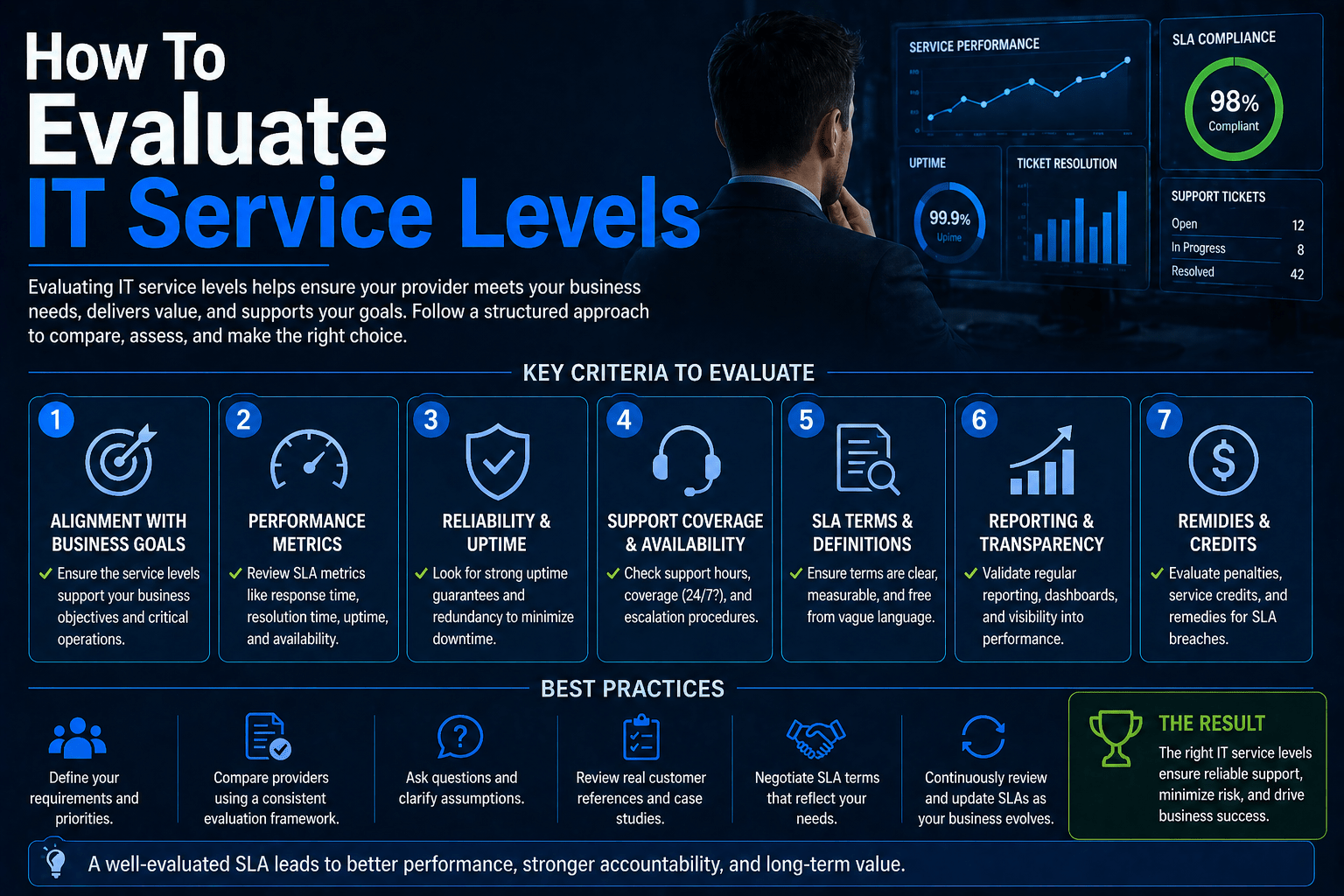
Evaluating IT service levels is not just a matter of reading SLA documents and comparing numbers. Response time commitments on paper tell you what a provider is willing to put in a contract. Actual service delivery quality is determined by operational maturity, staffing, tooling, and process discipline — factors that SLA documents do not reveal.
A complete evaluation of IT service levels requires looking at both the documented commitments and the operational reality behind them. This guide gives you the framework to do both.
The Two Layers of IT Service Level Evaluation
Layer 1: Documented Commitments
What the provider has committed to in writing:
- Response time commitments by priority level
- Resolution time targets
- Coverage hours and after-hours procedures
- Uptime and availability guarantees for managed infrastructure
- Escalation paths and triggers
- Remedy structure for SLA failures
These are the baseline. They define the minimum standard the provider claims to meet.
Layer 2: Operational Reality
Whether the provider actually meets those commitments — and how:
- Historical SLA performance data from current clients
- Staffing depth and how coverage is maintained during off-hours and vacations
- Tooling and whether it supports the monitoring and response capability being claimed
- Client references from organizations of similar size and complexity
- Escalation history and how complex issues are actually handled
Questions That Reveal Operational Reality
Ask these questions of prospective providers — the answers reveal operational maturity that documentation does not:
On staffing and coverage:
- How many technicians are on the team serving clients of our size?
- How is after-hours coverage staffed — dedicated on-call staff or a rotation?
- How is coverage handled during vacations, holidays, and staff turnover?
On process and tooling:
- What RMM platform do you use, and what monitoring coverage does it provide?
- How are alerts triaged — automatically, manually, or a combination?
- What is your average time-to-close for P2 tickets in the last quarter?
On accountability:
- Can you provide SLA performance reports from your last quarter?
- How do you communicate with clients during a major incident?
- What happens when a client is repeatedly affected by the same recurring issue?
On continuity:
- What is your staff turnover rate?
- How do you maintain knowledge continuity when a technician who knows our environment leaves?
- Who owns our environment documentation if we end the relationship?
Metrics That Matter Beyond Response Time
Response time is the most commonly cited service level metric. It is also the easiest to game — a provider can acknowledge every ticket within the SLA window while delivering slow, low-quality resolution. The metrics that reveal true service quality:
- Mean time to resolution (MTTR): average time from ticket open to ticket close, by priority level
- First contact resolution rate: percentage of issues resolved on the first contact without escalation or callback
- Repeat issue rate: percentage of tickets related to recurring issues — a high rate indicates systemic problems not being addressed
- Client satisfaction scores: direct feedback from users about the quality of support interactions
- SLA miss rate: how often the provider fails to meet its own commitments
Ask for these metrics. Providers with mature operations track them and can share them. Providers without mature operations cannot.
Using References Effectively
References from existing clients are the most reliable indicator of service level reality. To use them effectively:
- Ask for references from clients of similar size, industry, and IT complexity
- Ask the reference about specific incidents — not just general satisfaction
- Ask how the provider performs under pressure — during outages, security incidents, or major projects
- Ask whether the provider communicates proactively or only when contacted
- Ask whether the provider has delivered on what they promised at proposal time
Final Takeaway
Evaluating IT service levels requires moving beyond SLA documents to the operational evidence behind them. Response time metrics matter less than resolution quality, continuity, and how the provider performs when things go wrong. The providers worth choosing can demonstrate operational maturity through data and references — not just commitments.
Evaluate Mindcore’s Service Levels Before You Commit
Mindcore provides managed IT services with documented SLA terms and operational data to back them up. We welcome client references, service level reviews, and operational questions before any engagement begins. Our IT consulting services team can help you build an evaluation framework for any provider you are assessing.

