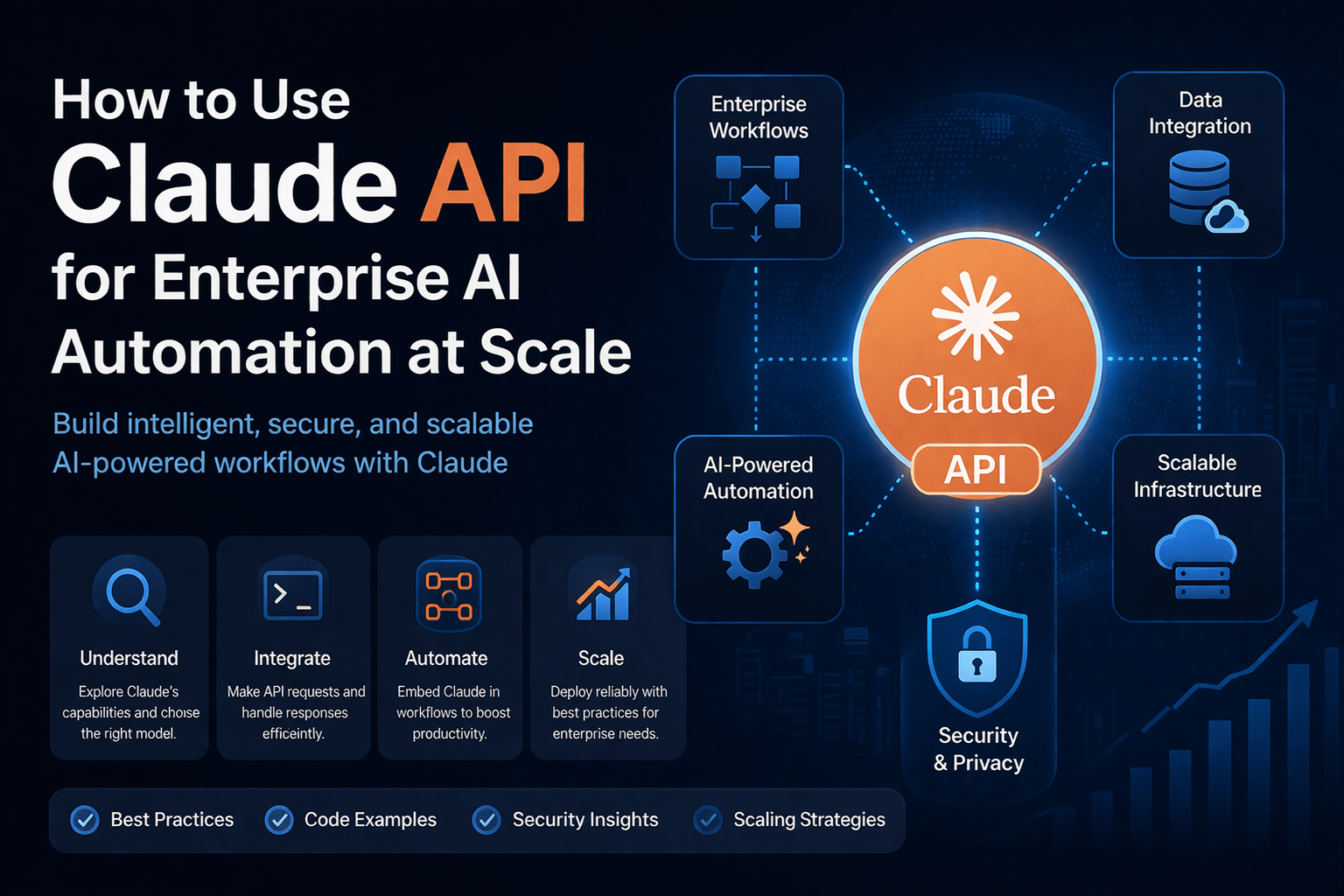
Enterprise AI automation does not happen through a chat interface. It happens through an API — the layer that allows AI capability to be embedded directly into the workflows, systems, and applications where work actually runs.
The Claude API is the access point that transforms Claude from a tool employees use manually into an AI capability that operates automatically inside enterprise processes. Getting that transformation right — at scale, across departments, with the security and governance that enterprise operations require — is what separates AI automation that compounds in value from AI deployments that plateau at individual productivity gains.
Overview
The Claude API gives enterprises programmatic access to Claude’s reasoning, language, and task execution capabilities — enabling AI to be embedded in internal applications, automated workflows, and operational systems without requiring employees to interact with Claude directly for every output. At enterprise scale, that embedding is what makes AI operational rather than supplemental.
- The Claude API enables AI to run inside enterprise workflows, not alongside them
- Automation at scale requires API-level integration — not manual employee interaction for every AI task
- Enterprise API usage requires architecture decisions around authentication, rate management, and output governance
- The API supports both synchronous interactions and asynchronous batch processing for high-volume workloads
- Scaling API-based automation across departments requires consistent integration patterns and centralized governance
The 5 Why’s
- Why does enterprise AI automation require API integration rather than direct tool access? Direct tool access produces individual productivity gains. API integration embeds AI into automated workflows that run without employee intervention — handling high-frequency tasks at volumes no employee interaction model can match. Scale requires automation. Automation requires the API.
- Why is the API layer the right abstraction for enterprise AI integration? The API provides a stable, programmable interface to Claude’s capabilities that enterprise applications and workflows can call directly. It abstracts the underlying model complexity while exposing the capabilities that matter — text generation, reasoning, analysis, classification — in a format that integrates cleanly with enterprise software architecture.
- Why do enterprise API deployments require architecture decisions that individual API users do not face? Enterprise-scale usage involves high request volumes, multi-tenant usage patterns, sensitive data handling, output quality requirements, and governance obligations that individual usage does not. Those requirements drive architecture decisions around authentication, rate limit management, error handling, output validation, and audit trail generation that must be designed in from the start.
- Why does scaling AI automation across departments require more than multiplying API usage? Departmental AI automation built independently produces inconsistent patterns, duplicated infrastructure, and governance gaps between deployments. Scaling across departments requires centralized API governance, shared integration patterns, and an organizational layer that manages the Claude API as enterprise infrastructure rather than a collection of independent integrations.
- Why is output governance a critical design requirement for enterprise API automation? Automated workflows that act on AI outputs without validation can propagate errors at the same scale they produce correct results. Enterprise API automation requires output validation frameworks — quality checks, confidence thresholds, human review triggers — that prevent automated action on outputs that do not meet defined reliability standards.
Building Enterprise AI Automation With the Claude API
Authentication and Access Architecture
Enterprise API deployments require more than API key management. The access architecture must address:
- Key management — API keys are treated as sensitive credentials, stored in secrets management systems rather than hardcoded in application code, rotated on defined schedules, and scoped to minimum required permissions
- Service account design — enterprise applications authenticate with Claude using service accounts that correspond to the application and use case, not individual user credentials — enabling attributable, auditable API usage at the application level
- Environment separation — development, staging, and production environments use separate API credentials; production keys never appear in development contexts
Request and Rate Management
High-volume enterprise workloads require request architecture that manages API rate limits, handles failures gracefully, and maintains throughput under variable load:
- Request queuing — asynchronous workloads use request queues that smooth peak volume against API rate limits rather than batching requests that exceed limits and fail
- Retry logic — transient failures are handled with exponential backoff and retry limits; permanent failures are routed to error handling workflows rather than silently dropped
- Throughput monitoring — API usage is monitored against rate limits in real time, with alerting that triggers before limits are reached rather than after requests start failing
Output Validation and Quality Control
Automated workflows that act on Claude API outputs require validation layers that prevent low-quality or incorrect outputs from triggering downstream actions:
- Structured output enforcement — prompts are engineered to produce outputs in defined formats (JSON, structured text, categorized results) that can be validated programmatically before downstream processing
- Confidence thresholds — outputs below defined quality or confidence thresholds are flagged for human review rather than passed directly to automated action
- Audit logging — every API call, its inputs, and its outputs are logged for quality monitoring, compliance auditing, and model performance tracking
What Enterprise AI Automation With the Claude API Enables
- Document processing at volume — contracts, invoices, clinical notes, compliance filings processed automatically with extraction, classification, and routing handled by Claude API calls embedded in the processing pipeline
- Customer interaction automation — inquiry classification, response drafting, escalation routing, and case preparation handled through API-integrated workflows that run without employee intervention for routine interactions
- Data extraction and transformation — unstructured data from documents, communications, and operational systems converted to structured formats automatically through API-integrated extraction pipelines
- Compliance and risk monitoring — ongoing monitoring workflows that apply Claude’s reasoning to operational data, flag compliance exceptions, and route findings to review queues automatically
- Internal knowledge operations — search, synthesis, and Q&A capabilities embedded in internal tools that retrieve and reason over enterprise knowledge bases through API integration
Scaling Across Departments: The Governance Requirements
- Centralized API management — API credentials, rate limit allocation, and usage monitoring managed centrally rather than independently by each departmental integration
- Shared integration patterns — common patterns for authentication, error handling, output validation, and audit logging applied consistently across all departmental deployments
- Usage attribution — API usage attributed to the application, department, and use case level — enabling cost allocation, performance monitoring, and governance by business unit
- Model version management — planned processes for evaluating and migrating to new Claude model versions across all integrations, rather than discovering breaking changes in production
A Simple Enterprise API Automation Readiness Check
Your organization is ready to scale Claude API automation if:
- High-frequency, well-defined AI tasks have been identified across multiple departments that are candidates for automated API-integrated processing
- API credential management and secrets infrastructure can support enterprise-grade key management
- Output validation requirements have been defined for automated workflows that will act on Claude API outputs
- Integration governance frameworks are in place or ready to be established for cross-departmental API usage
- IT architecture has capacity to manage Claude API as enterprise infrastructure with appropriate monitoring and operational support
Final Takeaway
Enterprise AI automation at scale is not a deployment of Claude for individual employees. It is an architecture decision — one that embeds Claude’s capabilities into the workflows, systems, and applications that run the business, through an API layer designed for the authentication, rate management, output governance, and operational monitoring that enterprise scale requires.
The organizations that build that architecture deliberately produce AI automation that compounds in value with every new use case integrated. Those that approach API usage as a series of independent integrations accumulate the technical debt and governance gaps that limit eventual scale.
Build Enterprise AI Automation With Mindcore Technologies
Mindcore Technologies works with enterprise teams to design and deploy Claude API integrations at scale — from authentication architecture and rate management through output validation frameworks, departmental governance, and the operational infrastructure that keeps API-based AI automation reliable across the full enterprise.
Talk to Mindcore Technologies About Claude API Automation for Your Enterprise →
Contact our team to assess your current AI automation architecture and build the API integration model that scales across your departments and use cases.