

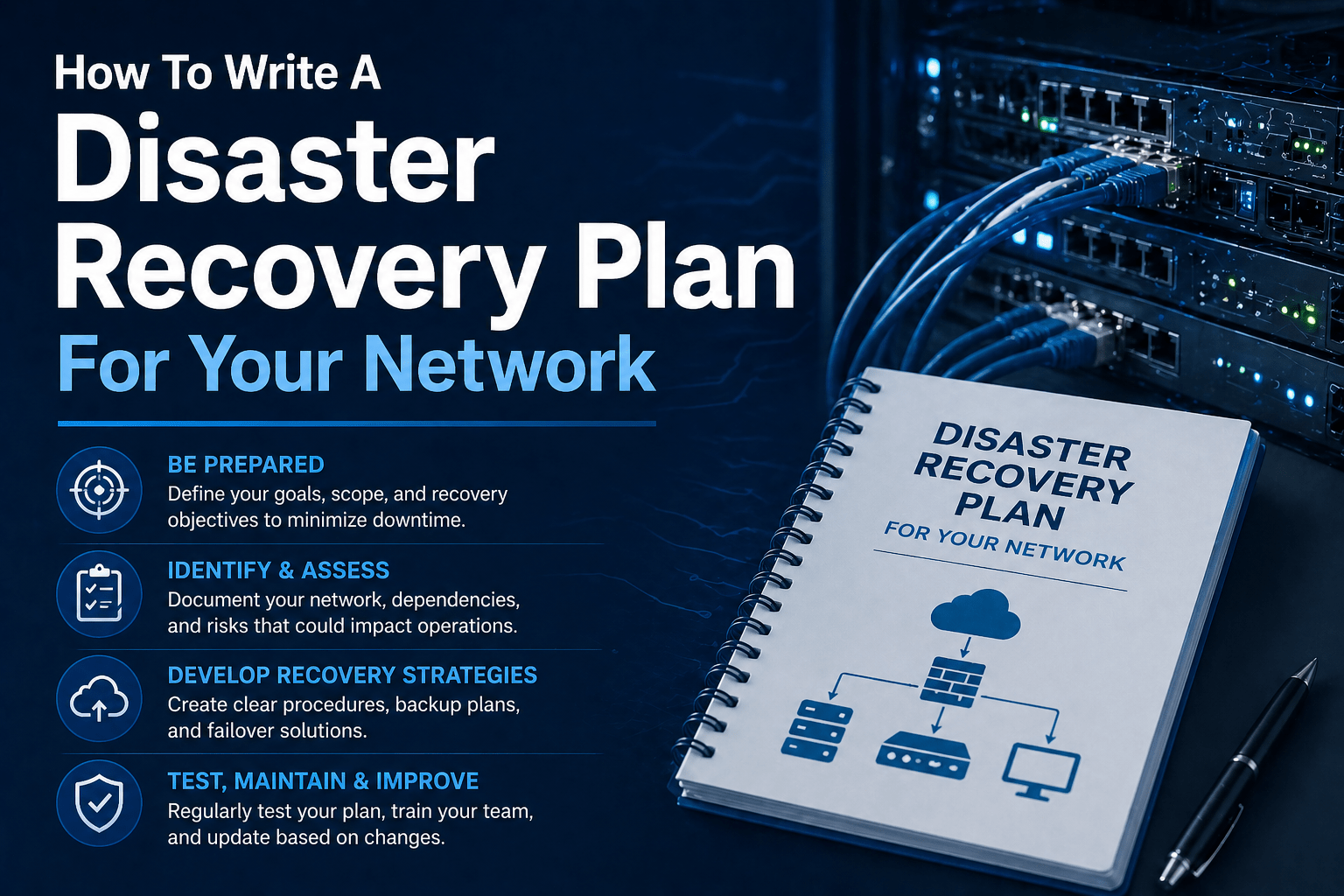
A network disaster recovery plan (DRP) documents how your organization will restore network infrastructure and connectivity after a significant failure — whether caused by hardware failure, cyberattack, natural disaster, or human error. It is the operational playbook your IT team executes when the network goes down and normal troubleshooting has been exhausted.
A good network DRP answers three questions with operational specificity: what does recovery look like for each critical failure scenario, who is responsible for executing each recovery step, and what are the success criteria that confirm recovery is complete? A plan that cannot answer those questions in the first minutes of an incident is a plan that will not be followed.
For businesses in the Gulf South where storm events create realistic network infrastructure scenarios, the network DRP needs to address physical infrastructure loss alongside software and cyberattack scenarios. Your managed IT services provider should be a co-author of your network DRP — they manage the infrastructure the plan covers.
Overview
A network disaster recovery plan covers the procedures, ownership, and infrastructure requirements for restoring network connectivity and services after a significant failure. It is a technical document paired with operational ownership — who does what, with what tools, in what sequence. Its quality is determined by specificity, not length.
- Network DRP scope: connectivity, routing, firewalls, DNS, DHCP, VPN, and the services that depend on them
- RTO drives architecture: recovery time objectives determine what infrastructure redundancy is required
- Scenario-specific procedures outperform generic “restore from backup” instructions
- Named ownership is mandatory — every step needs a person, not a role
- Testing is the only validation that matters — documented procedures that have never been executed are unverified
The 5 Why’s
- Why does a network DRP need to be scenario-specific rather than generic? A hardware failure scenario has different recovery procedures than a ransomware scenario, which is different from a facility loss scenario. A generic “restore the network” procedure does not provide actionable guidance in any of those specific situations. Scenario-specific procedures — what to do when the core switch fails, when the firewall is compromised, when the internet link is down — are the procedures that get followed.
- Why must the network DRP include infrastructure documentation, not just procedures? Recovery procedures are useless without the infrastructure information needed to execute them: network diagrams showing device locations and interconnections, IP addressing schemes, firewall and routing configurations, access credentials for network equipment, and vendor support contacts. A technician executing a recovery procedure who cannot locate the configuration backup or access the firewall management console cannot complete the procedure. Documentation belongs in the DRP.
- Why is the recovery time objective (RTO) a design constraint rather than just a measurement? The RTO defines how quickly network services must be restored. If the RTO is four hours, the infrastructure and procedures must support recovery within four hours. If the actual recovery time for the documented procedures exceeds the RTO, the architecture needs to change — more redundancy, pre-staged replacement equipment, faster ISP failover. RTO drives design.
- Why do network DRPs often fail at the internet connectivity layer specifically? Most network DRPs address internal infrastructure recovery but do not adequately address business internet connectivity loss, which in cloud-dependent environments can be as disruptive as any internal failure. A single-ISP environment with no failover leaves the organization without cloud services, email, and external communication during the ISP’s recovery timeline. Dual-ISP or LTE failover capability is a network architecture decision that belongs in the DRP alongside internal recovery procedures.
- Why should the network DRP be owned by the managed IT provider, not just stored with internal staff? In a disaster scenario, internal staff may be unavailable, displaced, or overwhelmed. The managed IT provider executing the recovery needs direct access to the DRP — not a document in a shared drive that requires internal staff to locate and share. The DRP should be accessible to the recovery team without depending on the staff whose availability the disaster may have disrupted.
Network DRP Components
1. Network Infrastructure Inventory
Document every component of the network infrastructure:
- Core switches, distribution switches, and access switches — make, model, location, management IP
- Firewalls and UTM devices — make, model, location, management access
- Wireless access points and controllers
- Routers and WAN edge devices
- Internet connections — ISP, circuit ID, support contact, failover configuration
- DNS and DHCP infrastructure
- VPN concentrators and remote access infrastructure
This inventory is the reference every recovery procedure points to.
2. Network Diagrams
Current, accurate network diagrams showing:
- Physical topology — device locations, cable runs, patch panel mapping
- Logical topology — IP addressing, VLAN structure, routing, firewall zones
- WAN connectivity — ISP links, failover paths, cloud connectivity
Diagrams must be current. An outdated network diagram is not useful during recovery.
3. Configuration Backups
Documented procedures and automated processes for backing up device configurations:
- Firewall rule sets and configuration
- Switch configurations
- Routing configurations
- Wireless controller configurations
Configuration backups should be stored off-device and off-site — a backup stored only on the device being recovered is not available when that device fails.
4. Scenario-Specific Recovery Procedures
Write a specific procedure for each major failure scenario:
Core switch failure:
- Identify failure through monitoring alert or user reports
- Locate spare or replacement equipment
- Restore configuration from backup
- Verify connectivity to downstream devices
- Escalate to vendor support if hardware fault requires RMA
Firewall failure or compromise:
- Isolate affected firewall from network
- Stand up replacement or backup firewall
- Apply current configuration backup
- Verify outbound and inbound connectivity
- If compromise: coordinate with cybersecurity team for forensic preservation
Internet connectivity loss:
- Verify ISP circuit status (ISP portal or support line)
- Activate LTE or secondary ISP failover if available
- Communicate outage to affected users and management
- Escalate to ISP with circuit ID if outage is ISP-side
Ransomware affecting network infrastructure:
- Isolate affected systems per the cybersecurity incident response playbook
- Assess scope of network infrastructure compromise
- Restore clean network infrastructure from verified configuration backups
- Do not reconnect affected systems until cleared by security team
5. Ownership Matrix
| Recovery Procedure | Primary Owner | Backup Owner | Contact |
|---|---|---|---|
| Core switch recovery | [Name] | [Name] | [Phone] |
| Firewall recovery | [Name] | [Name] | [Phone] |
| ISP escalation | [Name] | [Name] | [ISP Contact] |
| Wireless recovery | [Name] | [Name] | [Phone] |
| VPN recovery | [Name] | [Name] | [Phone] |
Every procedure has a named person, a backup, and a contact method that works when email is down.
6. Vendor and Support Contacts
- ISP support lines and circuit IDs for each internet connection
- Hardware vendor support contacts for network equipment
- Managed IT provider emergency contact and escalation path
- Cloud platform support contacts for network-dependent services
7. Recovery Validation Checklist
After each recovery procedure, verify:
- Core connectivity between network segments is restored
- Internet connectivity is available
- DNS resolution is functioning
- DHCP is assigning addresses correctly
- VPN remote access is functional
- Key dependent services (email, cloud apps, VoIP) are accessible
Testing the Network DRP
A network DRP that has never been tested is an untested hypothesis. Testing approaches:
- Configuration restore test: restore a device configuration from backup in a lab environment to confirm the process works and the backup is current
- Failover test: if LTE or secondary ISP failover exists, test the failover to confirm it activates correctly
- Tabletop exercise: walk through a failure scenario with the recovery team, identifying gaps in the documented procedures
- Annual review: review and update the DRP after any significant network change and on an annual schedule regardless
Final Takeaway
A network disaster recovery plan that works is specific, documented, owned, and tested. The procedures must cover the actual failure scenarios your environment faces — not just generic restoration steps. The infrastructure information must be current and accessible without the failed systems. And the plan must have been executed successfully at least once before the incident that matters.
Network Disaster Recovery Planning With Mindcore Technologies
Mindcore designs, documents, and tests network disaster recovery plans as part of our managed IT services engagement. Our team manages the network infrastructure the plan covers, which means we co-own the plan’s accuracy and the recovery’s success. We serve businesses across Louisiana and the Gulf South, including organizations with specific hurricane and flood resilience requirements.
Talk to Mindcore About Network Disaster Recovery Planning
Contact our team to review your current network DRP or build one from the ground up.

