

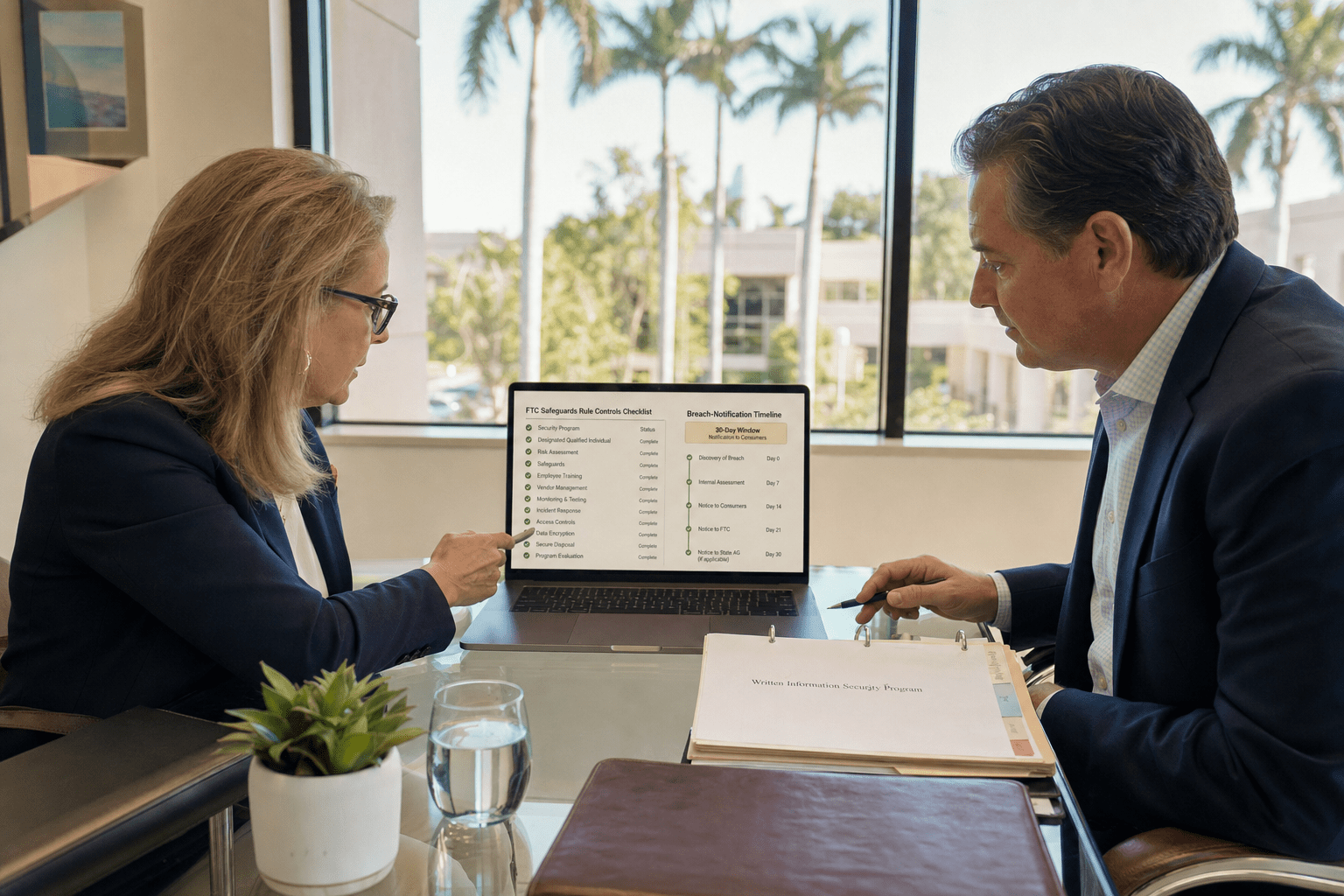
IT Compliance Boca Raton requires a locally informed approach that national compliance checklists often miss. This is a market thick with financial advisors, wealth managers, and professional-services firms, which means the FTC Safeguards Rule is the federal framework that catches the most businesses here. Layered on top is Florida’s own breach law, the Florida Information Protection Act, which sets a tighter notification clock than most states and names the Florida Attorney General as a reporting destination. An owner working from an out-of-state compliance template can be fully aligned with a federal standard and still blow the Florida deadline, and in a town where so many firms handle customer financial data, that gap is not hypothetical. We work with Boca Raton businesses across the spectrum, and the ones who stay clean understand both layers before an incident forces the question.
What IT Compliance Means for a Boca Raton Business
IT Compliance Boca Raton means documenting and maintaining the security controls required by your industry framework and Florida law to protect sensitive business data. It is not a one-time purchase or a firewall you install and forget. It is an ongoing program of policies, technical safeguards, and evidence that holds up when a regulator, an auditor, or an enterprise customer asks to see it. The trigger is the data you handle. A wealth-management firm on Federal Highway holding client financial records answers to the FTC Safeguards Rule. A medical practice answers to HIPAA. A retailer taking cards answers to PCI-DSS. And every one of them answers to Florida when personal data on a state resident is exposed.
Boca Raton’s business mix skews toward that financial-advisory and professional-services base, which is why the Safeguards Rule looms so large locally. But the state layer is universal. You do not need a federal financial obligation to be on the hook under Florida law if you store residents’ personal information, and the state’s timeline gives you less room than most owners assume.
The Florida Layer: FIPA and Its 30-Day Clock
The Florida Information Protection Act, codified at Fla. Stat. 501.171, is the state layer that trips up businesses running on a national playbook. FIPA requires notification to affected individuals within 30 days of determining that a breach occurred, which is a tighter window than the vaguer without-unreasonable-delay language many states and templates default to. Just as important, if a breach affects 500 or more Florida residents, the business must also notify the Florida Department of Legal Affairs, the Attorney General’s office, within that same 30-day window. A national incident-response plan that assumes a 60-day timeline or omits the state AG notification will put a Boca Raton business out of compliance the moment a breach happens.
FIPA also carries an affirmative security duty. It requires covered businesses to take reasonable measures to protect and secure personal information in electronic form, which means the obligation is not only to report a breach but to have guarded against it in the first place. Florida further layered on the Florida Digital Bill of Rights for larger data-heavy businesses, but for most SMBs it is FIPA’s 30-day clock and AG-reporting trigger that define the state duty. This is exactly the piece our cybersecurity compliance team writes into every Boca Raton client’s response plan, because a plan built for a longer timeline is a plan that fails a Florida deadline.
The FTC Safeguards Rule Dominates Boca Raton
The FTC Safeguards Rule is a central part of IT Compliance Boca Raton because many local SMBs fall under the FTC’s broad definition of a financial institution. That definition reaches well past banks to include financial advisors, tax preparers, accountants, mortgage brokers, and many other firms that handle customer financial information, which describes a big slice of this market. The FTC Safeguards Rule guidance requires a written information security program with a named qualified individual, documented risk assessments, access controls, encryption, and vendor oversight. The 2023 amendments added a breach-reporting requirement that took effect in 2024, tightening what a compliant program must include.
- Qualified individual. Someone must be formally accountable for the security program, not just informally responsible.
- Written risk assessment. The program has to document internal and external risks to customer information, not assume them.
- Encryption. Customer information must be encrypted in transit and at rest, or protected by an approved equivalent.
- Vendor oversight. Third parties touching customer data must be held to the same standard.
Our FTC compliance work with Boca Raton advisory firms starts by confirming the business actually falls under the rule, then building the program to the specific requirements rather than a generic security baseline. The deeper walkthrough lives in our guide to the best IT providers for FTC Safeguards compliance.
In-House or Outsourced Compliance in Boca Raton
Whether to run compliance in-house or outsource it is a real decision for a Boca Raton firm, and it usually comes down to whether you have the depth to own the qualified-individual role and the ongoing evidence work. A larger firm with a dedicated IT and risk function can carry it internally. Many advisory and professional-services SMBs cannot, because the Safeguards Rule’s documentation and vendor-oversight demands are steady work that a generalist office manager cannot absorb on top of everything else. The honest tradeoff is cost versus capacity, and we lay out both sides in our breakdown of the in-house versus outsourced cybersecurity question specific to Boca Raton. Neither answer is automatically right, but assuming an existing IT person can simply add compliance to their plate is where firms most often fall behind.
Why Local Support Matters for Florida Compliance
Local expertise strengthens IT Compliance Boca Raton because Florida businesses must address state-specific legal obligations, reporting triggers, and breach-notification deadlines. A provider that works with Florida businesses every week already knows FIPA’s 30-day clock, the 500-resident AG-notification trigger, and how the state approaches enforcement. A national help desk handling tickets from dozens of states will hand you a generic response plan with the wrong deadline and no state AG step. When a breach hits, the FIPA clock starts the moment you determine it occurred, and that is precisely when a Florida-aware plan earns its keep, which is why our emergency cybersecurity compliance response is built around the state timeline.
There is also the evidence reality. When a regulator or an enterprise client asks for proof, someone has to produce the documentation and walk them through the controls. A team that already knows your environment and Florida’s rules moves faster and asks fewer questions than a remote vendor learning your setup mid-audit.
How to Build a Boca Raton Compliance Program
Building an effective IT Compliance Boca Raton program starts with a comprehensive risk assessment rather than a standalone technology purchase. Inventory the sensitive data you hold, map it to the frameworks that apply, and surface the gaps between where you are and where the standard requires you to be. For most Boca Raton firms that means the FTC Safeguards Rule plus the FIPA state layer, and for some it means HIPAA or PCI on top. From there the work is methodical: name the qualified individual, write the policies, implement encryption and access controls, and build an incident-response plan wired to FIPA’s 30-day clock and AG-notification trigger. The NIST Cybersecurity Framework is a solid backbone for organizing that work.
The piece owners underestimate is evidence. Compliance is not just having controls, it is proving they operate, which means access logs, training records, dated policy reviews, and a tested response plan. A program that lives only as a binder fails the moment someone asks for last quarter’s access review. The goal is to bake the evidence-gathering into normal operations so the documentation is current rather than reconstructed under pressure, and so the FIPA clock never catches the firm flat-footed.
Frequently Asked Questions
What IT compliance rules apply to a small business in Boca Raton FL?
A Boca Raton FL small business usually faces the FTC Safeguards Rule, because so many local firms are financial advisors, accountants, or other businesses the FTC treats as financial institutions. On top of that sits Florida’s own breach law, the Florida Information Protection Act, which applies to any business holding personal data on Florida residents. Healthcare and card-handling firms add HIPAA or PCI-DSS respectively.
What is the Florida Information Protection Act?
The Florida Information Protection Act, Fla. Stat. 501.171, is Florida’s data breach law. It requires businesses to notify affected residents within 30 days of determining a breach occurred, and to notify the Florida Attorney General’s office when a breach affects 500 or more residents. It also imposes an affirmative duty to take reasonable measures to protect personal information, so it governs prevention as well as reporting.
How fast do I have to report a breach in Florida?
Florida’s FIPA sets a 30-day notification window from the point you determine a breach occurred, which is tighter than the without-unreasonable-delay language many states use. If 500 or more Florida residents are affected, you must also notify the state Attorney General within that same 30 days. A response plan built on a longer national timeline will miss the Florida deadline.
Does the FTC Safeguards Rule apply to my Boca Raton firm?
It likely does if your firm is a financial advisor, accountant, tax preparer, mortgage broker, or another business that handles customer financial information, because the FTC defines financial institution broadly. Given Boca Raton’s concentration of advisory and wealth-management firms, the Safeguards Rule is the most common federal framework here. A quick assessment confirms whether you fall under it before you build a program.
Can I handle IT compliance myself or should I outsource it?
It depends on whether you have the internal depth to own the qualified-individual role and the ongoing documentation and vendor-oversight work the Safeguards Rule requires. Larger firms with a dedicated IT and risk function can run it in-house. Many Boca Raton SMBs outsource because compliance is steady work a generalist cannot absorb on top of daily operations. The wrong move is assuming it fits into an existing role without added capacity.
Get Your Boca Raton Compliance Map Before a Breach Sets the Clock
IT compliance in Boca Raton FL rewards owners who treat it as a two-layer map rather than a single national checklist. For most local firms the FTC Safeguards Rule is the dominant federal driver, but Florida’s own FIPA statute adds a 30-day breach-notice clock and a state Attorney General reporting duty that a template built for a longer window will violate at the worst moment. The businesses that come out ahead build a program grounded in a real risk assessment, documented well enough to survive an audit, and wired to Florida’s actual deadlines. If you want a clear picture of which frameworks apply to your firm and where your gaps are, our team will map your data, flag the exposures, and build a program sized for a Boca Raton address and Florida law. Book a free strategy call and we will start with the assessment.

