


Most El Paso businesses shopping for IT support are solving the wrong problem first. They start by comparing providers when the decision that matters is which model fits their size: break-fix support you call when something breaks, a managed agreement covering everything monthly, or a co-managed arrangement that supplements someone you already employ. El Paso adds three conditions that change how this evaluation runs anywhere else in Texas, and most providers from Dallas or Houston have never considered any of them. We recommend you settle the model question first, then ask the El Paso-specific questions before you take a single demo.
Overview
- Pick the model before the provider. Break-fix, managed, and co-managed serve different sizes and different risk tolerances.
- El Paso runs on Mountain Time. Most Texas providers publish Central hours, which means your coverage window is narrower than it looks.
- Cross-border operations change the compliance question. Data crossing into Ciudad Juárez raises residency, access, and export control questions standard agreements do not address.
- Distance makes onsite a contract commitment, not an assumption. El Paso is the most isolated major Texas metro.
- Texas gives you a notification deadline after a breach. Know it before you need it.
The 5 Why’s
This is written for owners, operations managers, and the one technical person handling everything at El Paso businesses roughly between twenty and a few hundred employees. If you are past a few hundred people, the questions stay the same but the answers shift, and the co-managed section is probably where you should start.
The trigger is usually an event rather than a plan. Something broke and nobody knew who to call. The person who handled the computers left. An insurance renewal or a customer questionnaire asked questions nobody could answer. A hardware failure revealed that the backup had not run in three months. Or the business grew past the point where informal arrangements hold.
El Paso’s economy shapes what matters. The maquiladora and shelter industry, the logistics and customs brokerage operations around the ports of entry, the defense and federal supplier base around Fort Bliss, and the healthcare sector each carry different obligations. The smallest businesses across all of them share the same starting point: somebody technical left, or nobody was ever there, and the business is now deciding what to do about it.
The consequence of getting this wrong is not a dramatic incident. It is a business that loses a week of work to something a tested backup would have covered, or cannot answer a customer’s security questionnaire, or discovers a Texas notification deadline when it is already running.
What Model Fits Your Size
Three models, and they serve different sizes rather than different budgets.
Break-fix. You call when something breaks and pay by the hour or by the visit. Reasonable for very small operations with simple setups and no regulated data, no obligation to meet a notification deadline, and staff who can function for a few hours while a problem gets fixed. It stops being reasonable the moment downtime costs real money, because a break-fix provider has no obligation to prevent anything.
Managed services. A monthly fee covering monitoring, patching, support, backup, and security, priced per user or per device. The provider is responsible for keeping things working rather than for fixing them after. This is where most El Paso businesses land between roughly twenty and two hundred employees, and where our managed IT services in El Paso operate.
Co-managed. You keep an internal person and buy the capabilities they cannot provide alone: after-hours coverage, security operations, specialists, and project capacity. This suits businesses that already employ someone technical and is usually better than replacing them, because internal staff hold business knowledge no provider replicates. Covered in our co-managed IT work.
The thresholds work roughly like this. Below about ten people with no regulated data and simple systems, break-fix plus good cloud hygiene often covers the risk. From about ten to twenty, tested backups and email security stop being optional. From about twenty to fifty, monitoring, patching, and a support path with defined response times start paying for themselves in avoided downtime. Past about fifty, security operations and compliance evidence become the gap.
What Should IT Support in El Paso Cost?
Managed IT is almost always priced per user or per device monthly, with project work, hardware, and licensing billed separately. Five things move the number: device count and how it compares to user count, coverage hours, security depth, whether you have servers on premises, and what compliance obligations apply.
Three things reliably fall outside the monthly fee. Onboarding remediation, which lands in the first quarter when the environment arrives in worse shape than the quote assumed. Hardware refresh, which happens every four to five years whether or not it aligns with your budget cycle. And software licensing, which should be confirmed as passed through at cost rather than marked up.
The comparison worth making is not provider against provider on price. It is three years of total cost against what a serious outage or a breach notification process would cost you. For most businesses in this range, one bad event exceeds a year of managed services.

What we recommend you do about it:
- Count your devices, not just your people. The device-to-user ratio determines which pricing model favors you.
- Decide your coverage hours honestly. If nobody will use 24/7 support, do not pay for it.
- Get the onboarding assessment before signing. Remediation is real and it lands early.
- Model three years. Include projects, licensing, and hardware refresh.
What Does El Paso Add to Your Requirements?
Four things that apply here and nowhere else in Texas, and most providers from other markets will not raise them.
Mountain Time coverage. El Paso is the only major Texas metro on Mountain Time. A provider publishing Central business hours covers a window that starts an hour into your working day and closes an hour before it ends. Ask any provider which time zone their published support hours refer to and get the covered window written in your local time. Ask the same about escalation and engineering staff, not just the first-line desk.
Cross-border data. If any part of your operation runs in Ciudad Juárez, which for a meaningful share of El Paso manufacturers and logistics operators it does, your data crosses an international border routinely. Standard IT agreements do not address where that data physically resides, who can access it from which side of the border, or whether any of it qualifies as export-controlled technical data. For businesses supporting aerospace or defense programs, the last question is not theoretical, since access to controlled technical data by non-US persons is restricted regardless of intent. These are design-stage questions, not topics to raise after the agreement is signed.
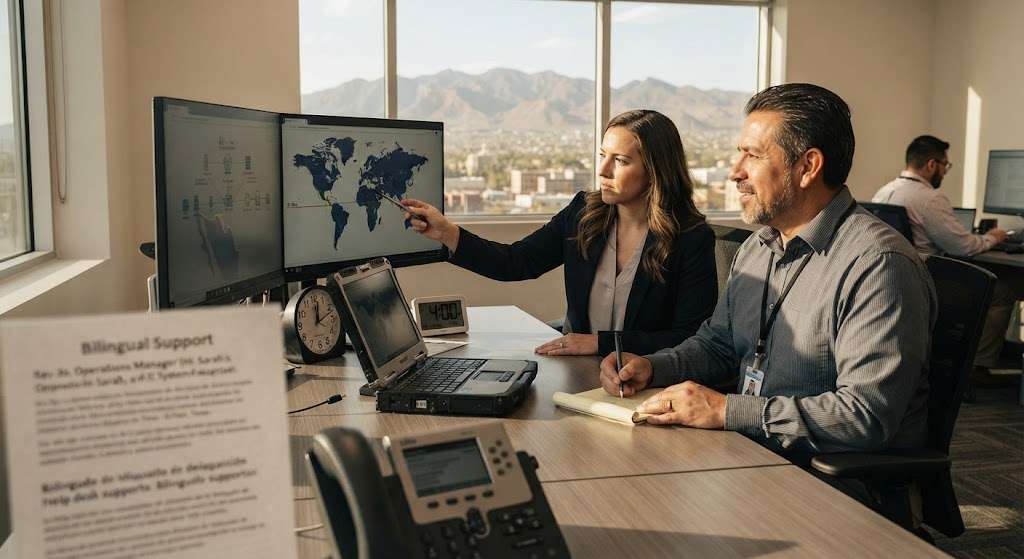
Bilingual support. In a borderplex workforce, a help desk that cannot take a call in Spanish will be routed around by the staff who need it most. Ask directly: how many bilingual staff, on which shifts, and what happens when they are unavailable. Extend the question to documentation and end-user communications.
Distance and onsite response. El Paso is several hundred miles from the nearest major Texas metro. Most delivery is remote regardless of address, but when something needs hands on hardware, the provider’s location matters. Get a written response window for your specific sites rather than inferring it from an address. Ask whether onsite is delivered by employees, a local partner, or dispatch.
What we recommend you do about it:
- Confirm support hours in Mountain Time. Get it in the agreement.
- Raise cross-border data before the architecture conversation. It changes the design.
- Ask about bilingual support directly. It affects adoption, not just courtesy.
- Get a written onsite response window. An address is not a commitment.
What Do El Paso Businesses Get Wrong When They Buy IT Support?
Five patterns that are avoidable at the point of purchase.
Comparing price without normalizing scope. Two proposals at similar rates routinely cover different services. Send every provider the same one-page requirements document and require line-item answers. Read the exclusion list before the inclusion list.
Assuming backup means recovery. A backup job reporting success tells you data exists somewhere. It does not tell you how long a restore takes or whether it has ever been tried. Ask when your provider last performed a test restore of an environment like yours.
Skipping the cross-border conversation. A provider who has never operated in a border market will not raise data residency or export control questions. You have to ask, and the answer shapes the design of the engagement.
Signing a long term without reading the exit. Multi-year agreements with annual increases, hardware you must return, and documentation held in the provider’s platform all change what leaving costs. Your network diagrams, configurations, and administrator credentials should be yours in a usable format at any time.
Relying on one person. The single-IT-person model concentrates knowledge in a way that is hard to recover from when that person leaves. Whatever model you choose, insist that documentation lives somewhere the business controls and that at least two people know how to reach it.

What we recommend you do about it:
- Write your requirements before you take a demo. One page is enough.
- Ask for the date of your last successful test restore. If nobody can answer, that is the answer.
- Raise cross-border and export control questions in the first conversation. Not the last.
- Read the exit terms before negotiating the rate.
- Document the environment in a place the business controls. Two people minimum.
Texas Adds a Notification Obligation
Texas requires notification to affected individuals and to the Texas Attorney General following a breach of personal information. The statute specifies a deadline and a threshold for AG notification that have been amended in recent years. Confirm the current figures with counsel before you need them, because the practical consequence is the same everywhere: meeting the deadline requires logging, tested backups, and an incident response plan with names already in it. Build that plan before an incident, not during one.
Local IT Expertise from Matt Rosenthal
In 30 years of working with businesses of every size, I have seen the same thing cause more avoidable damage than any technology failure. What I have seen firsthand in border markets is a business whose entire IT operation lived in one person’s head, including the backup credentials, the licensing records, and the knowledge of which system talked to which plant across the border. When that person left, the business spent months reconstructing what had taken years to build. Document your environment before you optimise it. Everything else is easier after that. See our IT support in El Paso and managed IT services in El Paso.
Where to Start
Three steps, and none require choosing a provider yet.
Write down what you have: users, devices, the applications the business depends on, where data lives, and who currently supports each. For El Paso businesses with operations in Juárez, include how data moves between the two sides and who has access to what.
Decide your model. Break-fix if you are small and simple with no regulated data. Managed if downtime costs real money and nobody is covering prevention. Co-managed if you already employ someone technical and need to extend rather than replace.
Write one page of requirements: coverage hours in Mountain Time, onsite response expectations for your specific sites, cross-border and compliance obligations, and what bilingual support you need. Send that page to every provider. Require line-item pricing against it. Ask for the onboarding assessment findings before signing, take three reference calls with similarly sized El Paso or West Texas businesses, and read the exit terms before you negotiate the rate.
For more on the El Paso market, see our guides to IT consulting in El Paso and cybersecurity services in El Paso.
If you would like help building that requirements page rather than another proposal, that is a reasonable place to start. Schedule a consultation to talk through what your El Paso business actually needs.

