Visual AI analysis of sensitive documents creates a data exposure risk that text-based AI processing does not always face in the same form. An image of a medical record, a scanned financial statement, or a photographed identification document contains the same sensitive information as its text equivalent — plus the additional surface area of the image format itself, which is harder to redact partially, harder to transmit selectively, and harder to audit at the field level.
Using Claude Vision in secure workspaces addresses that risk directly. The analysis happens inside a controlled environment where the image never reaches an uncontrolled endpoint, where access is enforced at the session level, and where every interaction is attributable and auditable. The visual intelligence is available. The sensitive image data is not exposed beyond the workspace it was analyzed in.
Overview
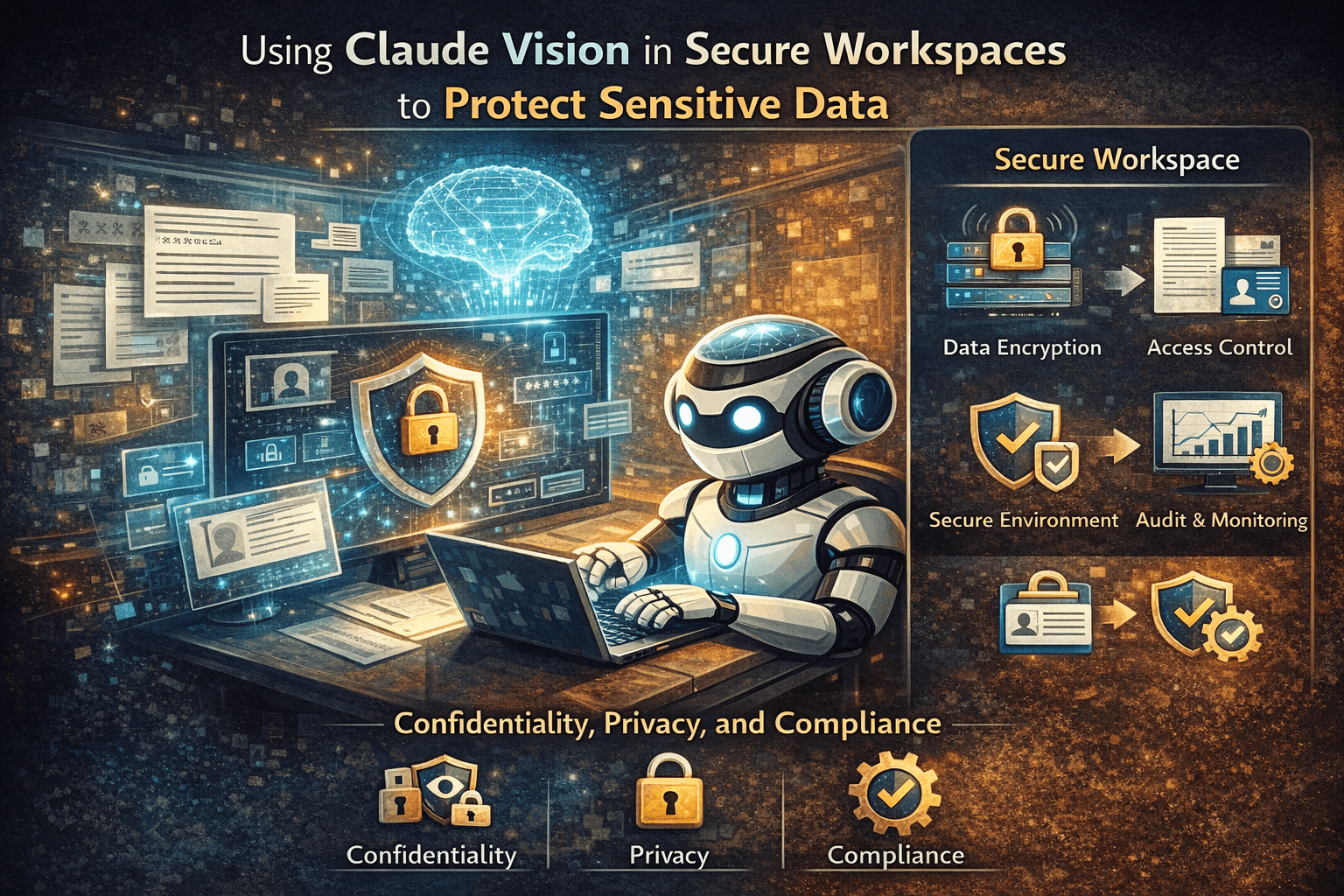
Secure workspaces provide the execution environment that makes Claude Vision deployable for sensitive visual data analysis. Images processed within a secure workspace do not reach end-user devices, are not cached outside the controlled environment, and are processed under the access controls and audit infrastructure that regulated data requires. The visual AI capability operates inside the security perimeter. The sensitive image content stays there.
- Secure workspaces provide controlled execution environments where visual analysis happens without endpoint image exposure
- Images processed in secure workspaces do not reach user devices — preventing the data leakage risk of local image caching
- Session-based access controls enforce that only authorized users access specific image data within the workspace
- Audit trails capture every image access and analysis event within the workspace
- The secure workspace model enables visual AI in regulated industry contexts where uncontrolled image distribution is a compliance barrier
The 5 Why’s
- Why do sensitive images require workspace-level security controls rather than just API-level data handling? API-level data handling governs what happens to image data at the API provider. Workspace-level security governs what happens to image data in the enterprise environment — preventing images from being downloaded, cached, forwarded, or accessed by unauthorized users before and after AI analysis. Both layers are required for sensitive image data.
- Why is endpoint exposure the primary sensitive image data risk in enterprise visual AI deployments? Images that reach user endpoints — local storage, browser cache, download history — create exposure that persists beyond the AI analysis session. A clinician who does not need to download a patient record image to view the AI analysis output should not have that image in local storage. Secure workspaces prevent the endpoint exposure that conventional image analysis workflows create.
- Why do session-based access controls matter specifically for visual data in multi-user environments? Different users have different authorization levels for different image data. In healthcare, minimum necessary access applies — a clinician authorized to view a patient’s imaging for a specific encounter is not authorized to browse other imaging records. Session-based controls in secure workspaces enforce that the image access in each session is scoped to the user’s specific authorization, not to the full set of images the enterprise processes.
- Why does audit trail generation for image access matter beyond the analysis event itself? Who accessed which image, when, and what analysis was performed — that trail is a compliance requirement in regulated contexts, a security monitoring requirement in any sensitive data environment, and an incident response tool when image access patterns need to be reviewed. Audit infrastructure built into the workspace captures that trail without requiring additional logging configuration per deployment.
- Why is the secure workspace model the right architecture for visual AI in regulated industries, not a constraint on it? Regulated industries have legal obligations to protect the visual data they handle. A deployment architecture that protects that data while enabling AI analysis is not a limitation — it is the condition that makes deployment legally defensible. Secure workspaces make Claude Vision deployable in healthcare, finance, and legal contexts precisely because they address the compliance requirements those contexts impose.
How Secure Workspaces Protect Sensitive Image Data
Workspace Containment
Secure workspaces provide an execution environment where:
- Image data is processed and analyzed within the workspace without being transmitted to end-user devices
- Analysis results — extracted data, classifications, assessments — are delivered to the user; the underlying image remains within the workspace
- Image download, export, and sharing actions are controlled at the workspace level, with exceptions requiring explicit authorization
- Session termination clears the image data from the workspace execution environment — images are not retained in workspace session storage after the session ends
Access Control Integration
Workspace access controls integrate with enterprise identity and access management:
- User authentication is required to access any workspace session
- Image access within the workspace is scoped to the user’s role-based authorization for specific image types and data sets
- Multi-factor authentication requirements apply to workspace sessions that access sensitive image classifications
- Access is granted at the session level and does not persist after the session ends
Audit Infrastructure
Every image interaction within the secure workspace is logged:
- Image access events — which user, which image, when, under what authorization
- Analysis events — what AI analysis was performed, what outputs were produced
- Output delivery events — what analysis results were delivered outside the workspace
- Access control events — authorization checks, access denials, elevated access requests
Use Cases Where Secure Workspace Visual AI Produces the Highest Value
- Clinical record image review — physicians and clinical staff reviewing patient imaging and documentation through Claude Vision without those images reaching local devices or browser caches
- Financial document analysis — analysts reviewing sensitive financial documents through AI-assisted analysis in workspaces where the documents cannot be downloaded or forwarded
- Legal document review — attorneys and paralegals using Claude Vision for contract and document review in workspaces where privileged documents remain within controlled access environments
- Government and regulated record processing — processing sensitive visual records in environments where endpoint exposure would create compliance violations
A Simple Secure Workspace Readiness Check for Visual AI
Your organization is ready to deploy Claude Vision in secure workspaces if:
- Specific use cases have been identified where visual AI analysis of sensitive images is valuable but endpoint image exposure is a compliance or security concern
- Access control infrastructure can enforce session-based image access scoped to user authorization levels
- Audit trail infrastructure can capture image access and analysis events at the required level of detail
- Workspace termination and data clearing procedures meet the retention and deletion requirements applicable to the image data being processed
- Compliance and security teams have reviewed the secure workspace architecture and confirmed it addresses applicable data protection requirements
Final Takeaway
Claude Vision in secure workspaces is not a compromise between visual AI capability and data security. It is the deployment model that makes visual AI capability available precisely where sensitive image data lives — by providing the controlled execution environment that keeps sensitive image data inside the security perimeter while the AI analysis output reaches the users who need it.
The regulated industries where visual data processing value is highest are also the industries where uncontrolled image distribution creates the most compliance risk. Secure workspaces resolve that tension — enabling visual AI in the contexts where it is most needed without the exposure that conventional image analysis workflows create.
Deploy Claude Vision in Secure Workspaces With Mindcore Technologies
Mindcore Technologies works with enterprise security and compliance teams to design and deploy Claude Vision in secure workspace environments — access control integration, audit infrastructure, workspace containment design, and compliance validation for regulated industry visual AI use cases.
Talk to Mindcore Technologies About Secure Workspace Visual AI Deployment →
Contact our team to design the secure workspace architecture that makes Claude Vision deployable for your most sensitive visual data processing requirements.