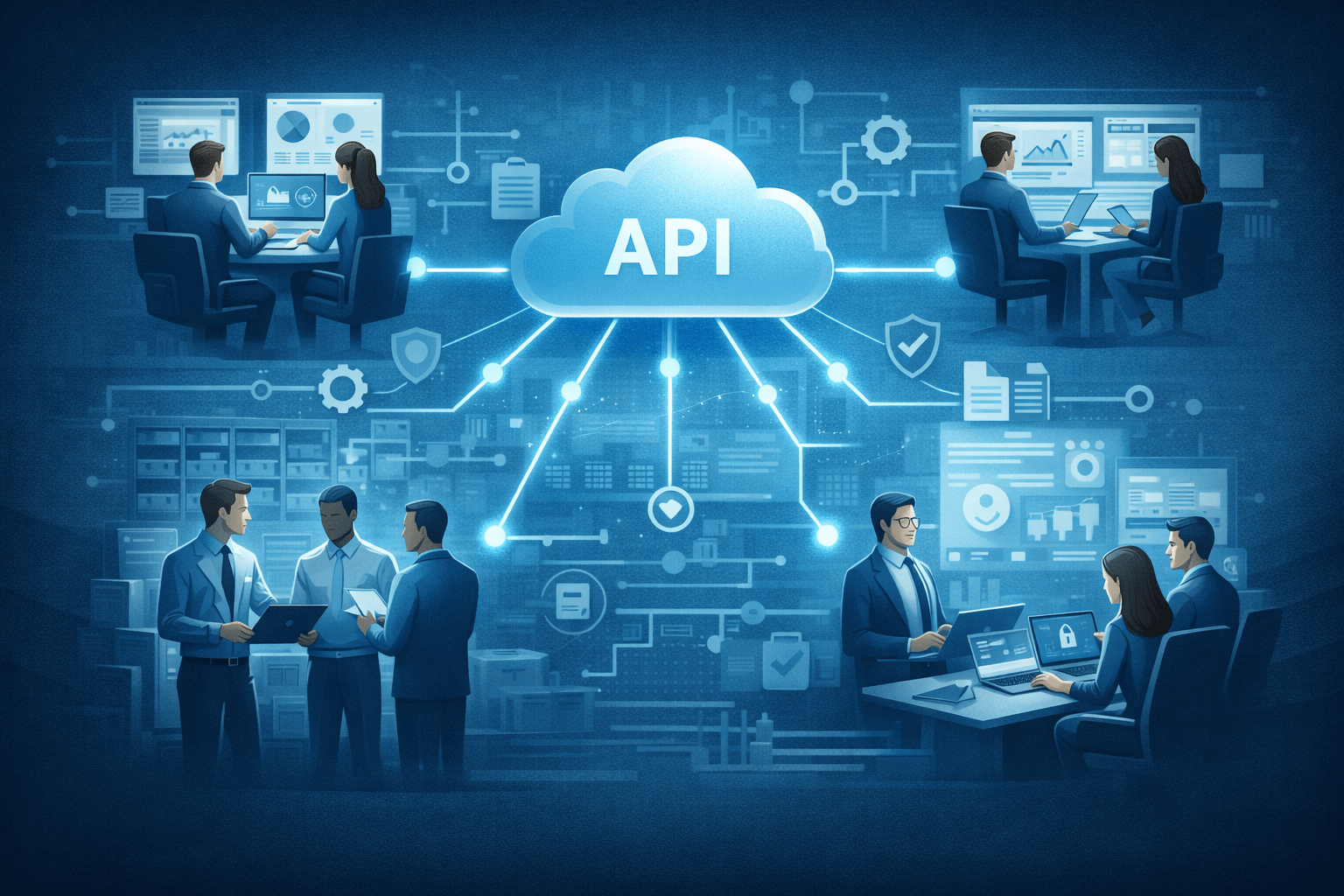
The first Claude API integration in an enterprise is an engineering project. The tenth is an infrastructure problem.
Organizations that approach each departmental API integration as an independent build accumulate the costs of that approach quickly: duplicated authentication infrastructure, inconsistent error handling, variable output quality standards, fragmented monitoring, and governance gaps between deployments. The integration that worked well for Finance was built one way. The one built for Legal was built differently. Neither was designed to connect, share infrastructure, or be governed consistently.
Scaling across departments requires treating the Claude API as enterprise infrastructure — with shared components, consistent patterns, and organizational governance that applies across every integration rather than within each one independently.
Overview
Scaling Claude API integrations across departments is an organizational and architectural decision as much as a technical one. The architectural components that enable scale — shared authentication infrastructure, common integration patterns, centralized monitoring, consistent output governance — are the foundation. The organizational model that governs that infrastructure — ownership, quality standards, expansion sequencing — is what determines whether scale produces compound value or compound complexity.
- Shared authentication infrastructure eliminates redundant credential management across departmental integrations
- Common integration patterns produce consistent error handling, output validation, and audit logging across every deployment
- Centralized monitoring covers the full API usage landscape, not just the integrations each department built and monitors independently
- Organizational governance defines who owns what, what standards apply, and how expansion decisions are made
- The expansion model determines whether each new departmental integration adds to a coherent infrastructure or adds to technical debt
The 5 Why’s
- Why does each department building its own API integration create organizational problems at scale? Independent builds produce inconsistent patterns, duplicated infrastructure components, and governance gaps. When something breaks or needs to change — a credential rotation, a rate limit increase, a model version migration — the change must be applied separately to every independent integration rather than once to shared infrastructure.
- Why does centralized API governance not mean centralized control of every integration? Centralized governance means shared standards, shared infrastructure components, and consistent quality requirements — not that every integration is built and owned by a central team. Departments own their integrations. The central governance layer owns the infrastructure those integrations run on and the standards they conform to.
- Why does rate limit management become a shared concern at multi-department scale? Rate limits apply across the organization’s API usage, not per department. A departmental integration that generates a high-volume spike can degrade performance for all other integrations sharing the same API credentials. Centralized rate limit management — with usage allocation across departments and monitoring that sees the full picture — prevents one department’s load from affecting others.
- Why do output quality standards need to be consistent across departments rather than defined independently by each one? Outputs from one department’s API integration sometimes feed into another department’s workflows. Inconsistent quality standards produce integration points where output from one workflow does not meet the quality requirements of the downstream workflow that consumes it. Consistent standards prevent those gaps.
- Why is expansion sequencing a strategic decision rather than a first-come, first-served one? Not all departmental integrations produce equal return. Sequencing expansion to prioritize the integrations with the highest volume of automatable tasks, the clearest compliance requirements, and the strongest fit with existing shared infrastructure components produces faster compounding return than arbitrary expansion order.
The Multi-Department Scaling Architecture
Shared Authentication Infrastructure
- Single secrets management system stores and rotates API credentials across all departmental integrations
- Service accounts are defined at the integration level, not the department level — enabling granular usage attribution and scope control
- All integrations authenticate through the shared infrastructure; no departmental integration manages its own credential outside the central system
- Credential rotation is automated and applies to all integrations simultaneously through the shared infrastructure
Common Integration Patterns
A documented integration pattern library defines how every new departmental API integration is built:
- Authentication pattern — how integrations authenticate through the shared credential infrastructure
- Request construction pattern — how prompts are structured for consistent output quality across use cases
- Output validation pattern — how outputs are validated before downstream processing, including schema validation, confidence thresholds, and error routing
- Error handling pattern — how transient failures, rate limit events, and validation failures are handled consistently
- Audit logging pattern — what is logged, in what format, to which centralized logging destination, for every API call
New integrations build on the pattern library rather than designing their own approaches. Deviation from patterns requires documentation and approval, not just implementation.
Centralized Monitoring
- All departmental integrations log to a central monitoring infrastructure that provides organization-level visibility into API usage, latency, error rates, and output quality
- Rate limit utilization is visible across the full organization’s usage, with alerts that trigger at departmental thresholds before organization-level limits are approached
- Output quality metrics are aggregated across integrations — degradation in one integration is visible and addressable before it propagates to downstream workflows
- Cost attribution by integration and department enables accurate cost management and ROI calculation per deployment
Expansion Governance
- New departmental integration requests are evaluated against expansion criteria: estimated volume, compliance requirements, infrastructure fit, and return against existing integration ROI baselines
- Approved integrations follow the pattern library from the start — no one-off implementations that require retrofitting to shared infrastructure later
- Integration owners are accountable for ongoing quality monitoring and for flagging issues that affect shared infrastructure
- Model version migrations and infrastructure changes are managed centrally and communicated to integration owners with defined timelines
What Multi-Department Scale Produces
- Reduced integration build cost — shared infrastructure and pattern library reduce the engineering cost of each new departmental integration
- Consistent quality across the portfolio — common patterns and shared quality standards produce consistent output quality across all departmental integrations
- Centralized visibility — organization-wide monitoring reveals usage patterns, quality trends, and cost attribution that independent departmental monitoring cannot produce
- Lower maintenance overhead — shared infrastructure components require maintenance once, not per integration
- Faster compliance auditing — centralized logging and consistent audit trail formats make compliance audits faster and less resource-intensive than auditing independently built integrations
A Simple Multi-Department Scaling Readiness Check
Your organization is ready to scale Claude API integrations across departments if:
- Two or more departmental integrations exist or are planned, and building each independently would produce duplicated infrastructure
- A central function owns the shared API infrastructure and has the authority to set integration standards
- Rate limit management at the organization level has been addressed — departmental usage is monitored against organization-level limits
- A pattern library for API integration is ready to be established or already exists
- Expansion governance — who approves new integrations, what criteria apply — is defined
Final Takeaway
Scaling Claude API integrations across departments is not a matter of giving more departments API access. It is a matter of building the shared infrastructure, governance model, and expansion sequencing that prevents multi-department scale from producing the fragmentation, redundancy, and governance gaps that independent builds accumulate.
Organizations that treat their Claude API as enterprise infrastructure from the first multi-department expansion build a foundation that compounds in value. Those that treat each departmental integration as an independent project build technical debt that is proportionally more expensive to address with each additional integration.
Scale Claude API Integrations Across Your Organization With Mindcore Technologies
Mindcore Technologies works with enterprise IT and operations teams to build the shared infrastructure, governance frameworks, and expansion models that scale Claude API integrations across departments without the fragmentation that independent builds produce.
Talk to Mindcore Technologies About Multi-Department Claude API Scaling →
Contact our team to assess your current API integration landscape and build the scaling architecture that compounds in value across every department that deploys it.