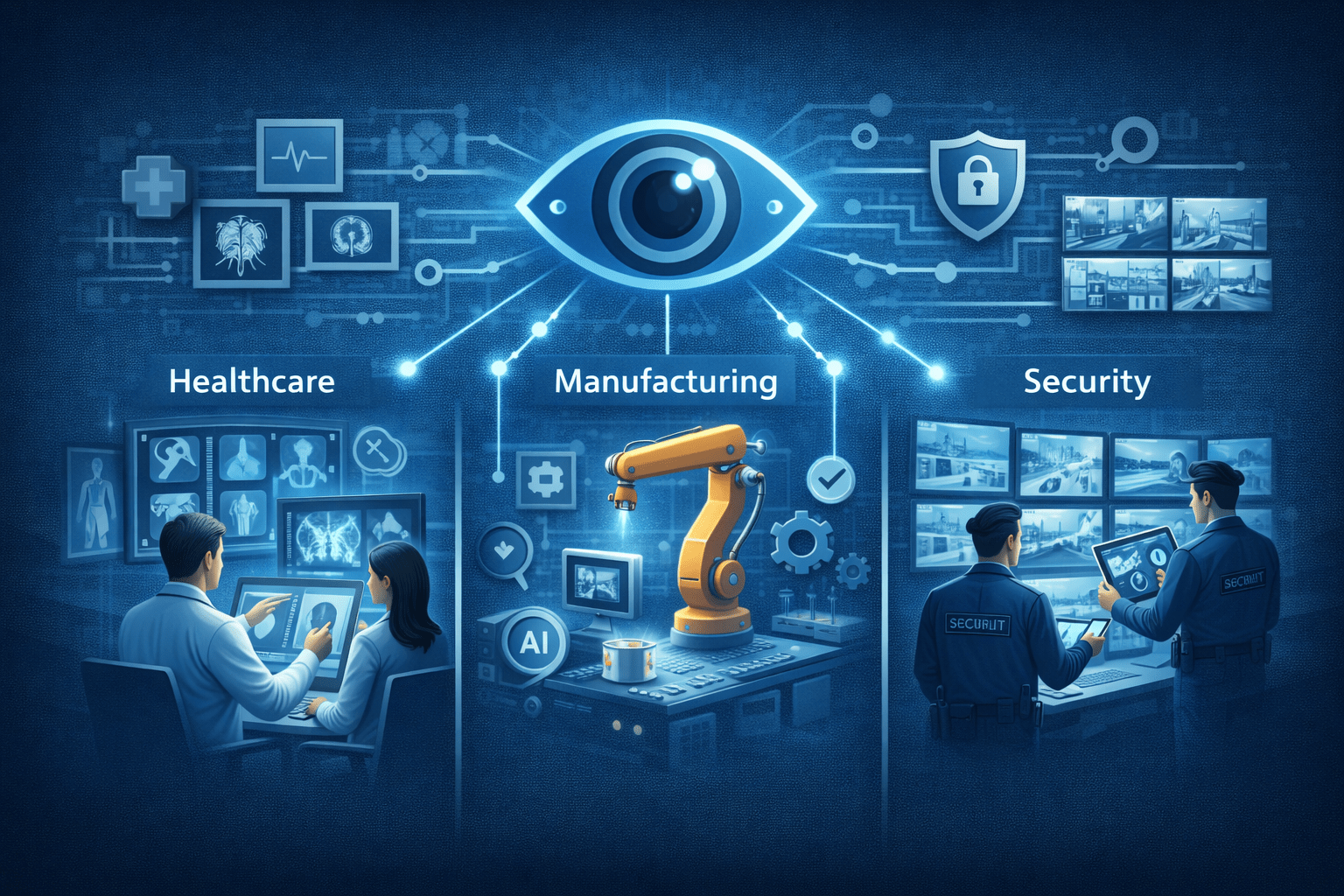
Visual data is everywhere in regulated enterprise environments. Clinical imaging, manufacturing inspection photos, security footage stills, facility compliance documentation — each represents a category of high-volume visual data where manual review is the current standard and AI-driven analysis is the available improvement.
Claude Vision applies contextual reasoning to visual inputs — not just detecting what is present but understanding what it means in context. That capability maps directly to the highest-value visual data processing problems in healthcare, manufacturing, and security operations.
Overview
The highest-value Claude Vision use cases share a common structure: high volume of visual inputs, defined quality or compliance criteria the images are assessed against, and a current process that requires manual review because conventional computer vision systems lack the contextual reasoning to handle the variability involved. Claude Vision addresses that structure consistently across healthcare, manufacturing, and security contexts.
- Healthcare use cases center on clinical documentation imaging, form processing, and compliance record analysis
- Manufacturing use cases center on quality inspection, defect classification, and specification verification
- Security use cases center on incident documentation, physical compliance monitoring, and visual access control support
- In each context, Claude Vision replaces manual review for the initial assessment layer while keeping human judgment for the decisions that require it
- Compliance and audit requirements in each sector require secure image handling architecture before production deployment
The 5 Why’s
- Why do healthcare, manufacturing, and security represent the highest-value Claude Vision deployment sectors? Each sector generates massive volumes of visual data that current processing methods handle manually or with conventional computer vision that cannot reason about context. The manual review volumes are high, the cost per review is significant, and the consistency of human review at scale is variable — all conditions where AI-driven visual analysis produces measurable return.
- Why does contextual reasoning matter specifically for these sectors, not just object detection? Healthcare imaging requires understanding clinical significance, not just presence. Manufacturing inspection requires understanding whether a component meets specification in context, not just detecting surface features. Security monitoring requires assessing whether a visual condition represents a threat or a compliance violation, not just detecting motion or objects. Context is the capability that makes the analysis actionable.
- Why does human oversight remain required in regulated visual analysis contexts? Clinical determinations require physician accountability. Quality disposition decisions with safety or regulatory implications require human sign-off. Security incident determinations require human judgment on appropriate response. Claude Vision handles the initial analysis and preparation. The accountable professional retains the decision.
- Why does volume consistency matter as much as analytical quality for enterprise visual processing? Human reviewers at high volume produce quality that varies with fatigue, experience, and workload pressure. Claude Vision produces consistent analysis quality across the full volume — the ten-thousandth inspection image receives the same analytical attention as the first. Consistency at scale is a quality advantage independent of average analytical quality.
- Why does secure image processing architecture need to be designed before deployment, not after? Medical images contain PHI. Manufacturing inspection images may contain proprietary specifications. Security images may contain sensitive facility information. Each image type requires data handling controls that are appropriate for the sensitivity of its content — and those controls need to be in the pipeline before sensitive images start flowing through it.
Healthcare Use Cases
Clinical Form and Document Image Processing
Healthcare forms — intake questionnaires, consent documents, insurance authorization forms — are frequently received as image scans with handwritten entries alongside printed fields. Claude Vision can extract structured data from these images — reading both printed and handwritten content, identifying field values, flagging incomplete or inconsistent entries — at volumes that manual data entry cannot match.
Compliance requirement: HIPAA data handling for all form images containing PHI; minimum necessary processing; complete audit trails.
Radiology and Pathology Report Image Analysis
Radiology and pathology reports are generated as image documents that contain structured findings alongside unstructured clinical narrative. Claude Vision can extract key findings, identify abnormal value flags, and structure report content for downstream clinical workflow integration — supporting the administrative and triage functions around clinical interpretation without substituting for radiologist or pathologist judgment.
Facility and Equipment Compliance Documentation
Healthcare facilities generate ongoing photographic documentation of facility conditions, equipment status, and safety compliance. Claude Vision can review compliance documentation images against defined criteria — flagging conditions that do not meet requirements, verifying presence of required safety equipment, and generating structured audit documentation from visual inspection records.
Manufacturing Use Cases
Component and Assembly Inspection
Visual quality inspection of manufactured components generates high volumes of inspection images that require pass/fail assessment against specification criteria. Claude Vision can assess inspection images against defined visual specifications, classify findings by defect type (surface defect, dimensional issue, assembly error), and route failed components to human review with a structured finding report — at throughput rates that manual inspection cannot achieve.
Incoming Materials Verification
Incoming raw materials and components require visual verification against specification before entering production. Claude Vision can review receiving inspection images, verify dimensional and condition criteria, identify specification mismatches, and flag discrepancies for buyer review — reducing the handling time for routine receiving inspections while ensuring specification compliance.
Production Line Visual Monitoring
Production line images captured at defined inspection points can be analyzed in near-real-time for process anomalies — material placement issues, assembly sequence deviations, surface condition variations — that should trigger process review before the out-of-specification condition propagates through the production run.
Security Use Cases
Physical Access Control Documentation Review
Physical access control systems generate image records of access events — badge photos, entry point images, visitor documentation. Claude Vision can review access documentation images for completeness, verify that required identification elements are present, and flag access records that do not meet documentation requirements for security team review.
Incident Documentation Analysis
Security incident reports are accompanied by photographic evidence — damage documentation, access point conditions, equipment status images. Claude Vision can analyze incident documentation images, extract relevant observations, assess documented conditions against defined criteria, and generate structured incident analysis inputs for security team investigation.
Facility Security Compliance Monitoring
Physical security compliance requires ongoing documentation of security control conditions — access control hardware status, perimeter condition, secure area compliance. Claude Vision can process facility inspection images against defined compliance criteria, identify non-compliant conditions, and generate compliance monitoring reports that support ongoing security audit functions.
Secure Image Processing Requirements by Sector
- Healthcare — HIPAA compliance for PHI-containing images, minimum necessary access, audit trails for every image processing event, physician review for clinically significant image analysis outputs
- Manufacturing — proprietary specification protection, access controls for inspection images that reveal manufacturing processes, retention policies aligned with quality record requirements
- Security — access controls for sensitive facility images, retention policies aligned with security incident record requirements, chain of custody documentation for incident evidence images
Final Takeaway
Healthcare, manufacturing, and security operations each have large, well-defined volumes of visual data that manual review is currently handling at significant cost and variable consistency. Claude Vision addresses those volumes with contextual image analysis that produces structured outputs at scale — with the human oversight at the decision layer that each sector’s accountability requirements demand.
The use cases are real, the compliance requirements are addressable, and the deployment architecture is available. The limiting factor for most organizations is not whether the capability exists — it is whether the deployment has been designed with the secure image handling and workflow integration requirements that each sector’s visual data demands.
Deploy Claude Vision Across Your Operations With Mindcore Technologies
Mindcore Technologies works with healthcare, manufacturing, and security enterprise teams to identify Claude Vision use cases, design the secure image processing architecture each sector requires, and integrate visual intelligence into existing workflows that produce measurable operational returns from day one.
Talk to Mindcore Technologies About Claude Vision for Your Industry →
Contact our team to map your visual data processing volumes and build the Claude Vision deployment that addresses them.