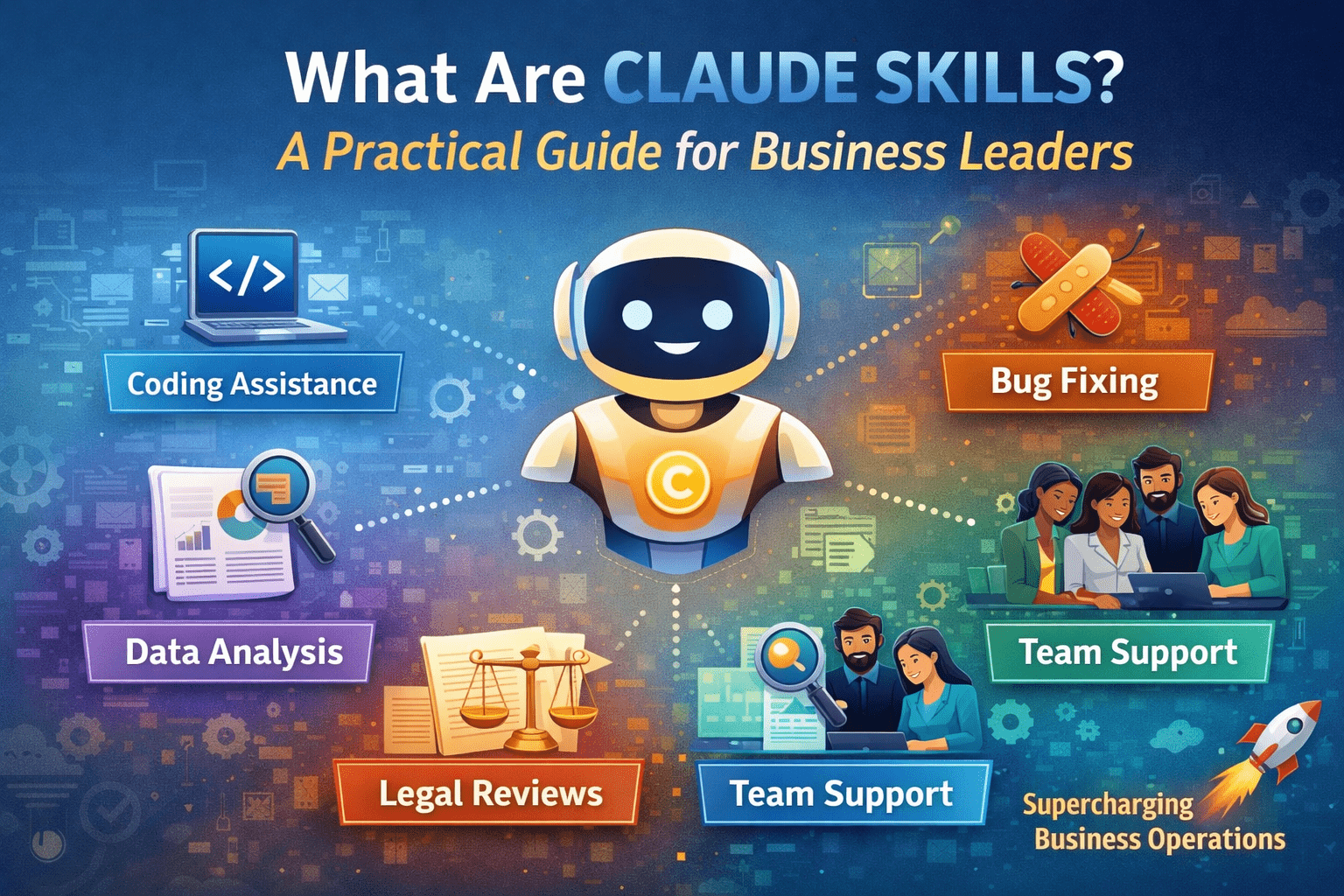
Most AI conversations at the business leader level focus on what AI can do in general. The more useful question — the one that determines whether AI investment produces operational returns — is what AI does specifically, repeatedly, and reliably within the workflows your business runs every day.
Claude Skills answer that question. They are purpose-built AI capabilities that handle specific business tasks with the consistency and reliability that operational deployment requires. Not a general AI you prompt differently each time. A structured capability you deploy once and run at scale.
This is the practical guide business leaders need to understand what Skills are, why they matter, and how to evaluate where they belong in your organization.
Overview
Claude Skills are AI capabilities designed and optimized for specific, repeatable business tasks. They differ from general AI access in one fundamental way: the task requirements, workflow structure, and output parameters are built into the capability itself, not reconstructed from a prompt each time someone uses it. For business leaders, that distinction determines whether AI produces consistent operational value or inconsistent individual utility.
- Claude Skills are purpose-built capabilities for specific repeatable tasks — not general AI tools with saved prompts
- They deliver consistent outputs regardless of individual user AI proficiency
- Deployment scales across departments without requiring each team to develop independent AI usage expertise
- The business case is operational: Skills reduce per-task handling time and standardize output quality at scale
- Skills represent the maturation of enterprise AI from access-based to capability-based deployment
The 5 Why’s
- Why should business leaders think about Skills differently from general AI tools? General AI tools deliver value proportional to how well each user leverages them. Skills deliver value proportional to how well they are designed — which is a one-time investment that pays dividends every time the capability is invoked. The business model is different, and so is the ROI calculation.
- Why does output consistency matter more than output quality at the organizational level? High-quality outputs from skilled AI users are useful. Consistent outputs across all users — regardless of individual AI proficiency — are operationally valuable. Operations run on consistency. Skills deliver it.
- Why can’t general AI access achieve what Skills achieve with enough training? Training employees to prompt AI effectively is an ongoing investment with significant variation in outcomes. Skills remove the dependency on prompt quality by building task requirements into the capability. The training investment goes into Skill design once, not into employee AI proficiency repeatedly.
- Why is the “specific task” requirement central to what makes a good Skill? Skills work best for tasks that are well-defined, run repeatedly, produce outputs with clear quality criteria, and do not require judgment calls that vary significantly with context. The more precisely a task can be defined, the more precisely a Skill can be built to handle it reliably.
- Why does the business case for Skills improve as task frequency increases? A Skill for a task that runs once a quarter produces modest returns. A Skill for a task that runs hundreds of times daily produces returns that compound with every execution. Business leaders evaluating Skills should prioritize high-frequency tasks — that is where the operational return is highest.
What Claude Skills Look Like in Practice
The clearest way to understand what a Skill is — and what it is not — is through concrete examples of the tasks they are built for.
Document classification — an incoming document arrives, the Skill identifies its type, extracts the relevant fields, routes it to the correct workflow, and logs the action. No employee needs to read the document to determine where it goes. The Skill handles it.
Report generation — a defined dataset is provided, the Skill generates a structured report in the required format, with the relevant metrics highlighted and the standard commentary applied. The analyst reviews and approves. The construction of the report is handled by the Skill.
Customer inquiry triage — an incoming customer message is analyzed by the Skill, categorized by type and urgency, populated with relevant account context, and routed to the appropriate team with a suggested response framework. The human handles the response. The Skill handles the preparation.
Contract review — a contract is submitted, the Skill reviews it against defined criteria, flags non-standard clauses, summarizes key terms, and produces a structured review output. The legal team makes decisions. The Skill handles the initial review pass.
Each of these is a task that runs repeatedly, has defined quality criteria, and does not require human judgment for the execution stage. Each is a candidate for Skill-level AI capability.
What Makes a Task a Good Skill Candidate
Business leaders evaluating Skill development opportunities should assess tasks against four criteria:
- Frequency — tasks that run daily or weekly produce higher Skill ROI than tasks that run occasionally
- Definition — tasks with clear inputs, defined outputs, and measurable quality criteria are more effectively built into Skills than tasks with high contextual variability
- Volume — tasks handled across large employee populations produce higher aggregate returns from Skill standardization than tasks handled by small teams
- Current inconsistency — tasks where output quality varies significantly across employees are the highest-priority targets for Skill standardization
Tasks that meet all four criteria are where Skill development produces the most immediate and measurable return.
What Skills Are Not
Skills are not:
- Saved prompts with a better interface
- Replacements for human judgment on decisions that require context and expertise
- Solutions for tasks that are highly variable or situationally dependent
- General AI access with a different name
Skills are structured execution capabilities for defined tasks. The judgment layer — the decisions that require context, expertise, and situational assessment — remains with the people who possess it. Skills handle the tasks that should not be consuming that judgment in the first place.
How Skills Change the AI Investment Calculation
General AI access produces returns that are difficult to measure because usage patterns vary, output quality varies, and the connection between AI usage and business outcomes is indirect. Skills produce returns that are measurable because the task is defined, the output is structured, and the volume of executions is trackable.
For business leaders who have struggled to demonstrate ROI from AI investment, Skills provide the measurement framework that general access lacks. Every Skill execution is a discrete, attributable event. Aggregate time saved, output quality consistency, and error reduction are all measurable against the pre-Skill baseline.
How to Evaluate Skill Opportunities in Your Organization
- Audit high-frequency tasks — identify the tasks across your operation that run most frequently and currently require employee time for execution
- Assess definition quality — determine which of those tasks have clear enough inputs, outputs, and quality criteria to be built into a structured capability
- Prioritize by volume and inconsistency — the highest-value Skill candidates are high-frequency tasks with significant cross-employee output variation
- Start with contained workflows — initial Skill deployment is most effective on tasks that do not require extensive integration with other systems before value is demonstrable
- Measure against baseline — establish pre-Skill handling time and output quality metrics before deployment so Skill ROI is calculable from day one
A Simple Skill Opportunity Check
Your organization has strong Skill development candidates if:
- High-frequency tasks are currently handled manually with significant employee time investment
- Output quality for those tasks varies across employees and teams
- Employees spend time constructing AI prompts for the same tasks repeatedly
- AI adoption has produced individual utility but not consistent operational value
- There are tasks where the bottleneck is execution volume, not judgment quality
These are the conditions where Skills produce immediate, measurable return.
Final Takeaway
Claude Skills are the answer to the question every business leader eventually asks about AI: how do we get consistent, operational value out of this rather than useful-but-variable outputs from individual employees who happen to use it well?
The answer is capability-based deployment. Define the tasks. Build the Skills. Deploy them as operational infrastructure. Measure the return. The AI investment stops being a general access cost and starts being an operational efficiency driver with a clear ROI calculation attached to every high-frequency task it handles.
That is the practical value of Claude Skills for business leaders. Not AI in theory. AI executing the tasks your operation runs every day, reliably, at scale.
Deploy Claude Skills in Your Organization With Mindcore Technologies
Mindcore Technologies works with business leaders to identify Skill development opportunities, design capabilities that meet operational quality requirements, and deploy them as standard business infrastructure — with measurement frameworks that make the ROI clear from day one.
Talk to Mindcore Technologies About Claude Skills for Your Business →
Contact our team to identify your highest-value Skill development opportunities and build the deployment plan that turns them into operational returns.