

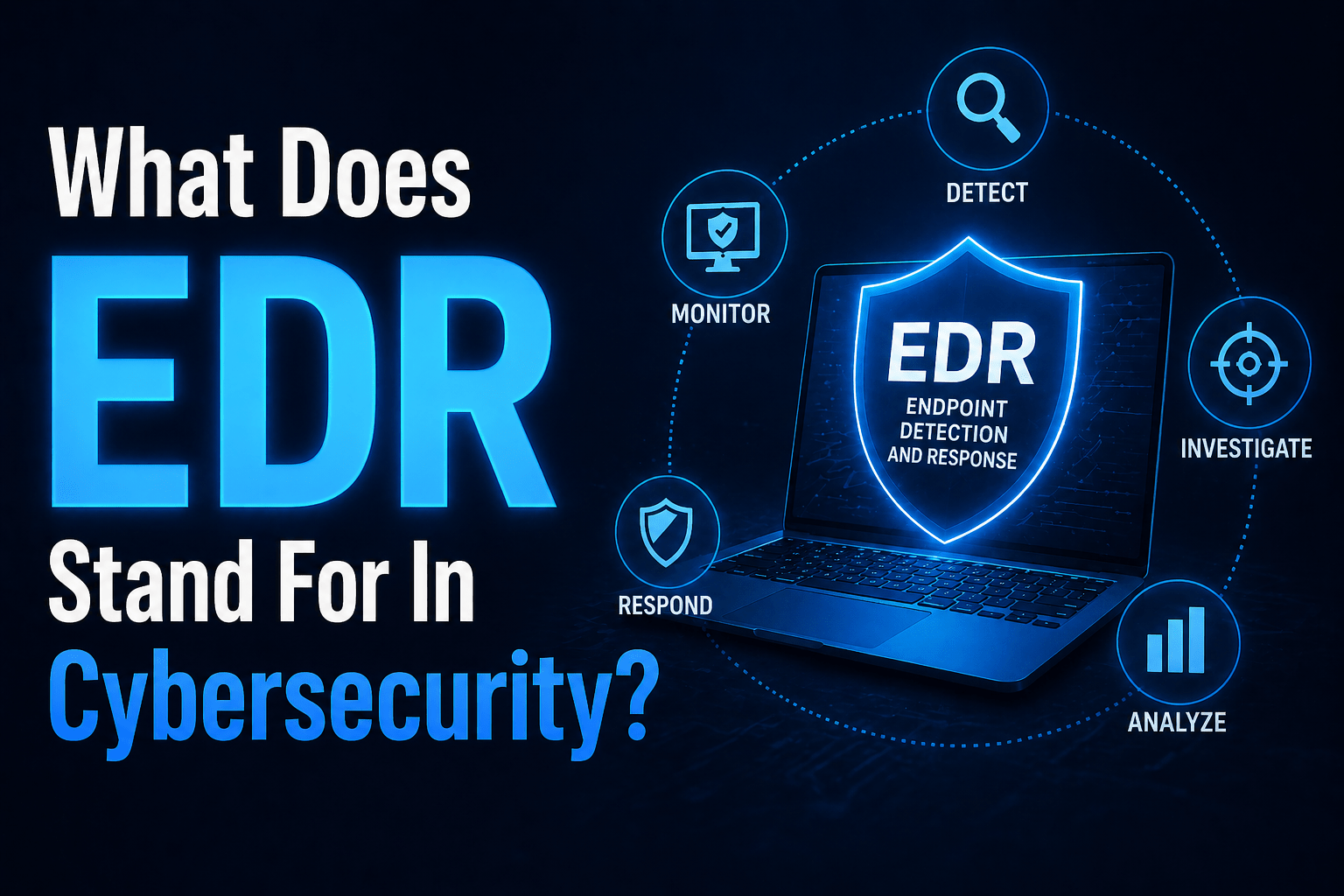
EDR stands for Endpoint Detection and Response. Each word in that name describes a specific capability:
Endpoint refers to the devices that connect to a network — laptops, desktops, servers, and mobile devices. Endpoints are where most cyberattacks originate or manifest, making them the highest-priority security monitoring surface in most organizations.
Detection refers to identifying threats. EDR detects threats through continuous behavioral monitoring rather than signature scanning alone — watching what endpoints are actually doing and identifying patterns that indicate malicious activity, even when the specific malware or technique has no known signature.
Response refers to the tools security teams use after detection — investigating what happened, containing the threat, and remediating the affected device. Response capabilities include remote endpoint isolation, process termination, file quarantine, and forensic investigation.
Together, EDR is the security technology that continuously watches device behavior, finds threats, and provides the tools to act on them. For businesses working with managed IT services providers, EDR is the current standard for endpoint security — not an enterprise-only premium tool.
Overview
EDR platforms deploy a lightweight agent on each endpoint that collects behavioral telemetry and sends it to a central console for analysis. The console applies detection rules and machine learning to identify threats, generates alerts, and provides investigation and response tooling. The result is continuous visibility into what every endpoint is doing — and the capability to act quickly when something is wrong.
- Endpoint: any device connecting to the network — laptops, desktops, servers
- Detection: behavioral analysis that catches threats signatures miss
- Response: investigation, isolation, containment, and remediation capabilities
- EDR replaces the detection and response gap that antivirus-only environments have
- It is the primary reason modern security programs recommend “EDR, not just AV”
The 5 Why’s
- Why is the “endpoint” focus specifically important in modern security? Because endpoints are where most attacks begin — through phishing that delivers malware to a laptop, through compromised credentials used to log in to a workstation, through malicious code executed on a server. Protecting endpoints is protecting the most common attack entry point.
- Why does “detection” in EDR specifically mean behavioral detection rather than signature detection? Because modern attacks are designed to evade signatures. Fileless malware, living-off-the-land techniques, and novel malware variants have no signature until they are identified. Behavioral detection identifies what malicious activity looks like — mass file encryption, unusual process injection, lateral movement patterns — regardless of whether the specific malware has been seen before.
- Why is “response” the capability that separates EDR from older endpoint security tools? Because detection without response is an alert without action. Traditional antivirus detects and quarantines known malware. EDR provides the investigation tooling to understand what happened and the response capabilities to contain it — remotely isolating devices, terminating processes, rolling back changes, and providing the forensic record that incident response requires.
- Why has EDR become the baseline rather than a premium security tool? Because the threat landscape has made antivirus-only environments inadequate. When the majority of successful attacks use techniques specifically designed to evade signature detection, a security posture built around signature detection is not effective. EDR’s behavioral approach addresses the current threat environment in a way that antivirus alone cannot.
- Why should SMBs deploy EDR rather than assuming it is only for enterprises? Because SMBs face the same attack techniques as enterprises. Ransomware does not discriminate by organization size; it uses the same evasion techniques against a 20-person accounting firm as against a Fortune 500 company. EDR is available at price points and service delivery models — managed through an MSP — that make it accessible for organizations of any size.
EDR vs. Traditional Antivirus: The Key Difference
| Capability | Traditional Antivirus | EDR |
|---|---|---|
| Detection method | Signature matching | Behavioral analysis + signatures |
| Monitoring frequency | Scheduled scans | Continuous |
| Fileless malware detection | Limited | Strong |
| Investigation capability | None | Full timeline, forensics |
| Remote response | None | Isolation, process termination, quarantine |
| Threat hunting | Not possible | Enabled by telemetry |
Final Takeaway
EDR — Endpoint Detection and Response — is the security technology that continuously monitors endpoint device behavior, detects threats through behavioral analysis, and provides the investigation and response capabilities that contain incidents before they cause maximum damage. The acronym describes exactly what it does: watch endpoints, detect threats, and enable response.
EDR Services From Mindcore Technologies
Mindcore’s cybersecurity services include EDR deployment and management as a standard component of endpoint protection. Our managed IT services ensure EDR is maintained, monitored, and current across all managed endpoints.

