

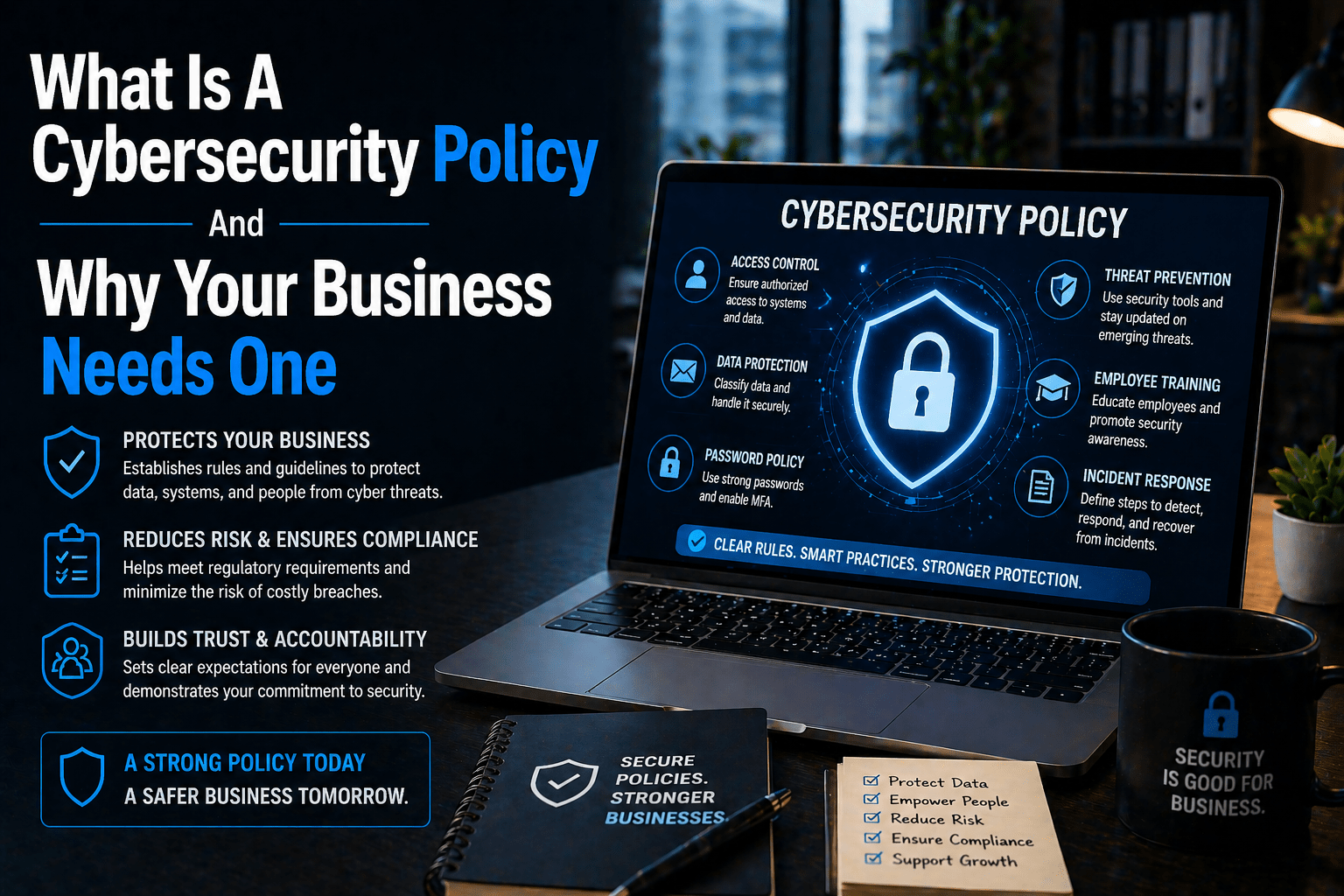
A cybersecurity policy is a formal set of rules, guidelines, and requirements that governs how an organization and its people protect digital systems, data, and assets from threats. It translates the organization’s security objectives into documented, enforceable standards that apply to employees, contractors, and vendors — establishing clear expectations for behavior, accountability for compliance, and consequences for violations.
Cybersecurity tools protect systems. A cybersecurity policy governs the people using those systems. Both are necessary. An organization with strong technical controls and no policy is operating on the assumption that employees will make the right security decisions without guidance — an assumption the breach statistics consistently refute.
For businesses working toward cybersecurity compliance under frameworks like HIPAA, PCI-DSS, or SOC 2, a documented cybersecurity policy is a required deliverable, not an optional governance exercise.
What a Cybersecurity Policy Covers
A cybersecurity policy addresses the organization’s complete security landscape through the lens of human behavior and organizational responsibility. Core components include:
Acceptable use: what employees may and may not do with organizational systems, devices, email, internet access, and cloud platforms.
Access control: requirements for how system access is provisioned, managed, reviewed, and revoked. MFA requirements, password standards, and least-privilege principles.
Data handling: how sensitive data is classified, stored, transmitted, shared, and disposed of. Which platforms are approved for sensitive data and which are not.
Incident reporting: how employees recognize and report suspected security incidents, who to contact, and what the expected process looks like.
Remote work and mobile device security: requirements for remote access, personally-owned device use, and mobile device management.
Third-party security: requirements for vendor security assessment, contractual obligations for vendors with system access, and access management for third parties.
Enforcement: consequences for policy violations and the process for addressing them.
The 5 Why’s
- Why does every business need a cybersecurity policy, not just large organizations? Because the human behavior risks that cybersecurity policies address are not scale-dependent. A small business where an employee sends sensitive customer data to a personal email account, reuses passwords across work and personal services, or clicks a phishing link has the same exposure as a large enterprise in the same situation. The policy that governs those behaviors is relevant regardless of size.
- Why is a written policy necessary rather than assumed best practices? Because unwritten expectations are unenforceable. When an employee causes a security incident through behavior that was never explicitly prohibited, the organization has limited recourse and no clear governance basis for response. A written policy establishes the documented standard against which behavior is measured and provides the foundation for consistent enforcement.
- Why do compliance frameworks specifically require written cybersecurity policies? Because audit and certification processes require evidence of documented governance, not just technical controls. HIPAA auditors, PCI-DSS assessors, and SOC 2 auditors ask to see written policies as evidence that the organization has deliberate security governance rather than ad hoc practices. An organization that has strong controls but undocumented policies fails the documentation test regardless of technical capability.
- Why must a cybersecurity policy be actively enforced rather than simply distributed? Because a policy that is distributed but not enforced quickly becomes understood by employees as optional. Visible, consistent enforcement — including addressing violations at every level of the organization, including management — establishes that the policy is a real governance instrument. Policies that are enforced only for junior employees while management exceptions are tolerated produce the cynicism and non-compliance that undermine security culture.
- Why does a cybersecurity policy need to address cloud and remote work specifically? Because those are the contexts in which most modern security policy questions arise. Where may an employee store sensitive files? Which video conferencing tools are approved for client communications? What security requirements apply when working from a home or public network? Without explicit policy on these questions, employees answer them individually and inconsistently — producing security decisions that reflect personal convenience rather than organizational security requirements.
The Business Case for a Written Cybersecurity Policy
Beyond compliance, a written cybersecurity policy provides the organization with specific practical protections:
Legal foundation: documented policies establish the security standard the organization maintains, which is relevant in regulatory investigations, customer contracts, insurance claims, and litigation. An organization that can demonstrate documented, enforced security policies is in a materially different legal position than one that cannot.
Insurance: cyber insurance underwriters increasingly require documentation of security policies and procedures as conditions of coverage. Organizations without documented policies face coverage limitations that may leave them exposed when they most need protection.
Employee accountability: policies establish the documented basis for disciplinary action when employees cause or contribute to security incidents. Without documentation, accountability for security-related behavior is inconsistent and legally exposed.
Vendor and partner confidence: many enterprise clients, regulated partners, and larger organizations require their vendors to maintain documented security policies as a contracting condition. Having a documented policy is increasingly a business development requirement, not just an internal governance practice.
Final Takeaway
A cybersecurity policy is the governance document that makes an organization’s security program coherent, enforceable, and defensible. It addresses the human behavioral risks that technical controls cannot eliminate, satisfies compliance documentation requirements, and provides the legal and accountability foundation for consistent security management.
Cybersecurity Policy Development From Mindcore Technologies
Mindcore’s cybersecurity services and IT consulting team develops cybersecurity policies tailored to each client’s industry, regulatory environment, and operational reality. We ensure policies satisfy compliance requirements while remaining practical and enforceable for the organization’s specific context.
Talk to Mindcore Technologies About Cybersecurity Policy Development

