

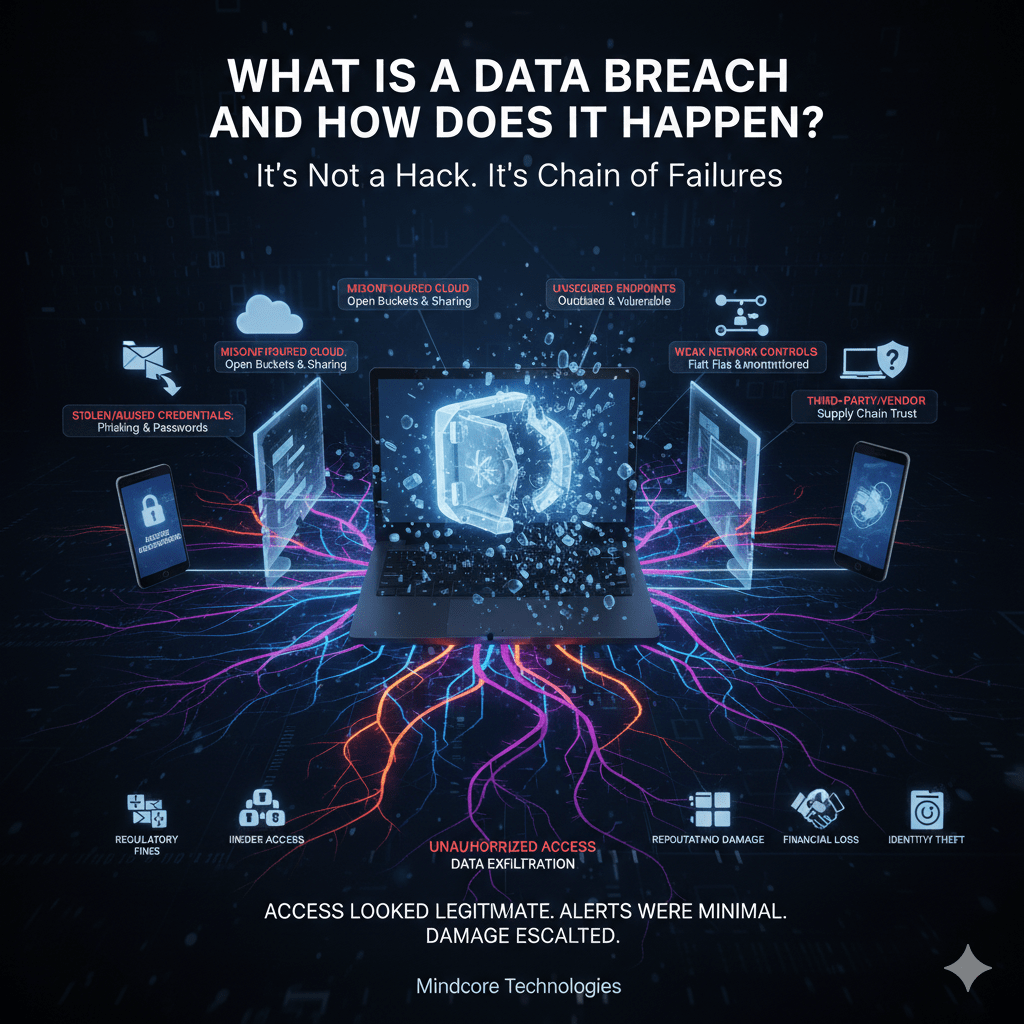
A data breach and the resulting exposure are not single events—they are a sequence of failures that allow unauthorized access to sensitive information. Most breaches don’t start with “hacking.” They start with trust, convenience, or visibility gaps that attackers exploit quietly.
At Mindcore Technologies, breach investigations almost always reveal the same pattern: access looked legitimate, alerts were minimal, and the damage escalated over time. Understanding how breaches actually happen is the first step to stopping them.
What Is a Data Breach (Plain English)
A data breach occurs when:
- Sensitive data is accessed, viewed, copied, or exfiltrated
- The access is unauthorized or exceeds intended permission
- The organization loses control over that data
Data breaches can involve:
- Customer records
- Financial information
- Login credentials
- Intellectual property
- Medical or regulated data
Encryption, firewalls, and compliance do not prevent breaches by themselves. Control and monitoring do.
What Counts as a Data Breach (Even If Nothing Is “Stolen”)
A breach does not require public leaks or ransom notes.
These still count:
- An attacker viewing data without exporting it
- A compromised account accessing files it shouldn’t
- Misconfigured storage exposed to the internet
- Data emailed or shared with the wrong party
Loss of confidentiality is the breach.
How Data Breaches Actually Happen (Real-World Paths)
1. Stolen or Abused Credentials
The most common breach vector.
How it happens:
- Phishing emails capture logins
- Password reuse exposes multiple systems
- Session tokens are hijacked
Why it works:
Access looks legitimate. Security tools trust it.
2. Phishing That Leads to Cloud Access
Modern breaches rarely involve malware first.
What attackers do:
- Compromise email or cloud accounts
- Create inbox rules to hide activity
- Access file storage and shared documents
Result:
Weeks of silent data exposure before detection.
3. Misconfigured Cloud Storage or SaaS
Speed beats security during growth.
Common mistakes:
- Publicly accessible storage buckets
- Over-permissive sharing links
- No monitoring of access logs
Impact:
Data exposure without any intrusion at all.
4. Unsecured Endpoints
One device is enough.
Attack path:
- Outdated laptop or weak local controls
- Credential or session theft
- Pivot into cloud and internal systems
Endpoints inherit trust across the environment.
5. Insider Access (Malicious or Accidental)
Not all breaches involve outsiders.
Examples:
- Excessive access granted “temporarily”
- Data shared with personal accounts
- Departing employees retaining access
Intent doesn’t matter. Exposure does.
6. Weak Network Controls
Flat networks amplify damage.
What attackers exploit:
- Unrestricted internal access
- No segmentation
- Minimal monitoring
Once inside, data discovery is easy.
7. Third-Party or Vendor Breaches
Your security depends on others.
Common scenario:
- Vendor account compromised
- Trusted integrations abused
- Data accessed through legitimate channels
Supply chain trust is frequently exploited.
Why Breaches Often Go Undetected
Most breaches:
- Use valid credentials
- Operate during business hours
- Avoid malware and noisy activity
- Blend into normal traffic
Detection fails when visibility and behavior monitoring are weak.
The Real Impact of a Data Breach
Breaches are not just IT problems.
They trigger:
- Regulatory reporting and fines
- Legal exposure
- Customer trust erosion
- Business disruption
- Long-term brand damage
The cost is often measured in months, not days.
What Prevents Breaches (In Practice)
Prevention is about reducing exposure and limiting blast radius.
Preventing a data breach and uncontrolled exposure requires:
- Phishing-resistant MFA
- Identity-based access with least privilege
- Short-lived sessions and revalidation
- Network segmentation
- Monitoring access behavior, not just malware
- Restricting outbound data movement
Perfect prevention is unrealistic. Controlled impact is achievable.
What Turns an Incident Into a Major Breach
Small incidents become major breaches when:
- Access is overly broad
- Monitoring is weak
- Response is slow
- Data can move freely
Architecture determines outcomes.
How Mindcore Technologies Helps Reduce Breach Risk
Mindcore helps organizations reduce data breach risk by focusing on how breaches actually occur:
- Identity-centric security architecture
- Cloud and SaaS access controls
- Endpoint hardening and posture enforcement
- Network segmentation and visibility
- Data access monitoring and response
- Incident readiness and containment planning
We design environments where one mistake doesn’t expose everything.
A Simple Reality Check
Your breach risk is high if:
- Credentials unlock too much access
- Cloud sharing is uncontrolled
- Endpoints lag on updates
- Network traffic isn’t monitored
- Data can leave freely
These conditions exist in most environments today.
Final Takeaway
A data breach and any resulting compromise are rarely the result of a single failure—they occur due to layered trust existing without layered controls. Attackers exploit credentials, sessions, misconfigurations, and visibility gaps to access data quietly and persistently.
Organizations that understand how breaches really happen can design security that contains damage, detects abuse early, and protects what matters most. Those that rely on tools alone often discover the breach only after exposure has already occurred.
Frequently Asked Questions
What is a data breach?
A data breach and any unauthorized viewing, copying, or exfiltration occur when sensitive information is accessed beyond intended permission. It happens when an organization loses control over protected data.
What are the most common causes of data breaches?
Common paths for a data breach and exposure include stolen credentials, phishing attacks, misconfigured cloud storage, unsecured endpoints, and vendor access abuse.
Can a data breach happen without ransomware or malware?
Yes. Many modern breaches involve attackers using legitimate credentials, cloud access, or misconfigured systems without deploying malware or triggering obvious alerts. Organizations using secure cloud infrastructure and identity-based controls can reduce this exposure.
Why do data breaches often go undetected for long periods?
Breaches frequently use valid accounts and normal business activity patterns, making them difficult to identify. Weak monitoring and limited visibility also delay detection, especially in distributed environments.
How can businesses reduce the risk of data breaches?
Businesses can reduce breach risk through phishing-resistant MFA, least-privilege access, endpoint hardening, network segmentation, behavior monitoring, and stronger cloud access controls. Organizations implementing Zero Trust security strategies improve visibility and reduce unauthorized access risk.
Matt Rosenthal’s Expertise in Data Breach Prevention and Cybersecurity Strategy
Matt Rosenthal, CEO of Mindcore Technologies, has extensive experience helping organizations reduce data breach risk through identity-focused security architecture, proactive monitoring, and resilient infrastructure design. His expertise in cybersecurity services, managed IT, cloud security, and network segmentation helps businesses limit unauthorized access, improve visibility, and contain incidents before they escalate. Matt’s approach focuses on reducing implicit trust, strengthening access governance, and building environments where sensitive data remains protected even when threats attempt to bypass traditional defenses.

