

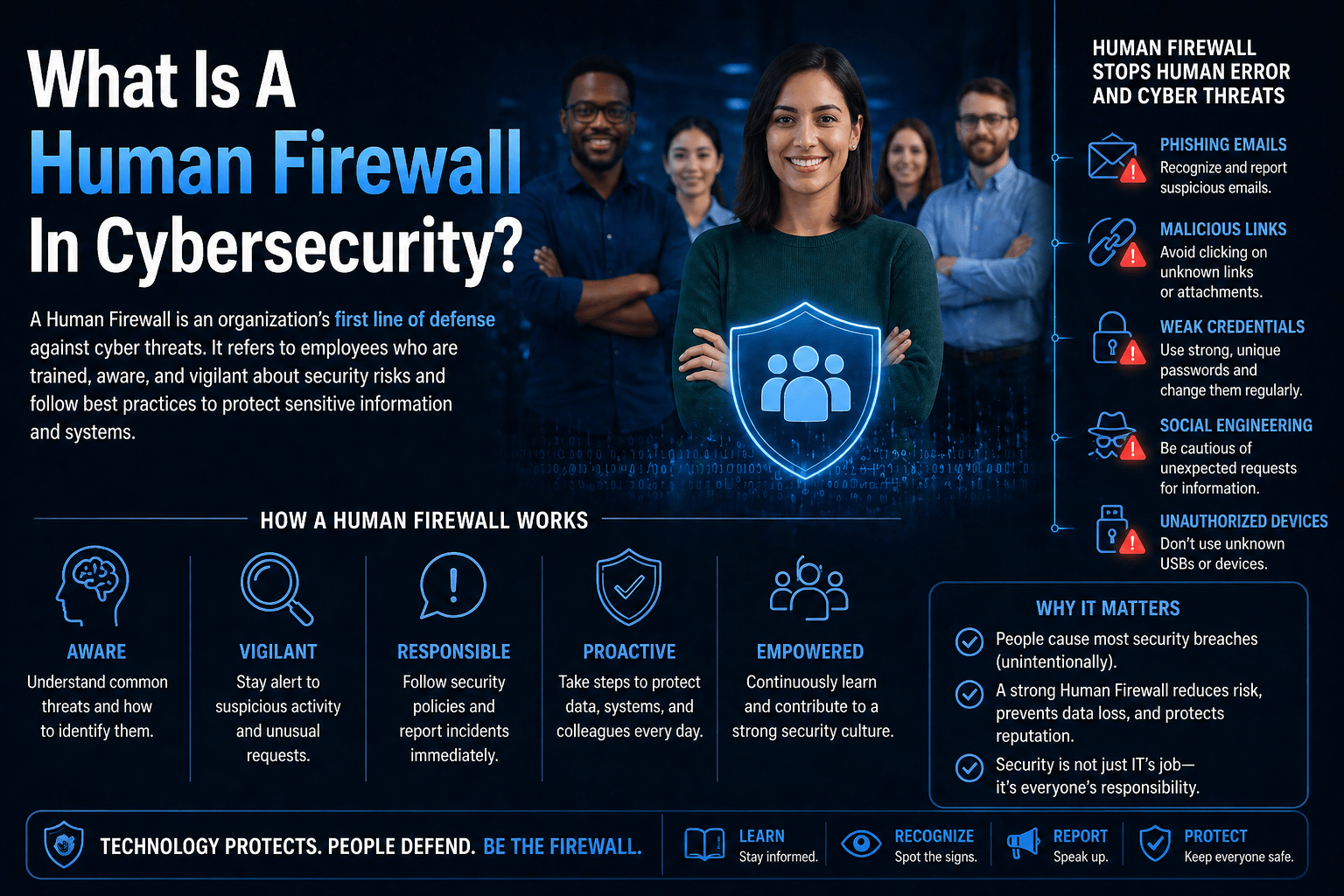
A human firewall is an employee who has been trained to recognize cyber threats and respond to them correctly — blocking attacks at the human layer rather than waiting for technical controls to catch them. The term draws a deliberate analogy to network firewalls: just as a network firewall inspects traffic and blocks threats before they enter the network, a human firewall inspects suspicious communications and behaviors and blocks attacks before they succeed.
The concept exists because technical firewalls have a fundamental limitation: they cannot filter human decisions. An employee who clicks a phishing link, shares their password, or transfers funds to a fraudster has bypassed every technical control between the attacker and the organization’s assets. The human firewall is the control that addresses this gap — converting the human from the most common attack vector into an active layer of defense.
For businesses building security programs through cybersecurity services and managed IT, a human firewall is not a metaphor — it is a program of ongoing training, culture development, and measurement that produces genuinely more secure employee behavior.
Overview
A human firewall is created through training, culture, and reinforcement. It requires employees to understand what threats look like, to know what to do when they encounter them, and to feel confident enough in that knowledge to act on it — including challenging suspicious requests and reporting potential incidents without fear of judgment. The strongest human firewalls exist in organizations where security is a shared responsibility modeled by leadership.
- A human firewall recognizes threats that technical controls cannot block
- It is created through regular, realistic training — not annual awareness modules
- Phishing simulation tests and reinforces recognition skills under realistic conditions
- Security culture — where reporting is valued and challenging is normalized — multiplies individual training effectiveness
- Measurement (click rates, reporting rates) confirms whether the human firewall is actually functioning
The 5 Why’s
- Why is the human firewall concept necessary when organizations have technical security controls? Because social engineering attacks specifically design around technical controls by targeting human behavior. A technical firewall blocks malicious network traffic. It does not block an employee who voluntarily provides their credentials to someone who convinced them to. A human firewall is the control that addresses the attack surface that technical tools cannot reach.
- Why do employees need to be specifically trained rather than just told to “be careful”? Because “be careful” does not provide the specific knowledge needed to recognize threats. An employee told to be careful about phishing still cannot identify the indicators that distinguish a sophisticated phishing email from a legitimate one without specific training on what to look for: domain mismatches, urgency engineering, impersonation techniques, unusual link destinations. Specific knowledge produces specific recognition.
- Why is organizational culture as important as individual training for human firewall effectiveness? Because individual employees do not make security decisions in isolation — they make them within an organizational context that either supports or undermines their security training. An employee who has been trained to challenge unknown visitors will not do so in an organization where challenging people is socially penalized. An employee who knows they should report a phishing email will not do so in an organization where reporting creates friction or judgment. Culture determines whether training translates into behavior.
- Why does the CEO and executive team’s participation in security training specifically matter? Because it signals organizational priority. In organizations where leadership participates visibly in security training, complies with the same security requirements as other employees, and discusses security as a shared responsibility, employees understand that security is genuinely valued. In organizations where leadership skips security training and makes exceptions to security policies, the signal is that security is a compliance exercise for others to complete.
- Why must human firewall effectiveness be measured rather than assumed from training completion rates? Because completing training and changing behavior are different outcomes. An employee who watched all the training videos and clicked on the next phishing simulation anyway has completed training but not formed a human firewall. Measuring click rates, reporting rates, and credential submission rates before and after training confirms whether behavior has actually changed. Organizations that measure see where training is working and where it needs reinforcement.
What a Strong Human Firewall Looks Like in Practice
An employee with a strong human firewall checks the actual sender domain before acting on an email. They verify unusual requests through a separate communication channel before complying. They report suspicious emails using the one-click reporting tool rather than deleting them. They challenge unknown visitors to the office politely but firmly. They use their password manager and MFA automatically rather than treating them as optional friction. They know who to call when something looks wrong.
They also feel comfortable doing all of these things — not because they are uniquely cautious by nature, but because they work in an environment where these behaviors are expected, reinforced, and valued.
Building a Human Firewall Program
Regular phishing simulations: realistic phishing tests that measure recognition and provide immediate education when an employee clicks. Not punitive — educational.
Short, frequent training modules: monthly or quarterly focused training that maintains current awareness more effectively than annual comprehensive sessions.
Easy reporting tools: a single click to report suspicious emails. Lowering the friction of reporting increases reporting rates.
Visible leadership participation: executives and managers who visibly comply with and discuss security requirements.
Recognition for good security behavior: acknowledging employees who correctly report phishing simulations, challenge suspicious access requests, or report genuine security concerns reinforces the behaviors the human firewall depends on.
Final Takeaway
A human firewall is an employee who has been trained, supported, and empowered to recognize and block cyber threats at the human layer — the layer that technical controls cannot protect. Building one requires specific knowledge training, realistic simulation, easy reporting tools, and a security culture where the behaviors that constitute a human firewall are expected and valued.
Human Firewall Development From Mindcore Technologies
Mindcore’s cybersecurity services include the training, simulation, and culture development programs that build functional human firewalls across employee populations. Our IT consulting services help organizations build the governance and culture frameworks that make individual training effective.
Talk to Mindcore Technologies About Building Your Human Firewall

