

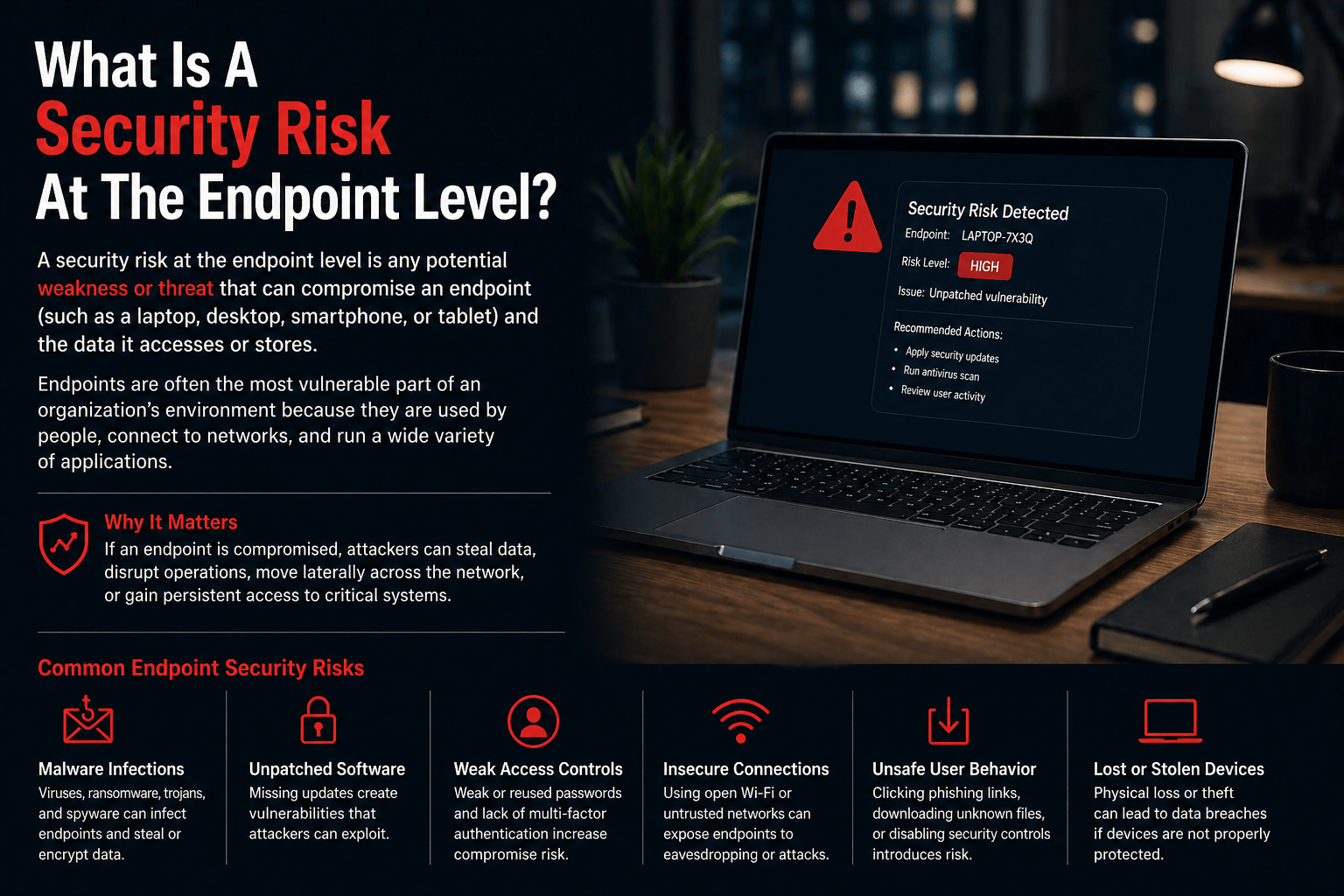
An endpoint security risk is any vulnerability, misconfiguration, or threat that could compromise a device connecting to an organization’s network — and through that device, provide access to the broader environment. Endpoints are the most common entry point for cyberattacks because they are the devices humans use to do their work, and human behavior is the most exploitable attack surface in any organization.
Every laptop, desktop, server, mobile device, and increasingly every IoT device that connects to a corporate network is an endpoint. Each one carries its own security risk profile: its software patch status, its configuration, its protection tools, who uses it, and how it is used all determine how much risk it introduces.
For businesses with managed IT services covering their IT environment, endpoint security risk management is a core component of the service — ensuring every managed device is protected, patched, and monitored.
The Most Common Endpoint Security Risks
Unpatched Software
Every unpatched vulnerability on an endpoint is a known exploitation opportunity. Attackers systematically scan for systems running vulnerable software versions and exploit them with available tools. The time between a vulnerability’s public disclosure and its active exploitation is measured in hours to days for high-severity vulnerabilities.
Weak or No Endpoint Protection
Endpoints without EDR or with outdated antivirus-only protection are exposed to the majority of modern attack techniques — fileless malware, living-off-the-land attacks, ransomware variants designed to evade signatures — that behavioral detection would catch.
Compromised Credentials
An endpoint whose user account has been compromised — through phishing, credential stuffing, or password theft — is an authorized access point for an unauthorized user. Once an attacker has valid credentials, they operate within the environment with the permissions of the compromised account.
Misconfiguration
Endpoints configured with excessive permissions, disabled security features, unnecessary exposed services, or default settings that were not hardened represent avoidable risk. Common misconfigurations include disabled firewall, USB boot enabled, remote desktop accessible without MFA, and auto-run enabled for removable media.
Unmanaged and Shadow IT Devices
Devices that connect to the network without being enrolled in device management — personal devices used for work, unauthorized tools installed by employees — are endpoints that do not receive security patches, do not have endpoint protection agents, and are not visible in security monitoring. They are the highest-risk endpoints in most environments.
Physical Theft or Loss
A stolen or lost laptop is a potential data breach if the device is not encrypted and the compromise is not reported immediately. Physical endpoint risk is a security risk, not just an asset loss.
The 5 Why’s
- Why are endpoints specifically the most common attack entry point? Because they are the interface between humans and organizational systems, and humans are the most exploitable attack surface. Phishing targets the humans using endpoints. Credential attacks target the accounts those humans use. Malware delivery targets the devices those humans operate. Endpoints are where human vulnerability and organizational system access converge.
- Why does a single compromised endpoint represent risk to the entire network? Because lateral movement — the attacker’s ability to move from a compromised endpoint to other systems on the same network — can expand a single-device compromise into an organization-wide breach. Network segmentation and access controls limit this, but an uncontained compromised endpoint is a foothold the attacker can expand from.
- Why does unmanaged device risk specifically matter when managed endpoints are well-protected? Because security is only as strong as its weakest point. An environment where all managed laptops have EDR, current patches, and MFA enforced — but where employees also connect personal devices to the corporate network — has a well-protected managed environment and an unprotected entry point right next to it.
- Why does patch management specifically address one of the highest-probability endpoint risks? Because known, exploitable vulnerabilities in unpatched software are systematically targeted. Exploiting an unpatched CVE does not require sophisticated attacker capability — exploit kits automate the process. Keeping endpoints patched eliminates the largest category of automated exploitation risk.
- Why has the remote work shift specifically increased endpoint security risk? Because remote endpoints are outside physical network perimeters and may connect from home networks with weaker security than corporate networks. They are more likely to be used on public Wi-Fi. They may be shared with family members. And the visibility that on-premises monitoring provided is absent unless endpoint agents are deployed and maintained.
Final Takeaway
Endpoint security risks span unpatched software, inadequate protection tools, compromised credentials, misconfiguration, unmanaged devices, and physical loss. Each represents a potential entry point for attacks that can spread from a single device to the broader environment. Managing these risks requires coverage, visibility, and continuous maintenance — not one-time configuration.
Endpoint Security Risk Management From Mindcore Technologies
Mindcore’s cybersecurity services include endpoint security risk management — EDR deployment, patch management, device management, and endpoint configuration hardening — as core components of our managed IT services engagement.

