

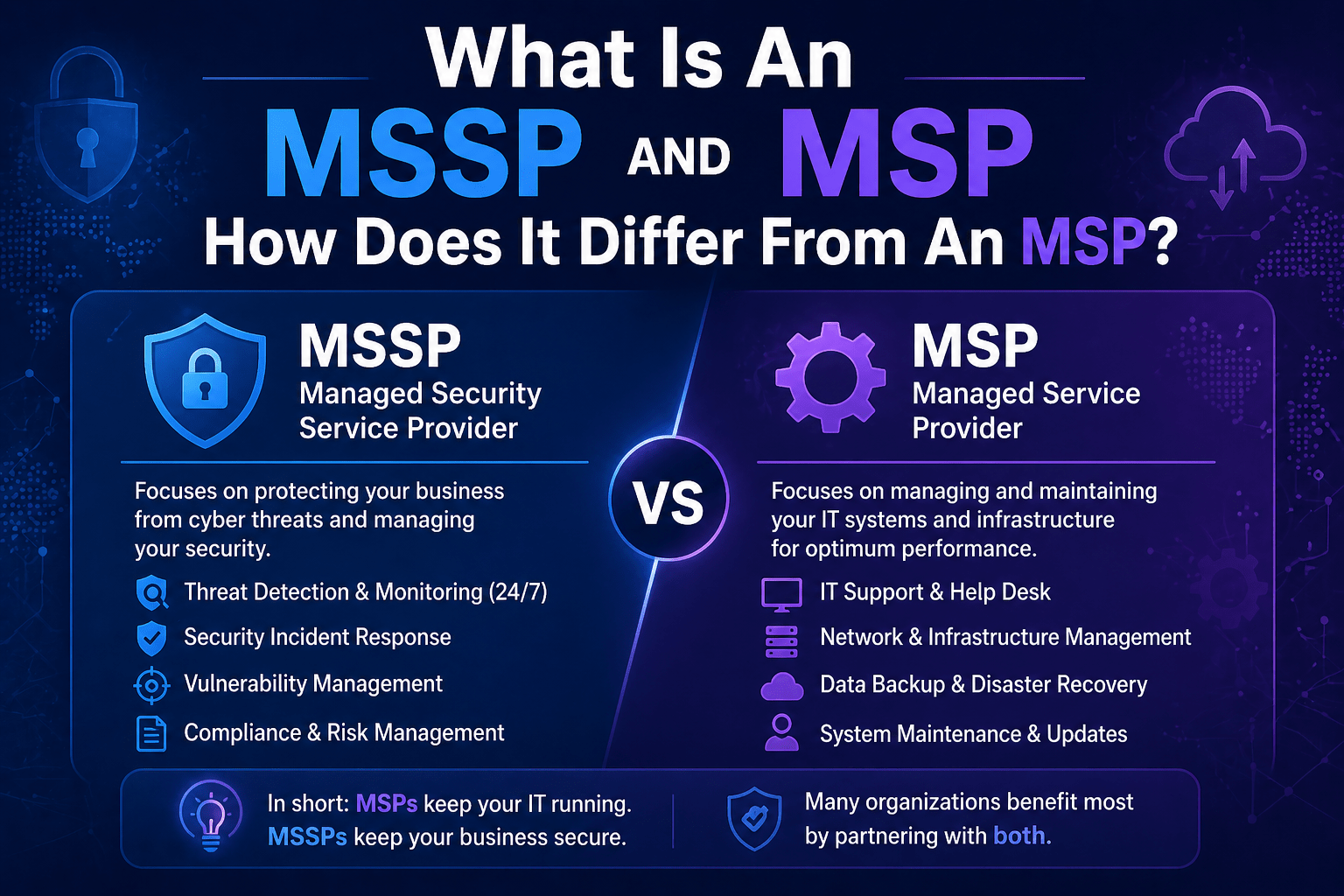
A managed security services provider (MSSP) is a company that specializes in delivering security operations and monitoring services to client organizations. An MSSP runs security operations center (SOC) functions, threat monitoring, incident detection, vulnerability management, and security response, for clients who do not maintain those capabilities internally.
The distinction from a managed service provider (MSP) is one of specialization and scope. An MSP manages IT infrastructure broadly, helpdesk, monitoring, patching, cloud management, and security as part of the overall IT scope. An MSSP focuses specifically on the security operations layer, deeper security monitoring, threat intelligence, and incident response than a general MSP typically provides.
For businesses with managed IT services already in place, the question is whether the MSP’s integrated security capabilities are sufficient, or whether a dedicated MSSP is needed for the security operations depth the organization requires.
Overview
MSPs and MSSPs serve complementary but distinct functions. An MSP manages IT operations with security integrated as a component. An MSSP manages security operations as a dedicated function. The right choice depends on the organization’s security requirements, risk profile, and regulatory environment.
- MSPs provide security as part of broad IT management
- MSSPs provide security operations as a specialized, dedicated function
- Some providers do both, combining MSP breadth with MSSP security depth
- Regulated industries and higher-risk environments often need MSSP-level security
- The gap between MSP security and MSSP security is most visible in threat detection and incident response
What Each Provider Actually Does
What an MSP does:
- Monitors and manages IT infrastructure (servers, networks, endpoints)
- Provides helpdesk and end user support
- Manages cloud environments and Microsoft 365
- Handles patching and vulnerability management
- Includes baseline security tools (endpoint protection, email filtering, MFA)
- Provides security as a component of broader IT management
What an MSSP does:
- Operates a 24/7 security operations center (SOC)
- Monitors security events across your environment continuously
- Detects threats through SIEM, EDR, and threat intelligence
- Manages vulnerability assessment and remediation
- Responds to security incidents
- Produces security documentation for compliance audits
- Focuses exclusively on security outcomes
The 5 Why’s
Why do organizations with an MSP sometimes also need an MSSP?
A general MSP provides security baseline: endpoint protection, patching, email security, MFA. An MSSP provides security operations: 24/7 SOC monitoring, threat hunting, advanced incident response. Organizations that face elevated threat environments, have compliance requirements demanding security operations evidence, or have experienced security incidents typically need MSSP-level depth beyond what a general MSP delivers.
Why is 24/7 SOC monitoring the most common capability that separates MSSPs from MSPs?
Security threats do not keep business hours. A ransomware attack that begins at 2 AM on a Saturday can encrypt the majority of an organization’s data before business opens Monday if no one is watching. 24/7 SOC monitoring, the core MSSP capability, detects and responds to threats at the time they occur, not when someone notices them during business hours.
Why do compliance frameworks increasingly require MSSP-level security evidence?
Frameworks like HIPAA, PCI-DSS, SOC 2, and CMMC require documented evidence of security monitoring, incident detection capability, and response procedures. An MSP’s standard security management may not produce the audit evidence those frameworks require. An MSSP’s dedicated security operations documentation, incident logs, threat detection records, response timelines, provides that evidence.
Why do some MSPs offer integrated MSSP capabilities rather than being purely one or the other?
Because the operational gap between IT management and security management is a liability. An MSP that manages your infrastructure but cannot respond to a security incident at 3 AM is managing a threat surface it cannot protect. Quality MSPs have expanded their security operations capability to close that gap, delivering both IT management and security operations under a single engagement.
Why should businesses be cautious about MSSPs that do not also understand their IT infrastructure?
An MSSP without IT infrastructure context is monitoring network traffic and logs without understanding the normal baseline of your specific environment. Anomaly detection depends on knowing what normal looks like. An integrated provider, one that manages both IT and security, has the infrastructure context that makes security monitoring more effective.
When You Need an MSP vs. When You Need an MSSP
An MSP is the right choice when:
- You need comprehensive IT management across your environment
- Your security requirements are met by integrated baseline security tools
- You want a single provider responsible for your entire IT operational environment
- You are a small to mid-sized business without elevated threat exposure or complex compliance requirements
An MSSP, or an MSP with MSSP capabilities, is the right choice when:
- You operate in a regulated industry with specific security monitoring requirements
- You have experienced a security incident and need deeper threat detection
- Your risk profile requires 24/7 SOC monitoring beyond standard IT security
- You need security-specific compliance documentation (SOC 2, HIPAA, PCI-DSS)
- You face targeted threats that require security operations depth
MSP vs. MSSP: Key Differences
| Dimension | MSP | MSSP |
|---|---|---|
| Primary function | IT infrastructure management | Security operations |
| Security scope | Baseline security tools and patching | SOC monitoring, threat detection, IR |
| Coverage | Business hours + on-call | 24/7 SOC monitoring |
| Compliance support | General IT compliance | Security-specific compliance evidence |
| Typical client need | IT management with security included | Dedicated security operations |
The Integration Advantage
An MSSP without IT infrastructure context manages security in partial isolation, monitoring traffic and logs without the deep environmental knowledge that makes anomaly detection accurate. An MSP without security operations depth manages an IT environment that is not adequately monitored for threats.
The best security outcome for most businesses comes from a provider that does both, managing IT infrastructure with the environmental context that makes security operations effective.
Final Takeaway
An MSSP provides the dedicated security operations depth that general MSP security integration does not. Organizations with elevated security requirements, regulated industries, higher threat profiles, compliance-driven security operations mandates, benefit from MSSP-level capability. The best outcome for most businesses is a provider that delivers both, managing IT infrastructure with the environmental context that makes security operations effective, rather than choosing between two disconnected vendors.
Integrated IT Management and Security Operations From Mindcore
Mindcore’s cybersecurity services combine MSP-level IT management with the security operations depth that protects against today’s threats, including cybersecurity compliance support for regulated industries.

