

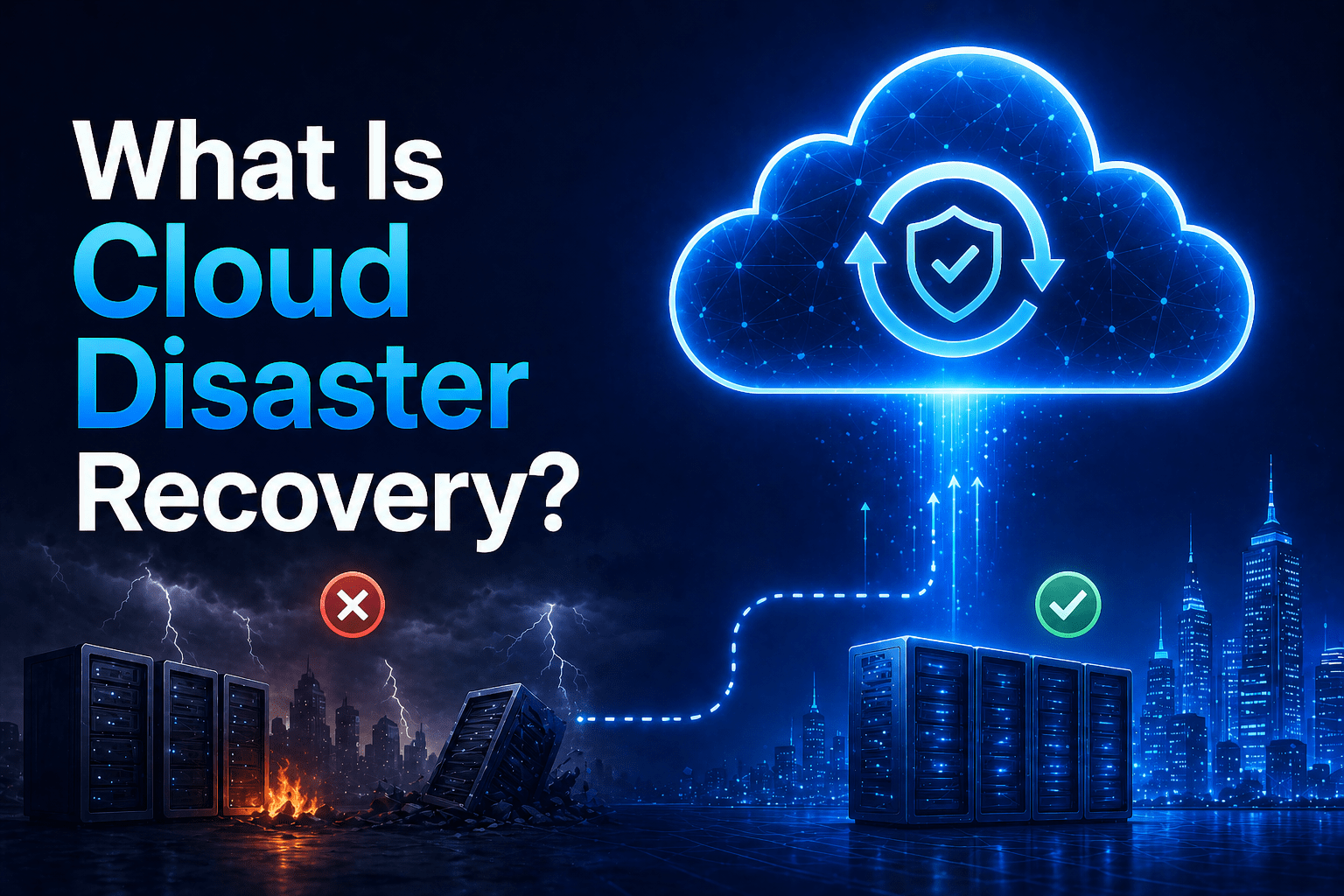
Cloud disaster recovery (cloud DR) is the use of cloud infrastructure and services to restore IT systems and data after a significant failure event — a ransomware attack, a natural disaster, a major hardware failure, or any other event that renders primary systems unavailable.
Disaster recovery is distinct from backup. Backup preserves data. Disaster recovery restores systems to an operational state — not just the data, but the infrastructure, configuration, and application environment that makes that data usable. Cloud disaster recovery uses cloud infrastructure as the recovery target, eliminating the need for a dedicated secondary physical data center that traditional DR approaches required.
Overview
Cloud disaster recovery works by continuously or periodically replicating on-premises or cloud-hosted systems to a recovery environment in the cloud. When a disaster event occurs, the replicated systems are activated in the cloud recovery environment — either automatically through defined failover procedures or manually following the disaster recovery plan. Users and applications are redirected to the cloud recovery environment, restoring operations while the primary environment is rebuilt or repaired.
- Cloud DR replicates systems to cloud infrastructure rather than to a secondary physical data center
- Replication frequency determines the Recovery Point Objective (RPO) — how much data is lost between the disaster event and the last replicated state
- Failover speed determines the Recovery Time Objective (RTO) — how quickly systems are restored to operational state
- Azure Site Recovery is Microsoft’s primary cloud DR service for on-premises and Azure workloads
- Cloud DR eliminates the capital expense of dedicated secondary DR infrastructure
The 5 Why’s
- Why is cloud disaster recovery specifically different from cloud backup — and why does the difference matter? Backup preserves data; disaster recovery restores systems. After a significant failure, backup provides the data to rebuild from, but rebuilding systems — provisioning servers, installing software, configuring applications, restoring data — is a lengthy process. Cloud DR maintains replicated, pre-configured system images that can be activated quickly, dramatically reducing the time to restore operations compared to building systems from backup.
- Why did traditional disaster recovery require a secondary physical data center, and why does cloud DR eliminate that requirement? Traditional DR maintained a secondary physical location with hardware sized to run production workloads in a failover scenario. That infrastructure was expensive to acquire, maintain, and keep current — and it sat idle most of the time. Cloud DR uses cloud infrastructure that is only billed at full cost when actively needed. The failover environment exists in the cloud; compute costs during normal operations are limited to replication overhead rather than full production-equivalent hardware.
- Why is Recovery Point Objective (RPO) specifically determined by replication frequency? RPO is the maximum data loss acceptable in a recovery scenario — measured as the time between the disaster event and the most recent replicated state. A system replicated every 15 minutes has an RPO of up to 15 minutes (data created in the 15 minutes before the disaster may not be in the replicated state). Continuous replication reduces RPO toward near-zero. The acceptable RPO for each workload determines the replication frequency and cost of the DR approach.
- Why is Recovery Time Objective (RTO) specifically determined by failover and validation speed? RTO is the maximum time acceptable between a disaster event and the restoration of operations. Cloud DR that requires manual steps to activate failover environments, update DNS, redirect users, and validate functionality takes longer than automated failover procedures. Azure Site Recovery supports automated failover with defined runbooks that execute the failover sequence without manual intervention — which is what enables sub-hour RTO for critical workloads.
- Why do organizations frequently discover that their disaster recovery assumptions are incorrect during actual events? DR plans look reasonable on paper but have operational gaps that only become visible when tested under pressure — or during an actual disaster. Failover procedures that have never been tested may fail for unexpected reasons. Recovery time estimates may not account for validation time or configuration issues. DR testing — failover rehearsals that activate the recovery environment and verify that it functions as expected — is what converts a DR plan into a DR capability.
Cloud DR Approaches by Recovery Requirement
Backup and Restore (Highest RTO/RPO, Lowest Cost)
Data is backed up to cloud storage. Recovery requires restoring data to rebuilt infrastructure — provisioning new VMs, installing applications, restoring data from backup. RTO is measured in hours to days depending on data volume and system complexity.
Appropriate for: non-critical workloads with tolerant recovery time requirements.
Pilot Light (Moderate RTO/RPO, Moderate Cost)
A minimal version of the production environment runs continuously in the cloud — critical databases replicating in near-real-time, core infrastructure components maintained in ready state. In a disaster event, the pilot light environment is scaled up to full production capacity. RTO is measured in hours.
Appropriate for: important workloads where recovery within a business day is acceptable.
Warm Standby (Lower RTO/RPO, Higher Cost)
A scaled-down but fully functional version of the production environment runs in the cloud continuously. In a disaster event, the standby environment is scaled to full production capacity. RTO is measured in minutes to hours.
Appropriate for: business-critical workloads requiring same-day recovery.
Multi-Site Active/Active (Lowest RTO/RPO, Highest Cost)
Production workloads run simultaneously in multiple geographic regions. In a failure event, traffic is redirected to the remaining active region instantly. RTO is near-zero; RPO is near-zero.
Appropriate for: mission-critical workloads where any downtime is unacceptable.
Azure Site Recovery
Azure Site Recovery (ASR) is Microsoft’s cloud disaster recovery service:
- Replicates on-premises VMware, Hyper-V, and physical servers to Azure
- Replicates Azure VMs between Azure regions
- Supports automated failover with recovery plan runbooks
- Provides non-disruptive DR testing through test failover to isolated networks
- Integrates with Azure Monitor for replication health monitoring
Final Takeaway
Cloud disaster recovery transforms what was previously a significant capital investment — secondary data center hardware, colocation costs, hardware maintenance — into a consumption-based service that scales with recovery requirements. It eliminates geographic concentration risk, supports automated failover, and enables DR testing without production impact. For organizations that have been deferring DR investment because of cost, cloud DR changes the economics fundamentally.
Implement Cloud Disaster Recovery With Mindcore Technologies
Mindcore Technologies designs and implements Azure-based disaster recovery solutions — RPO/RTO analysis, Azure Site Recovery configuration, recovery plan development, and DR testing that validates recovery capability before you need it.
Talk to Mindcore Technologies About Cloud Disaster Recovery →
Contact our team to assess your current disaster recovery posture and design the cloud DR solution that meets your recovery requirements.

