

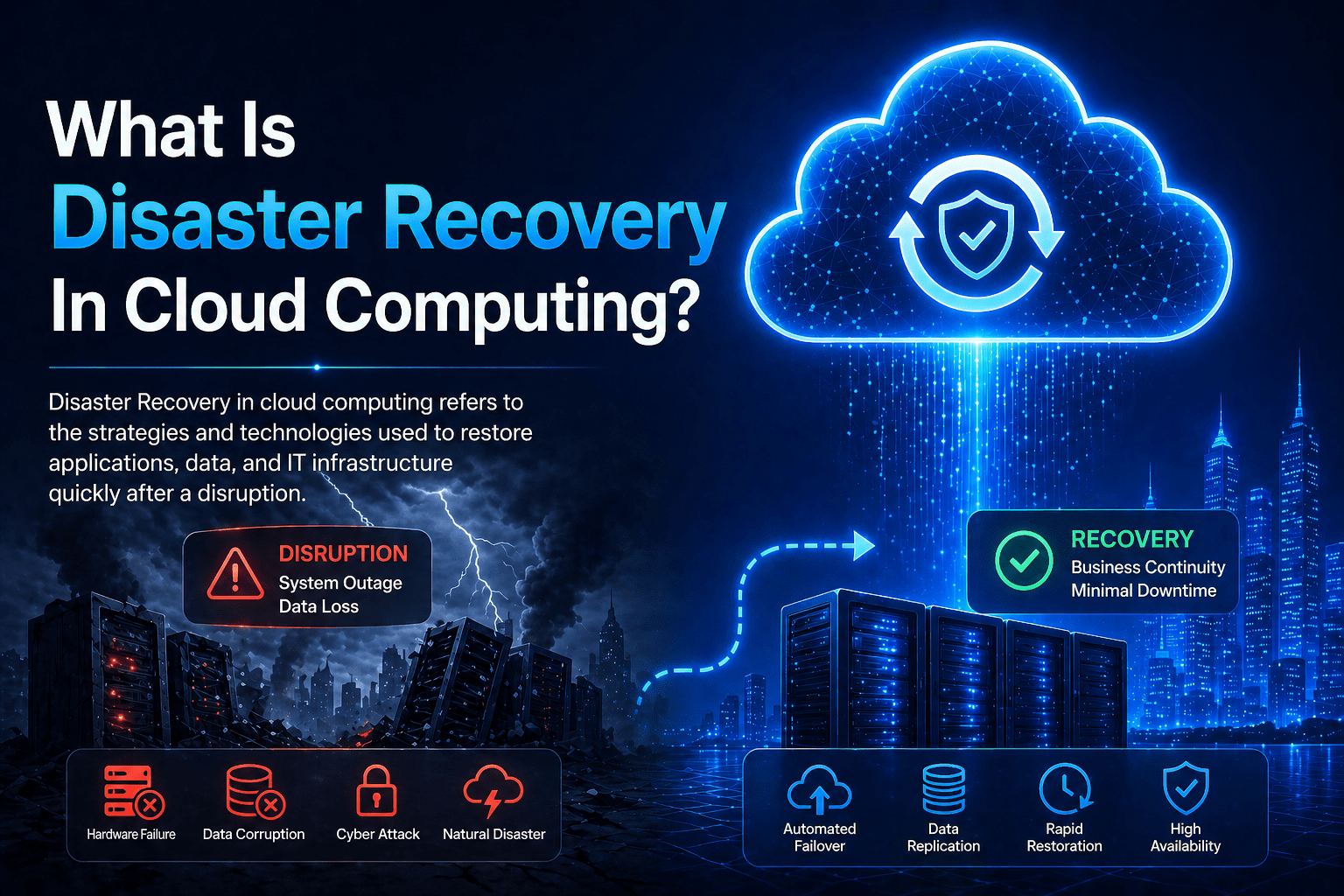
Disaster recovery in cloud computing refers to the strategies, technologies, and processes that use cloud infrastructure to restore IT systems and business operations following a disruptive event. It encompasses everything from how data is replicated to secondary cloud locations, to how systems are recovered and operational in the event of a significant failure.
Cloud computing has transformed disaster recovery from a specialized, expensive capability requiring dedicated physical infrastructure into a scalable, accessible service that organizations of any size can implement. The economics changed; the fundamental objective did not — restore critical systems and data fast enough to meet the business’s recovery requirements.
Overview
Disaster recovery in cloud computing works through a combination of data replication, infrastructure automation, and predefined recovery procedures. Data from production systems is replicated to cloud infrastructure continuously or at defined intervals. Recovery procedures define how replicated systems are activated when a disaster event occurs — either through automated failover triggered by defined conditions or through manual execution of recovery runbooks. The result is that when a disaster occurs, the process of restoring operations is an execution of defined, tested procedures rather than an improvised response to unexpected conditions.
- Cloud DR uses geographically separated cloud infrastructure to host recovery environments
- Replication frequency determines how current the recovery environment is relative to the production state
- Automated failover reduces recovery time by eliminating manual steps from the failover sequence
- DR testing in the cloud is non-disruptive — test failovers run in isolated environments without affecting production
- The cloud DR cost model is fundamentally different from traditional DR — pay for replication overhead during normal operations, full cost only during active recovery
The 5 Why’s
- Why does cloud computing specifically change the economics of disaster recovery for mid-sized organizations? Traditional enterprise-grade disaster recovery required a secondary data center — real estate, hardware, power, cooling, and ongoing maintenance costs for infrastructure that sat idle most of the time. Cloud DR replaces dedicated hardware with cloud infrastructure that is provisioned on demand. The idle cost is minimal; the recovery capability is equivalent or better. This change brought enterprise-grade DR within reach of organizations that could not previously justify the investment.
- Why is geographic separation specifically central to disaster recovery, and how does cloud provide it? If the recovery environment is in the same physical location as the production environment, any disaster that affects the primary location (fire, flood, extended power outage) also affects the recovery environment. Cloud DR places the recovery environment in a geographically separated cloud region — often hundreds of miles from the production environment — so that location-specific disasters do not eliminate both environments simultaneously.
- Why does automated failover specifically matter for meeting aggressive Recovery Time Objectives? Manual failover requires a human to detect the failure, initiate the failover procedure, execute each step correctly, and validate the outcome. Under the stress of a real disaster event, with systems down and business pressure mounting, manual procedures are error-prone and slower than their paper estimates suggest. Automated failover executes defined procedures without human intervention — reducing failover time from hours to minutes for well-configured environments.
- Why is DR testing in cloud computing specifically less disruptive than traditional DR testing? Traditional DR testing often required taking production systems offline to test whether they could fail over to the secondary environment — which meant planned downtime for the test. Cloud DR testing using Azure Site Recovery’s test failover capability creates an isolated test environment using replicated data without affecting production systems or replication. Organizations can test DR capability as frequently as needed without business impact.
- Why does cloud disaster recovery specifically require defined runbooks rather than generic procedures? Every environment has specific systems, specific dependencies, and specific recovery sequences that must be followed for recovery to succeed. Generic DR procedures provide a framework; runbooks provide the specific steps — which systems to bring up first, which dependencies must be resolved before other systems start, which validation tests confirm successful recovery. Without runbooks, DR execution under pressure produces inconsistent results. With runbooks, it produces repeatable outcomes.
Key Concepts in Cloud Disaster Recovery
Recovery Point Objective (RPO)
The maximum amount of data loss acceptable, measured in time. An RPO of 1 hour means the business accepts losing up to 1 hour of data changes in a disaster scenario. RPO is determined by how frequently data is replicated to the cloud recovery environment. Near-continuous replication produces near-zero RPO; hourly replication produces up to 1 hour RPO.
Recovery Time Objective (RTO)
The maximum time acceptable between a disaster event and the restoration of operations. An RTO of 4 hours means systems must be operational within 4 hours of a disaster event. RTO is determined by the speed of the failover process — how long it takes to activate recovery systems, redirect traffic, and validate that systems are functioning.
Replication
The ongoing process of copying data from production systems to recovery infrastructure. For cloud DR, replication uses platform-native services (Azure Site Recovery for system replication) or storage-level replication that keeps the recovery environment current relative to production.
Failover
The process of activating recovery systems to replace failed production systems. Failover may be automated (triggered by defined failure conditions) or manual (executed by IT staff following defined procedures). Failover includes bringing recovery systems to operational state and redirecting users and applications to the recovery environment.
Failback
The process of returning operations to the primary environment after it has been restored following a disaster. Failback ensures that data changes made in the recovery environment during the disaster period are synchronized back to the primary environment before production resumes there.
Cloud DR in Practice: Azure Site Recovery
Azure Site Recovery provides the replication and orchestration layer for cloud disaster recovery:
- Continuous replication of on-premises and Azure VMs to Azure (or between Azure regions)
- Recovery Point Objectives as low as 30 seconds for VMware-replicated workloads
- Automated recovery plans with customizable runbooks
- Non-disruptive test failover for DR validation
- Integration with Azure Monitor for replication health monitoring and alerting
- Support for complex multi-tier applications with sequenced recovery
Final Takeaway
Disaster recovery in cloud computing delivers geographic separation, automated failover, and DR testing capability at a cost model that makes enterprise-grade recovery attainable for organizations that could not previously justify dedicated secondary data center investment. The technology is mature and well-supported through Azure Site Recovery. What determines whether it works when needed is the quality of the implementation — the accuracy of the RPO/RTO analysis, the completeness of the recovery runbooks, and the regularity of DR testing that validates the recovery capability before an actual event.
Implement Cloud Disaster Recovery With Mindcore Technologies
Mindcore Technologies designs and implements disaster recovery solutions using Azure Site Recovery — RPO/RTO analysis, replication configuration, recovery plan development, runbook creation, and regular DR testing that turns disaster recovery from a paper plan into a verified capability.
Talk to Mindcore Technologies About Cloud Disaster Recovery →
Contact our team to assess your current DR posture and build the cloud disaster recovery capability your business operations require.

