

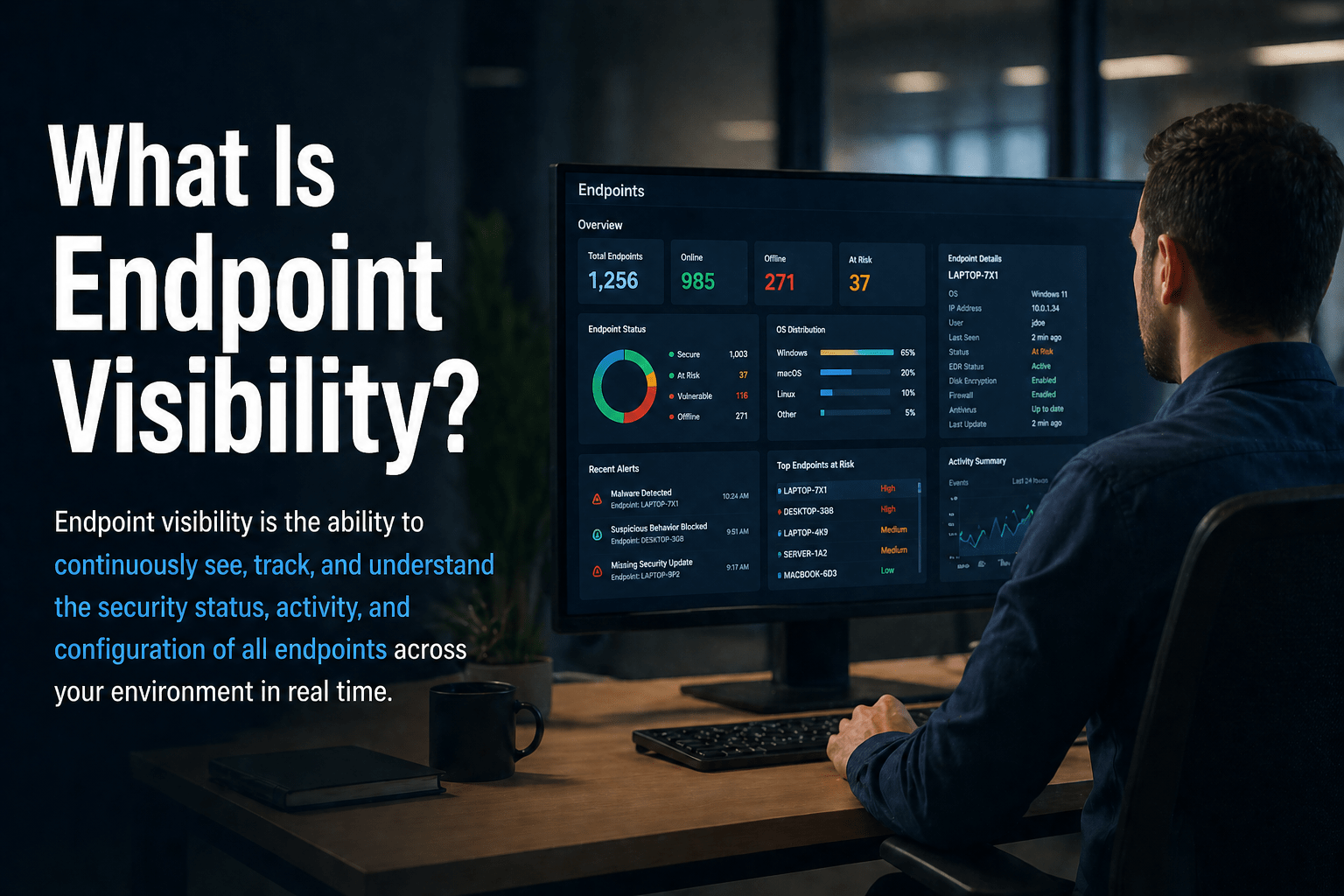
Endpoint visibility is the ability to see, in real time and in detail, what every endpoint device in an organization’s environment is doing — what processes are running, what files are being accessed, what network connections are being made, what changes are being made to the system, and what user actions are occurring.
An organization with full endpoint visibility knows the state of every managed device at any moment and has a recorded history of device activity it can review during investigation. An organization without endpoint visibility knows only what users report and what scheduled scans happen to find — a reactive, incomplete picture that is inadequate for detecting modern threats.
Endpoint visibility is the foundation that EDR provides. Without it, security teams are investigating incidents with incomplete information and monitoring for threats they cannot see.
Overview
Endpoint visibility is achieved through agents deployed on each device that continuously collect behavioral telemetry — process activity, file operations, network connections, registry changes, authentication events — and report it to a centralized platform. The result is a real-time and historical record of what every endpoint has done, enabling both proactive threat detection and retrospective investigation.
- Real-time visibility: knowing what endpoints are doing as it happens
- Historical telemetry: recorded activity that enables forensic investigation
- Coverage: visibility only exists where agents are deployed — ungoverned endpoints are blind spots
- Depth: quality visibility includes process-level, file-level, and network-level detail
- Actionability: visibility without analysis and response capability is data without value
The 5 Why’s
- Why is endpoint visibility specifically important when network monitoring also exists? Because endpoints and networks show different things. Network monitoring sees traffic between systems. Endpoint visibility sees what is happening on each system — which processes launched, what files were modified, what commands were executed. Many attacks operate primarily within endpoints before producing network-level indicators. Without endpoint visibility, those attacks are invisible until they produce network traffic.
- Why does endpoint visibility specifically enable faster incident response? Because investigation without visibility is reconstruction from incomplete information — interviewing users, reviewing logs that may not exist, trying to determine what happened from what remains visible after the fact. Visibility provides a recorded timeline. An incident response team with full endpoint telemetry can reconstruct the attack chain, identify the scope of compromise, and determine what the attacker accessed in hours rather than days.
- Why does the absence of visibility on some endpoints create disproportionate risk? Because attackers look for the path of least resistance. An environment where most endpoints are monitored but some are not is an environment where attackers will specifically target the unmonitored ones. A single unmonitored endpoint is a blind spot that invalidates the visibility confidence of the rest of the environment.
- Why is endpoint visibility increasingly important as remote work has become standard? Because remote endpoints are outside the physical network perimeter and outside the observation range of on-premises monitoring tools. An employee working from home on a device with no endpoint agent is effectively invisible to the organization’s security monitoring. Visibility that covers remote devices is the only way to maintain a consistent security picture in distributed work environments.
- Why does endpoint visibility benefit threat hunting beyond just incident response? Because threat hunting — proactively searching for indicators of compromise that automated detection has not flagged — requires telemetry to hunt through. Security analysts hunting for specific indicators, attack techniques, or behavioral anomalies need historical endpoint data to search. Without it, threat hunting is not possible, and the organization has no way to proactively identify compromises that automated detection missed.
What Full Endpoint Visibility Includes
Process visibility: every process that executes on each endpoint, with its parent process, command line arguments, and execution context. Process visibility catches malware executing under legitimate process names and identifies unusual execution chains.
File system visibility: file creation, modification, deletion, and access events. File visibility catches ransomware behavior (mass file encryption), data staging for exfiltration, and persistence mechanisms (malicious files written to startup locations).
Network connection visibility: every network connection made from each endpoint, including destination IP and domain, port, protocol, and data volume. Network visibility from the endpoint perspective captures command-and-control communications and exfiltration activity.
Registry visibility: changes to the Windows registry, including additions and modifications to persistence locations. Registry visibility catches persistence mechanisms that attackers use to survive reboots.
Authentication and access visibility: logon events, privilege escalation, and credential use patterns. Authentication visibility from endpoints complements identity platform logging for complete access visibility.
Final Takeaway
Endpoint visibility is the security foundation that enables detection, investigation, and response. Without it, organizations are blind to what their devices are doing — reactive to incidents rather than proactive against threats. With it, security teams have the real-time and historical data needed to detect attacks as they develop and reconstruct them completely when they occur.
Endpoint Visibility From Mindcore Technologies
Mindcore’s cybersecurity services include full endpoint visibility deployment through EDR and endpoint management tools across all managed devices. Our managed IT services ensure that every endpoint in the environment has an agent and that visibility data is monitored continuously.

