

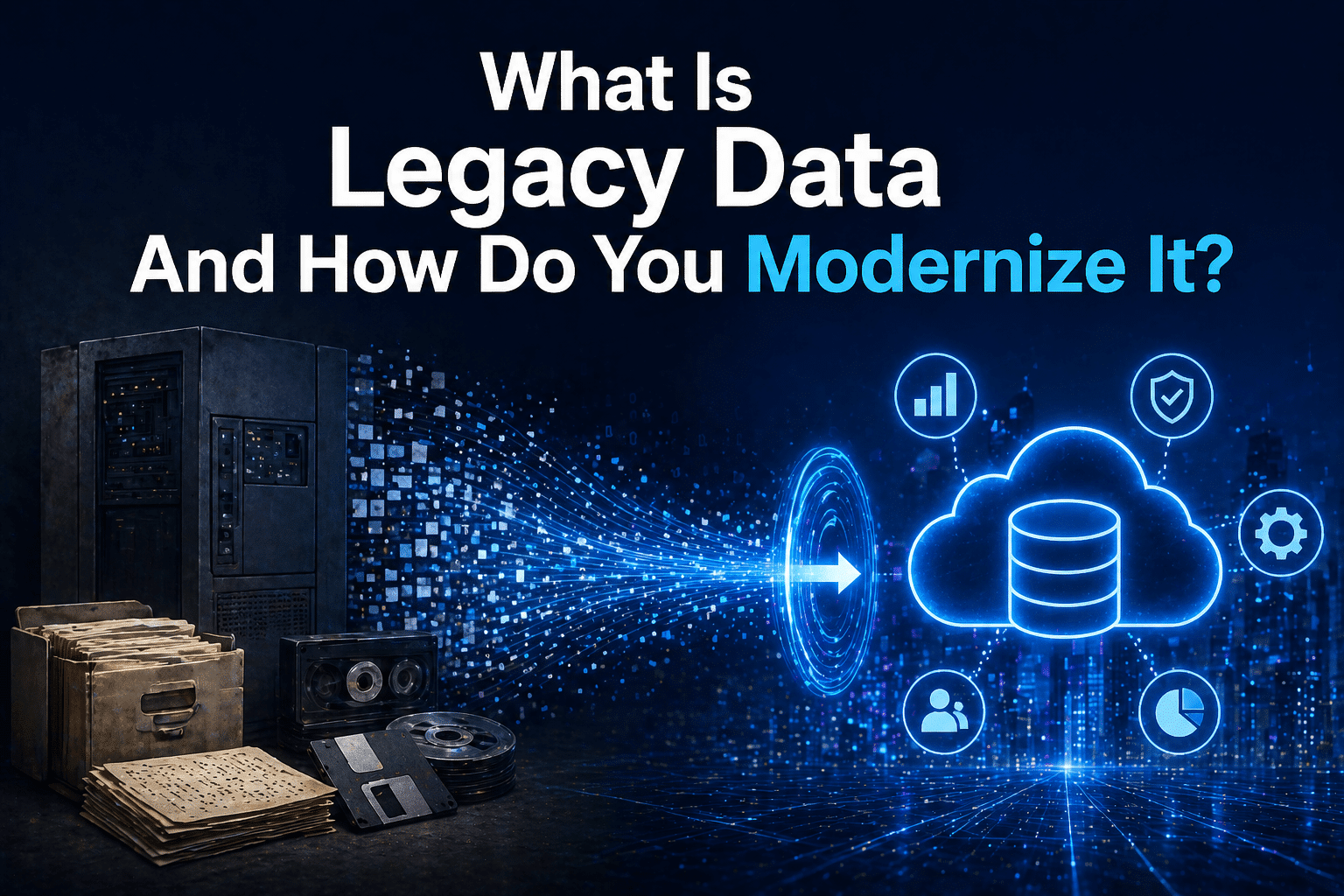
Legacy data is organizational information stored in outdated systems, formats, or databases that are difficult to access, difficult to integrate with modern tools, and difficult to protect with current security controls. It is the accumulated data of an organization’s history — transactions, records, customer information, operational data — that exists in systems that the organization has grown beyond but cannot easily leave behind.
The challenge with legacy data is not that it exists. Organizations need historical data for compliance, analytics, and operational continuity. The challenge is that legacy data systems typically cannot be managed, secured, or accessed to the standard that current tools and requirements demand.
For businesses undergoing digital modernization or application modernization, legacy data management is frequently the most complex and underestimated component of the project.
Overview
Legacy data takes several forms: data in end-of-life database platforms, data in formats no longer natively supported by current applications, data in systems whose vendors no longer provide support or security patches, and data in physical formats (paper records, tape backups) that require digitization before they can be managed at all. Each type requires different modernization approaches.
- End-of-life database platforms: data that must be migrated to supported platforms before the legacy system creates irreversible security exposure
- Proprietary formats: data that must be extracted and converted before it can be used in modern systems
- Unsupported application data: data in systems whose vendors no longer maintain the platform
- Physical legacy data: paper records and physical media that require digitization
The 5 Why’s
- Why is legacy data specifically a security risk rather than just an operational inconvenience? Because legacy data systems typically run on platforms that no longer receive security patches — end-of-life databases, end-of-life operating systems — creating persistent, unfixable vulnerabilities in the systems that hold the organization’s most sensitive historical data. Compliance requirements, customer records, and financial data in legacy systems are at higher risk than the same data in modern, supported platforms.
- Why does data migration specifically require more planning than application modernization? Because data has no equivalent of “just replace the application.” Every record in a legacy system represents actual business information — a customer, a transaction, a regulatory record — that must be accurately and completely transferred to the new system. Migration errors produce downstream data quality problems that can persist for years. Planning for data quality assessment, transformation, validation, and reconciliation is required before migration begins.
- Why does compliance specifically create legacy data management urgency? Because many compliance frameworks require data to be retained for defined periods in accessible, auditable formats. An organization whose required retention records are locked in legacy systems that are approaching end-of-life faces a compliance deadline: migrate the data before the legacy system fails or becomes irrecoverably inaccessible.
- Why is data archiving a modernization option rather than just migration? Because not all legacy data needs to be in active operational systems. Data required for compliance retention but not for operational use can be migrated to cost-effective cloud archive storage — accessible for compliance purposes, searchable when needed, not loaded into expensive operational databases. Archiving right-sizes the data infrastructure rather than loading all legacy data into new operational systems.
- Why should organizations not defer legacy data modernization until forced by a system failure? Because forced migration under time pressure — when a legacy system fails or hits an unrecoverable state — produces higher error rates, greater data loss risk, and higher cost than planned migration. Legacy systems fail unexpectedly; the data in them may be the only copy of critical historical records. Proactive migration while the legacy system is operational provides the ability to validate migrated data against the source.
How to Modernize Legacy Data
Assess and inventory: document what data exists in legacy systems, its business value, its compliance requirements, and the urgency of migration based on the legacy system’s support status and failure risk.
Classify and prioritize: not all legacy data requires the same treatment. Classify by regulatory requirement, operational use, and migration complexity. Prioritize based on risk (imminent system failure, compliance deadline) and value (operationally critical vs. archive-only).
Choose the right migration approach: active operational data migrates to current application databases. Compliance-only records may migrate to cost-effective archive storage. Some data may be retired after confirming it has no continuing requirement.
Plan for data quality: legacy data frequently has quality issues — inconsistent formats, missing fields, duplicates, encoding problems — that must be addressed during migration rather than imported into the new system.
Validate post-migration: verify that migrated data is complete, accurate, and accessible in the new system before decommissioning the legacy source.
Final Takeaway
Legacy data is historical organizational information in outdated, insecure, or inaccessible systems. Modernizing it requires assessment, classification, migration planning, data quality work, and validation — the most demanding component of many modernization projects. The cost of proactive migration is consistently lower than the cost of emergency recovery from legacy system failure.
Legacy Data Modernization Support From Mindcore Technologies
Mindcore’s IT consulting and cloud services teams support legacy data modernization — from assessment and migration planning through execution and validation — for businesses across Louisiana and the Gulf South.
Talk to Mindcore Technologies About Legacy Data Modernization

