

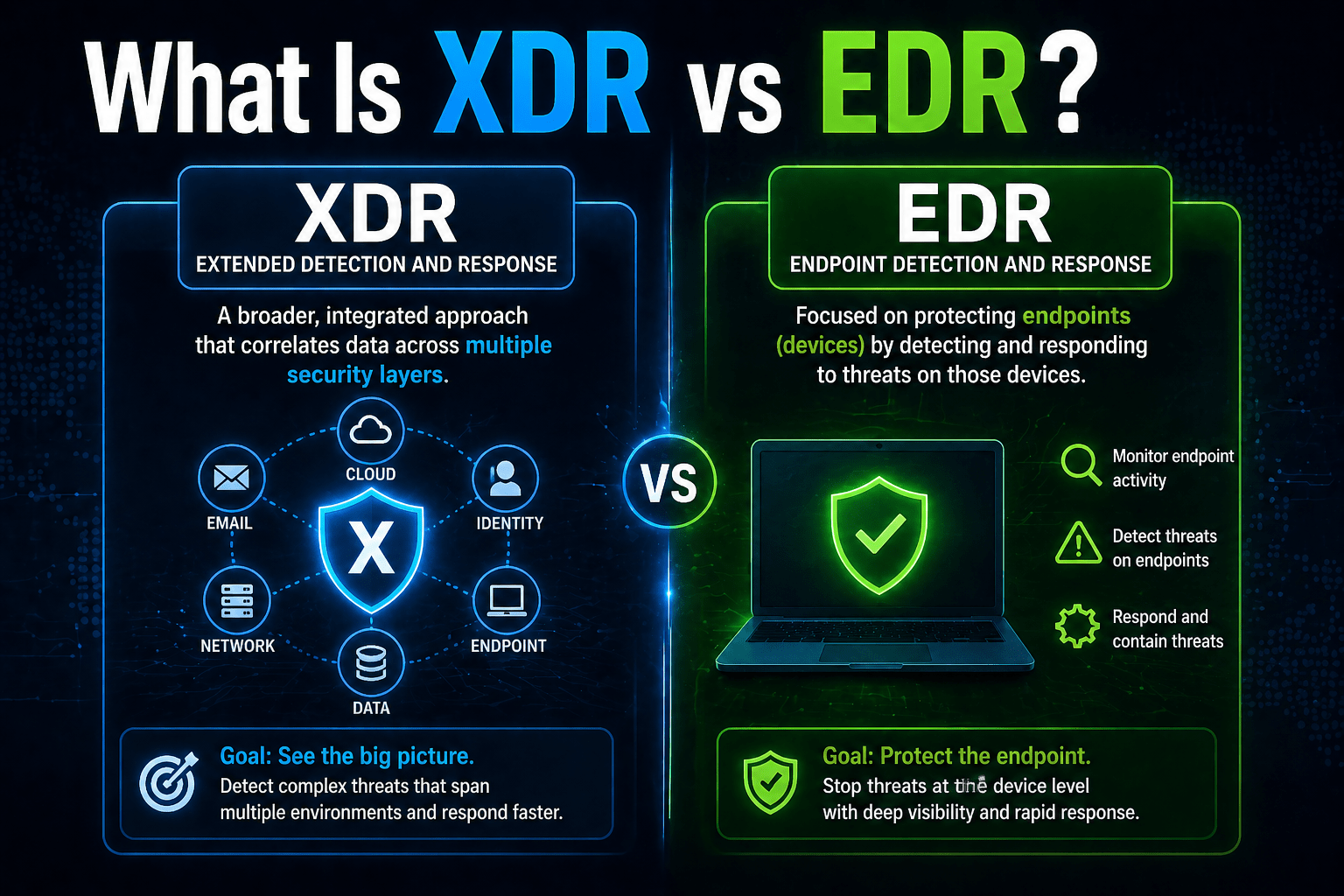
EDR (Endpoint Detection and Response) and XDR (Extended Detection and Response) are both security technologies focused on threat detection and response. The difference is scope.
EDR focuses on endpoints — laptops, desktops, and servers. It monitors endpoint behavior, detects threats on those devices, and provides response capabilities for endpoint-level incidents. It is a purpose-built, deeply capable tool for the endpoint layer of the security stack.
XDR extends that detection and response capability across multiple security layers simultaneously: endpoints, network, email, cloud platforms, identity systems, and any other data source that feeds into the XDR platform. Where EDR sees what is happening on each device, XDR correlates what is happening across the entire security environment and identifies threats that span multiple layers — the kind of multi-stage attacks that no individual tool sees in full.
For businesses building their security program with cybersecurity services support, the choice between EDR and XDR depends on the maturity and scope of the security program they are building.
Overview
EDR and XDR are complementary points on a maturity spectrum rather than competing alternatives. EDR provides deep endpoint visibility and is the current standard for endpoint protection. XDR builds on that endpoint visibility by integrating telemetry from additional security layers — network, email, cloud, identity — and correlating it to detect complex, multi-stage attacks that cross layer boundaries. XDR is the natural evolution for organizations that have deployed EDR and need to extend detection capability to the full security stack.
- EDR: deep endpoint monitoring, detection, investigation, and response
- XDR: multi-layer telemetry correlation that includes EDR as one input
- XDR detects attacks that span endpoints, email, network, and identity simultaneously
- XDR requires mature data sources across layers to deliver its value
- For most SMBs, EDR is the starting point; XDR is a maturity milestone
The 5 Why’s
- Why does extending detection across layers specifically improve security outcomes? Because sophisticated attacks are multi-stage: an initial phishing email delivers a malicious link, which installs malware on the endpoint, which uses legitimate tools to move laterally, which eventually accesses the target data through what looks like authorized access. No single security tool — email security, EDR, network monitoring, identity security — sees the full chain. XDR correlates telemetry from all of them and identifies the pattern that spans the chain.
- Why is EDR still necessary when XDR exists? Because XDR includes and extends EDR rather than replacing it. The endpoint telemetry that EDR collects is one of the most important inputs to XDR’s cross-layer correlation. An XDR platform without strong endpoint data is missing a critical detection source. EDR is not made obsolete by XDR — it is incorporated by it.
- Why do SMBs typically deploy EDR before XDR? Because XDR requires mature data sources across all the security layers it integrates. An organization that does not yet have mature email security, network monitoring, and identity logging in place gets limited value from XDR’s cross-layer correlation — the layers being correlated are not producing enough data. EDR first, matured security stack second, XDR when the integration delivers its full value.
- Why is XDR specifically better at detecting advanced persistent threats (APTs)? Because APTs are specifically designed to look normal at any single layer. An APT that takes weeks to move from initial access to data exfiltration, using legitimate tools and authorized-looking access at each step, does not produce the individual-layer alerts that simpler attacks generate. XDR’s correlation of low-confidence signals across layers identifies the pattern that each layer’s individual tooling misses.
- Why has XDR adoption grown as security stacks have matured? Because as organizations have deployed EDR, improved email security, added network monitoring, and built out identity security, they now have rich telemetry from multiple layers — but that telemetry exists in separate tools without a single platform correlating it. XDR addresses this by unifying the detection and investigation view across the full stack.
EDR vs. XDR: Direct Comparison
| Dimension | EDR | XDR |
|---|---|---|
| Data sources | Endpoints only | Endpoints + network + email + cloud + identity |
| Detection scope | Endpoint-level threats | Multi-layer attack chains |
| Best for | Endpoint threat detection and response | Full security stack threat correlation |
| Complexity | Moderate | Higher — requires data source maturity |
| Typical deployment sequence | First | After EDR and other sources are mature |
| APT detection | Limited to endpoint indicators | Strong — correlates indicators across layers |
Which Does Your Organization Need?
Deploy EDR first if: you are building or improving your endpoint security posture. EDR is the current standard for endpoint protection and the foundation that XDR builds on. If your endpoints are not covered by behavioral detection, EDR is the priority.
Add XDR when: you have mature EDR coverage, functional email security, network monitoring, and identity logging in place and want to unify detection across those layers. XDR delivers its value when the layers it integrates are producing quality telemetry.
Final Takeaway
EDR and XDR address the same fundamental need — detecting and responding to threats — at different scopes. EDR provides deep endpoint visibility. XDR extends detection across the full security stack. For most organizations, EDR is the starting point and XDR is the next maturity milestone, not an alternative choice.
EDR and XDR Services From Mindcore Technologies
Mindcore’s cybersecurity services include EDR deployment as a standard component and XDR integration for organizations ready to extend their detection capabilities across the full security stack. Our IT consulting team helps organizations understand where they are on the maturity spectrum and what the right next investment is.
Talk to Mindcore Technologies About EDR and XDR for Your Organization

