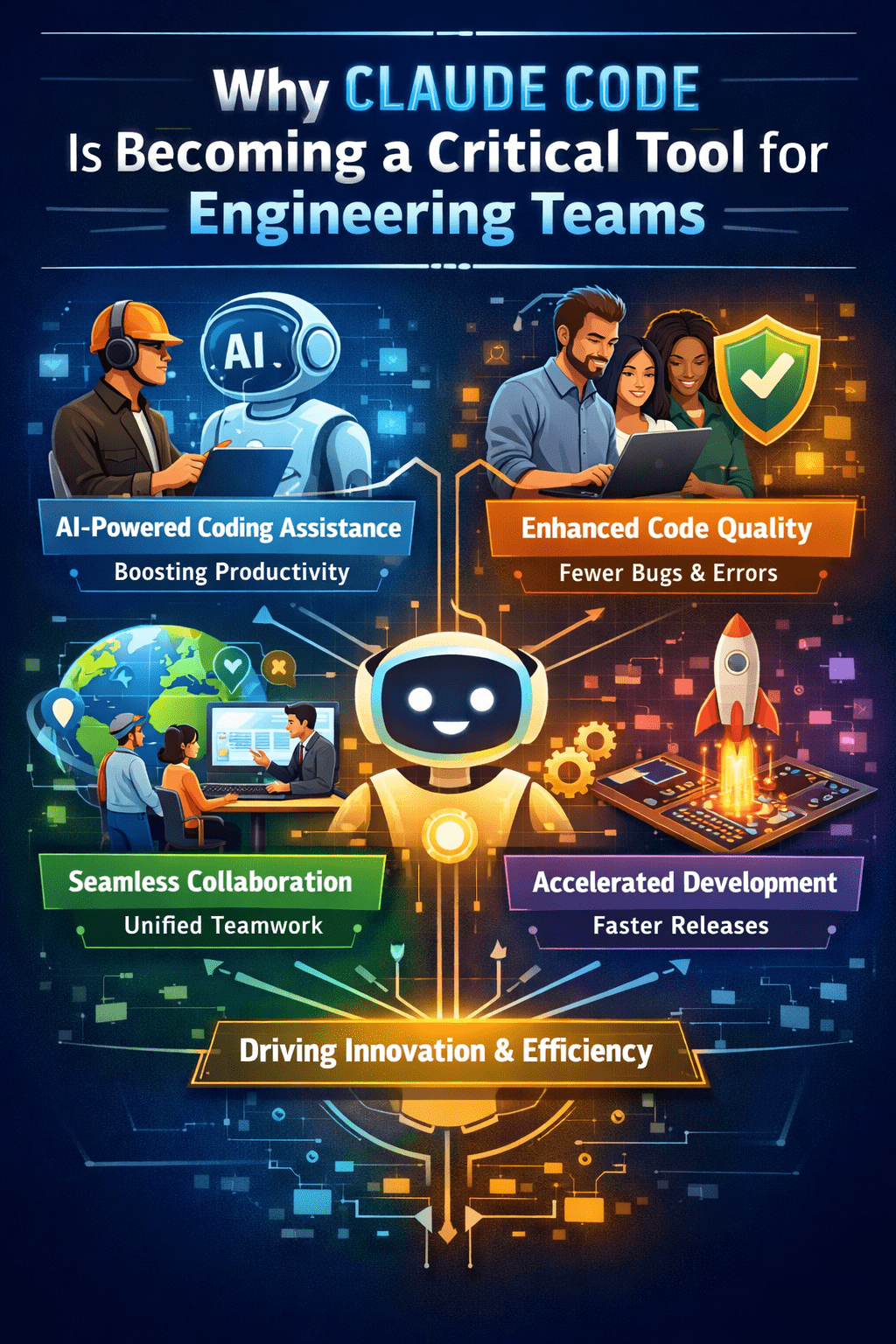
There is a point in the adoption curve of any significant engineering tool where “optional experiment” becomes “standard infrastructure.” Version control reached it. Continuous integration reached it. Cloud deployment reached it. Claude Code is approaching it faster than most engineering leaders have recognized.
The teams that adopted those tools early did not just become more productive. They established operational practices, accumulated institutional knowledge about effective usage, and set delivery expectations that teams adopting later had to work significantly harder to match. The compounding advantage of early adoption in foundational engineering tools is real and durable.
Claude Code is at that inflection point. The engineering teams deploying it now are not running experiments. They are building the operational baseline that will define what a capable engineering team looks like in three years.
Overview
Claude Code is becoming critical infrastructure for engineering teams for the same reason any tool becomes critical: it addresses a real constraint at the core of engineering operations. The constraint it addresses — implementation execution velocity, debugging efficiency, test coverage consistency, codebase onboarding speed — is not peripheral to what engineering teams do. It is central. Tools that address peripheral problems remain optional. Tools that address central ones become standard.
- The implementation execution constraint is the core engineering productivity problem Claude Code addresses
- Codebase-level context and agentic execution are capabilities that change engineering output at the team level, not just the individual level
- Early adoption produces compounding advantages in operational practice, institutional knowledge, and delivery expectations
- The alternative to governed adoption is ungoverned individual usage — which is already happening across most engineering organizations
- Engineering teams that standardize on Claude Code now are building the operational baseline that defines competitive engineering capability going forward
The 5 Why’s
- Why is “critical tool” the right classification rather than “productivity enhancement”? Critical tools are the ones an engineering team cannot operate effectively without. They address constraints that are central to delivery, not peripheral to it. Claude Code addresses implementation execution velocity, debugging efficiency, and test coverage — the stages where engineering teams spend most of their time and where delays have the most direct impact on delivery timelines.
- Why does early adoption matter for a tool in this category? The compounding advantage of early adoption in foundational engineering tools is operational, not just technological. Teams that adopt early develop usage practices, identify the highest-value applications within their specific codebase, and build delivery expectations around the tool. Teams that adopt later inherit less refined practices and face a gap in delivery velocity that is difficult to close quickly.
- Why is the adoption decision not fully under engineering leadership’s control? Individual engineers are already using AI coding assistance — officially sanctioned or not. The decision engineering leadership actually makes is not “should our team use AI coding tools” but “should our team’s AI coding tool usage be governed, standardized, and optimized or invisible and ungoverned.” That framing changes the urgency of the decision.
- Why does team-level impact distinguish Claude Code from individual productivity tools? Suggestion-based coding assistants improve individual developer speed. Claude Code’s codebase-level context and agentic execution change what the team ships collectively — how fast features move from specification to production, how consistent implementation quality is across engineers at different experience levels, and how effectively codebase knowledge distributes across the team. These are team-level outcomes, not individual ones.
- Why does onboarding speed matter as a critical-tool criterion? Engineering teams face a consistent challenge: new engineers take too long to reach full productivity on complex codebases. Claude Code’s codebase-level context provides on-demand architectural orientation — reducing the time new engineers spend waiting for a senior colleague to explain how the system fits together. For teams with significant onboarding volume or high turnover, that acceleration is a critical operational capability.
Why Engineering Teams Are Reaching That Conclusion
Implementation Velocity Is the Core Constraint
The primary constraint on most engineering team delivery is not ideas, requirements, or architectural decisions. It is implementation velocity — the speed at which defined work moves through the write-test-debug-iterate cycle and reaches a production-ready state.
That cycle has not changed structurally in decades. Better languages, better frameworks, and better tooling have made each stage faster at the margin. Claude Code changes the structure — taking over the execution stages of the cycle while the engineer operates at the review and guidance layer. The constraint that has defined engineering delivery timelines is not just accelerated. It is addressed at the structural level for the first time.
Codebase Knowledge as a Team Asset
Every engineering team carries a knowledge distribution problem. Senior engineers understand the architecture deeply. Junior engineers are learning it. New engineers are disoriented by it. That distribution creates a dependency on senior engineer time for every task that requires codebase context — which, on complex systems, is almost every task.
Claude Code distributes codebase knowledge on demand. Any engineer, at any experience level, can access architectural context, understand how existing systems fit together, and produce implementations that are consistent with established patterns — without waiting for a senior engineer to be available. The knowledge is no longer locked in individual experience. It is accessible through the agent.
Test Coverage as a Team-Level Capability
Test coverage is consistently one of the most expensive capabilities to maintain across an engineering team. It requires discipline, time, and consistent prioritization that deadline pressure regularly erodes. The result is a coverage debt that accumulates over time and surfaces as production failures, slow debugging cycles, and refactoring risk.
Claude Code generates tests as part of the implementation cycle, derived from actual code behavior, without requiring separate developer time. Test coverage becomes a default output of the implementation process rather than a discipline that competes with delivery speed. That change matters at the team level because coverage quality no longer depends on individual engineer discipline under pressure.
Onboarding Acceleration as an Operational Requirement
For engineering teams in growth mode, the speed at which new engineers reach full productivity is an operational constraint that compounds with every hire. Slow onboarding means senior engineer time is consumed in orientation, production contributions are delayed, and the team’s effective capacity does not scale proportionally with headcount.
Claude Code provides on-demand codebase orientation — explaining how systems fit together, identifying relevant abstractions, and surfacing the context a new engineer needs to contribute effectively. Onboarding accelerates because the dependency on senior engineer availability for codebase orientation is reduced. New engineers contribute faster. Senior engineers stay at the work that requires their experience.
What Makes Claude Code Critical Rather Than Optional
- Addresses the core delivery constraint — implementation execution velocity is central to engineering output, not peripheral to it
- Produces team-level outcomes — codebase knowledge distribution, coverage consistency, and onboarding acceleration are team capabilities, not individual productivity bumps
- Changes the delivery baseline — teams operating with Claude Code establish delivery expectations that teams without it cannot match with the same headcount
- Governs what is already happening — individual AI coding tool usage is already occurring; standardization on Claude Code makes that usage visible, consistent, and optimizable
- Compounds with adoption depth — teams that develop effective usage practices, integrate Claude Code into review workflows, and build deployment knowledge over time pull further ahead of later adopters
A Simple Critical Infrastructure Assessment
Claude Code has crossed into critical infrastructure territory for your engineering team if:
- Implementation execution speed is the primary constraint on feature delivery timelines
- Codebase knowledge distribution creates a consistent dependency on senior engineer time for implementation guidance
- Test coverage quality varies across the team and degrades under deadline pressure
- New engineer onboarding to complex codebases takes longer than the team can sustain without senior engineer involvement
- AI coding tools are already in use by individual engineers without organizational governance or standardization
If three or more of these conditions are true, the tool is already critical. The question is whether its usage is governed.
Final Takeaway
Critical engineering tools do not stay optional for long. The teams that recognized version control, CI/CD, and cloud infrastructure as critical early built operational advantages that compounded over years. The teams that adopted late did not just fall behind on tooling. They fell behind on the delivery velocity, institutional practices, and team capabilities that those tools enabled.
Claude Code is at the same inflection point. It addresses the implementation execution constraint that sits at the center of engineering delivery. It produces team-level outcomes — knowledge distribution, coverage consistency, onboarding acceleration — that compound over time. And the adoption decision is not fully optional, because individual usage is already occurring across most engineering organizations regardless of official position.
The question is not whether Claude Code becomes critical infrastructure for engineering teams. It already is for the teams operating at the highest delivery velocity. The question is when your team joins them — and what operational advantage the delay costs.
Make Claude Code Critical Infrastructure With Mindcore Technologies
Mindcore Technologies helps engineering teams move from individual AI coding experimentation to standardized, governed Claude Code deployment — building the operational practices, review workflows, and usage optimization that produce team-level velocity gains and compound over time.
Talk to Mindcore Technologies About Making Claude Code Core to Your Engineering Operations →
Contact our team to assess where your current engineering delivery is