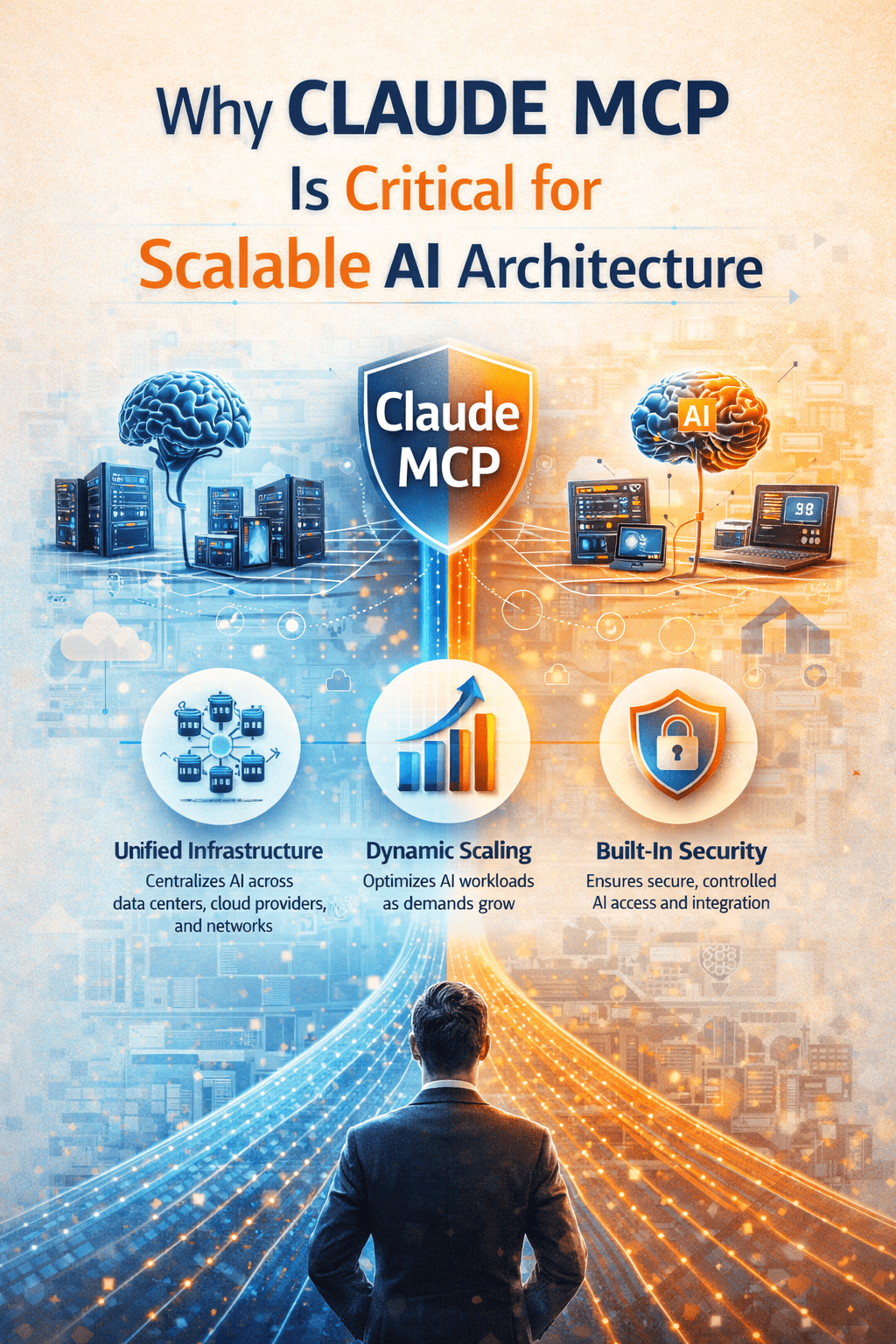
Every enterprise AI architecture reaches a scaling decision point. The early deployments — individual tools, isolated capabilities, productivity enhancements for specific teams — are working. The question becomes how to scale from those early deployments to an AI architecture that operates across the full enterprise, connected to live systems, executing workflows autonomously, and producing compounding operational value.
That scaling decision has a prerequisite: a connectivity layer that can reach every relevant system without requiring custom development for each connection, that operates within existing security frameworks, and that provides the protocol standard that AI-to-system communication requires at enterprise scale.
Claude MCP is that layer. It is not a feature of the AI architecture. It is the foundation it scales on.
Overview
Scalable AI architecture requires more than powerful AI models. It requires the infrastructure that connects those models to the systems where business data lives and where business actions are executed. Without that connectivity layer, AI scales at the model level — better reasoning, faster outputs, broader capability — but does not scale at the operational level, because the fundamental constraint is not reasoning quality but system reach. Claude MCP is the connectivity infrastructure that removes that constraint.
- Scalable AI architecture requires a connectivity layer — MCP is that layer
- The protocol model scales across the enterprise system landscape; custom API development does not
- MCP is foundational — every AI capability that requires live system data or system action execution builds on it
- Without MCP, AI architecture scales in capability but not in operational reach
- Organizations building AI architecture on MCP now are building the foundation that subsequent AI capabilities extend, rather than rebuilding connectivity for each new capability
The 5 Why’s
- Why is connectivity infrastructure the scaling constraint for enterprise AI, not model capability? Model capability has advanced significantly and continues to advance. The operational constraint in most enterprises is not that AI reasons insufficiently well. It is that AI cannot reach the live data and systems it needs to reason usefully about real business operations. Connectivity is the scaling bottleneck — and MCP addresses it.
- Why does the custom API development model fail to scale enterprise AI connectivity? Custom APIs are point-to-point. Each new system connection requires a new development project. As enterprise AI architecture expands to address more workflows and more systems, the custom API model multiplies development and maintenance cost proportionally. That scaling curve makes comprehensive enterprise AI connectivity economically impractical through custom APIs alone.
- Why is a protocol standard — not just better integrations — the right foundation for scalable AI architecture? A protocol standard defines the interface once. Any system that implements the protocol becomes accessible through the same interface. The marginal cost of adding new system connections after protocol adoption is configuration, not development. That is the scaling economics that enterprise AI architecture requires.
- Why does building on MCP now produce architectural advantages over building on proprietary integrations? Architectures built on proprietary integrations accumulate lock-in, maintenance debt, and connectivity gaps as the AI system landscape evolves. Architectures built on MCP maintain flexibility — any MCP-compatible AI capability can leverage the existing connectivity infrastructure, and any MCP-implementing system is immediately accessible. The standard is durable; proprietary integrations are not.
- Why does MCP become more valuable as the enterprise AI architecture expands? Each new AI capability that requires live system data or system action execution builds on the MCP connectivity layer. The connectivity infrastructure does not need to be rebuilt for each new capability — it is already there. The value of the MCP investment compounds with every new AI capability that leverages it.
What Scalable AI Architecture Built on MCP Looks Like
Foundation Layer: MCP Connectivity Infrastructure
The foundation of the scalable AI architecture is the MCP connectivity layer — the collection of implemented MCP servers across enterprise systems that make live data access and action execution available to Claude across the system landscape.
This layer is built progressively, starting with the highest-value systems and expanding to cover the full enterprise infrastructure. Each new system added to the MCP connectivity layer extends the reach of every AI capability built on top of it — without additional connectivity work for each individual capability.
Operational Layer: AI Capabilities Built on Live Connectivity
The operational layer is where AI capabilities — Skills, workflows, automation sequences, and interactive AI tools — operate using the live data and action execution that the MCP connectivity layer provides.
Because the connectivity infrastructure is in place, each new operational AI capability can reach the systems it needs without custom connectivity work. The architectural investment is in the capability, not in rebuilding the connectivity it requires.
Intelligence Layer: Cross-System AI Intelligence
The intelligence layer operates on the aggregated data and workflow outputs that accumulate through the operational layer — producing insights, identifying patterns, generating strategic recommendations, and synthesizing intelligence from across the connected enterprise system landscape.
This layer is only possible because the MCP connectivity infrastructure provides access to live, current data from the full system landscape. Without MCP, intelligence generation at this layer requires manual data aggregation that is too expensive and too slow to be operationally useful.
Why MCP Is Becoming Critical Infrastructure, Not Just a Feature
The indicators that a technology component has become critical infrastructure are consistent: the architectural decisions of other components depend on it, its absence creates gaps that other components cannot fill, and removing it from the architecture would require significant reconstruction of what built on top of it.
MCP is approaching that status in enterprise AI architecture:
- AI capabilities depend on it — Skills, workflows, and interactive AI tools that require live system data depend on the MCP connectivity layer for that access
- Its absence creates gaps — enterprise AI without MCP cannot address the class of workflows that require live system connectivity; those gaps do not close without the connectivity layer
- Building without it creates technical debt — AI architectures built with proprietary integrations rather than MCP accumulate the technical debt of those integrations as the AI system landscape evolves around the standard
Organizations that treat MCP as optional infrastructure are making the same mistake that organizations made in the early days of API standardization — discovering later that the proprietary approach was more expensive to maintain and more limiting to evolve than the standard would have been.
What Scalable AI Architecture Requires From MCP
- Comprehensive system coverage — the MCP connectivity layer needs to reach the full set of systems that enterprise AI capabilities need to access, not just the handful of systems that early deployment prioritized
- Consistent access policies — data access and action execution policies need to be defined and enforced consistently across all MCP-connected systems, not defined independently for each connection
- Protocol governance — the MCP infrastructure needs to be managed as enterprise infrastructure — with version management, health monitoring, and update processes — not as a collection of independent integration projects
- Extensibility design — the connectivity architecture needs to be designed for extension from the start — new system connections should follow established patterns and integrate cleanly with the existing MCP infrastructure
A Simple Scalable AI Architecture Assessment
Your enterprise AI architecture has a critical MCP gap if:
- AI capabilities that would require live system data or action execution cannot be deployed because connectivity is not in place
- Each new AI capability that requires system connectivity requires a new custom integration project
- The AI architecture has scaled in model capability but not in operational reach across the enterprise system landscape
- Proprietary integrations are accumulating technical debt as the enterprise AI and system landscapes evolve
- Leadership is making AI architecture decisions without accounting for the connectivity layer those decisions depend on
Final Takeaway
Scalable AI architecture is not built by deploying better models in isolation. It is built by providing the connectivity infrastructure that connects AI capability to the live systems and real data that make that capability operationally valuable at enterprise scale.
Claude MCP is the connectivity infrastructure that scalable AI architecture requires — a standardized protocol that extends the enterprise system landscape to Claude without custom development per connection, operates within existing security frameworks, and compounds in value as the AI architecture expands on top of it. The organizations building their AI architecture on MCP now are not just deploying a useful integration tool. They are building the foundation that every subsequent AI capability in their architecture will scale on.
Build Your Scalable AI Architecture With Mindcore Technologies
Mindcore Technologies works with enterprise teams to design the MCP connectivity infrastructure that scalable AI architecture requires — from system coverage planning and MCP implementation through governance frameworks, access policy design, and the architectural standards that ensure every AI capability built on the foundation compounds in value rather than complexity.
Talk to Mindcore Technologies About Building Scalable AI Architecture →
Contact our team to assess your current AI architecture’s connectivity gaps and design the MCP infrastructure that makes it scalable.