

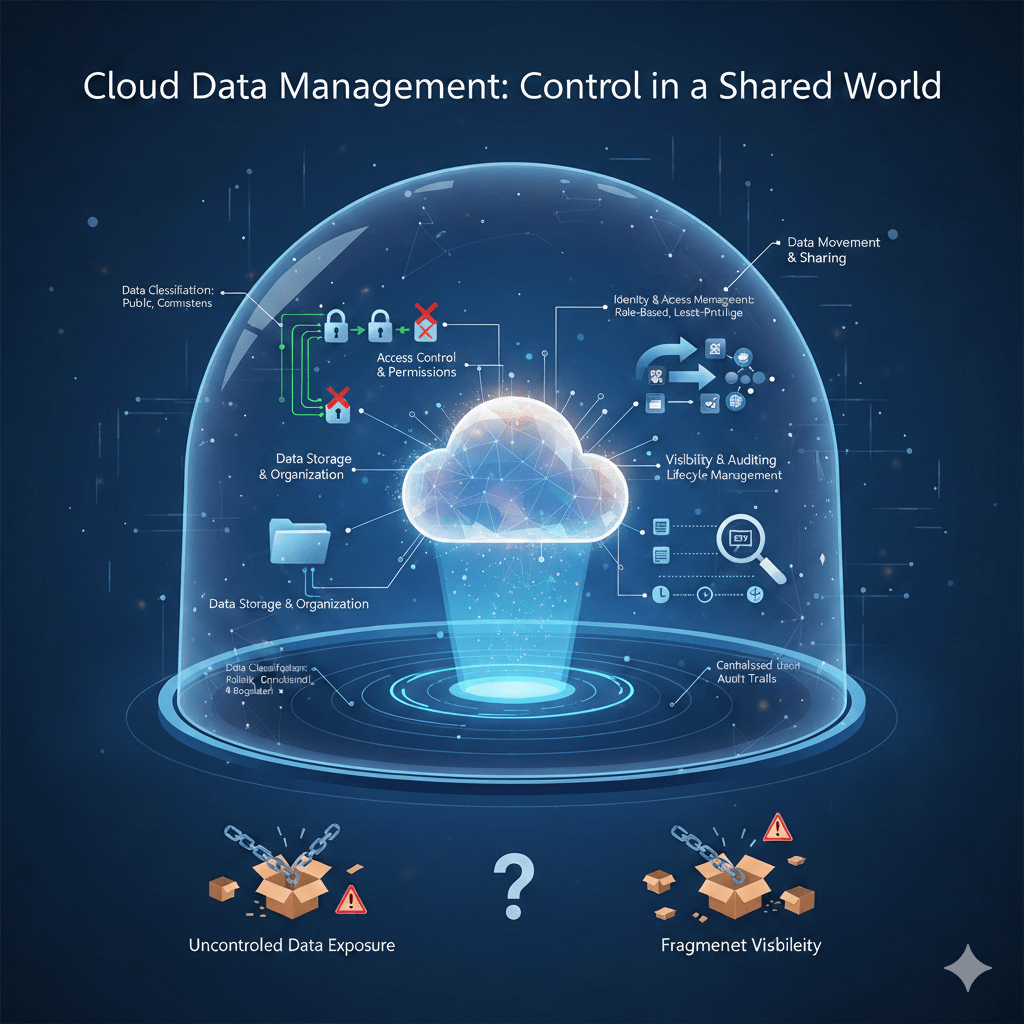
Understanding Data Management for the Cloud means knowing how data is controlled, accessed, governed, and protected across cloud platforms, not just where it is stored.
Most organizations think they have a cloud data problem. What they actually have is an access and visibility problem.
At Mindcore Technologies, cloud assessments repeatedly show the same pattern. Data exists across SaaS platforms, cloud storage, analytics tools, and integrations, but no one can confidently answer who can access what, for how long, and under what conditions.
That gap is what cloud data management is meant to close.
What Cloud Data Management Really Covers
Businesses exploring Data Management for the Cloud should recognize it as a discipline covering storage, access control, data movement, visibility, auditing, and lifecycle management.
It includes:
- Data storage and organization
How data is stored across cloud platforms, repositories, and regions, and how it is structured for use. - Access control and permissions
Who can access specific data sets, applications, and services, and what actions they are allowed to perform. - Data movement and sharing
How data is copied, synced, exported, integrated, and shared internally or externally. - Visibility and auditing
The ability to see how data is accessed and used across platforms. - Lifecycle management
How data is retained, archived, or deleted over time.
Cloud data management exists to prevent data from becoming uncontrolled simply because it is distributed.
Why Cloud Data Management Became Critical
Cloud adoption changed how data behaves.
It became critical because:
- Data no longer lives in one system
Files, records, and datasets span SaaS apps, cloud storage, collaboration tools, and third-party services. - Users authenticate directly to applications
Network-based controls no longer govern access in most cloud environments. - Sharing is frictionless by default
Cloud platforms are designed for collaboration, not containment. - Permissions accumulate over time
Access is granted quickly but rarely reviewed or revoked.
Without deliberate management, cloud data exposure grows silently.
The Biggest Cloud Data Management Mistake
The most common mistake organizations make is treating cloud data management as a storage problem.
In reality, the biggest risks come from:
- Excessive access
Users can see or manipulate data they do not need. - Uncontrolled data movement
Sensitive data is copied, exported, or synced without oversight. - Fragmented visibility
Logs exist in multiple platforms but are never correlated. - Policy without enforcement
Rules exist, but nothing technically prevents violations.
This is why breaches often involve legitimate access.
Core Components of Effective Cloud Data Management
Strong cloud data management requires alignment across several areas.
Data Classification
Organizations must:
- Define sensitivity levels clearly
For example: public, internal, confidential, regulated. - Apply classification consistently
Across SaaS platforms, cloud storage, analytics, and backups. - Align controls with sensitivity
Higher-risk data requires tighter access and monitoring.
Classification determines how data should be treated.
Identity and Access Management
Cloud data is accessed through identity.
Effective management requires:
- In Data Management for the Cloud, role-based access aligned to job functions ensures permissions reflect real responsibilities and prevent overexposure.
- Least-privilege access by default
Users receive only what they need to perform their role. - Regular access reviews
Especially for sensitive or regulated data. - Automated deprovisioning
Access is removed immediately when roles change.
Identity control is the backbone of cloud data management.
Data Movement Control
Data governance fails most often when data moves.
Organizations must manage:
- Downloads to endpoints
Sensitive data should not freely leave controlled environments. - External sharing
Third-party access must be deliberate and auditable. - Integrations and APIs
Service accounts often have more access than users. - Bulk exports and sync operations
Large transfers should be visible and justified.
Data that moves without oversight becomes exposed data.
Visibility and Auditability
Effective Data Management for the Cloud requires visibility and auditability, so organizations can see how data is accessed and used across all platforms.
Effective cloud data management includes:
- Centralized logging of access and activity
Not just login events, but data usage. - Correlation across platforms
SaaS and cloud service logs must tell a unified story. - Clear audit trails
Who accessed what data, when, and for what purpose.
Visibility turns governance into enforcement.
How Secure Workspaces Improve Cloud Data Management
Secure workspace models strengthen cloud data management by design.
They help by:
- Containing sensitive data inside controlled environments
Data does not sprawl across unmanaged endpoints. - Delivering application-level access
Users interact with data through approved applications only. - Reducing reliance on endpoint security
Devices become access points, not data stores. - Providing session-level visibility
Access is tracked at the session level, not just the account level.
This reduces both accidental exposure and breach impact.
Cloud Data Management and Compliance
Regulatory frameworks expect control, not just policy.
Strong cloud data management supports compliance by:
- Enforcing minimum necessary access
Users only see what their role requires. - Providing consistent audit evidence
Logs are centralized and reliable. - Reducing uncontrolled data duplication
Sensitive data stays in approved environments. - Supporting retention and deletion requirements
Data lifecycle rules are enforced automatically.
Compliance becomes an outcome, not a scramble.
How Mindcore Technologies Approaches Cloud Data Management
Mindcore helps organizations operationalize cloud data management by:
- Mapping where data lives and how it moves
Governance reflects real-world usage. - Defining ownership, classification, and access models
Accountability is clear and enforceable. - Implementing identity-driven access controls
Least privilege is applied consistently. - Reducing data exposure through secure workspace architectures
Sensitive data stays contained. - Centralizing visibility and audit readiness
Security and compliance teams gain a single source of truth.
The focus is sustainable control without slowing the business.
A Simple Cloud Data Management Reality Check
Your cloud data management is weak if:
- You cannot quickly list who can access sensitive data
- Access reviews are infrequent or manual
- Users can freely download or share regulated data
- Logs exist but are fragmented
- Governance relies on policy reminders
These are architectural gaps, not training failures.
Final Takeaway
Data Management for the Cloud is not merely about storage—it is the discipline of controlling access, movement, and visibility of data in environments optimized for speed, sharing, and security.
Organizations that succeed design data control into their cloud architecture. Those that do not discover their weaknesses only after exposure has already occurred.
Frequently Asked Questions
What is cloud data management?
Cloud data management is the process of organizing, storing, securing, accessing, and governing data across cloud environments to support operational efficiency, scalability, and business continuity.
Why is cloud data management important for businesses?
Cloud data management helps businesses maintain data accessibility, improve operational visibility, strengthen security, support compliance requirements, and scale infrastructure efficiently as data volumes grow. Organizations using cloud infrastructure services can better control data movement and operational governance.
How does cloud data management improve cybersecurity?
Cloud data management improves cybersecurity through encryption, identity governance, backup strategies, access controls, monitoring, and secure data lifecycle management across cloud environments. Businesses implementing strong cybersecurity controls reduce unauthorized access and cloud exposure risks.
What are common challenges in cloud data management?
Common challenges include data sprawl, inconsistent governance, misconfigured cloud environments, compliance complexity, visibility gaps, integration issues, and managing access across distributed systems. Organizations without centralized governance often struggle to maintain operational visibility and control.
Why is data governance important in cloud environments?
Data governance helps organizations control data access, maintain compliance, improve data integrity, reduce operational risk, and ensure sensitive information is managed consistently across systems. Businesses implementing Zero Trust security frameworks strengthen identity governance and access control across cloud platforms.
Cloud Data Management and Infrastructure Strategy Expertise from Matt Rosenthal
Matt Rosenthal, CEO of Mindcore Technologies, has extensive experience helping organizations strengthen cloud infrastructure, cybersecurity resilience, and operational continuity through scalable data management strategies. His expertise in cloud architecture, identity governance, data protection, infrastructure scalability, compliance readiness, threat monitoring, and operational risk management helps businesses improve visibility into cloud operations while reducing cybersecurity exposure. Matt’s leadership focuses on building proactive cloud frameworks that strengthen infrastructure resilience, improve operational efficiency, reduce enterprise risk, and support long-term digital transformation initiatives.

