

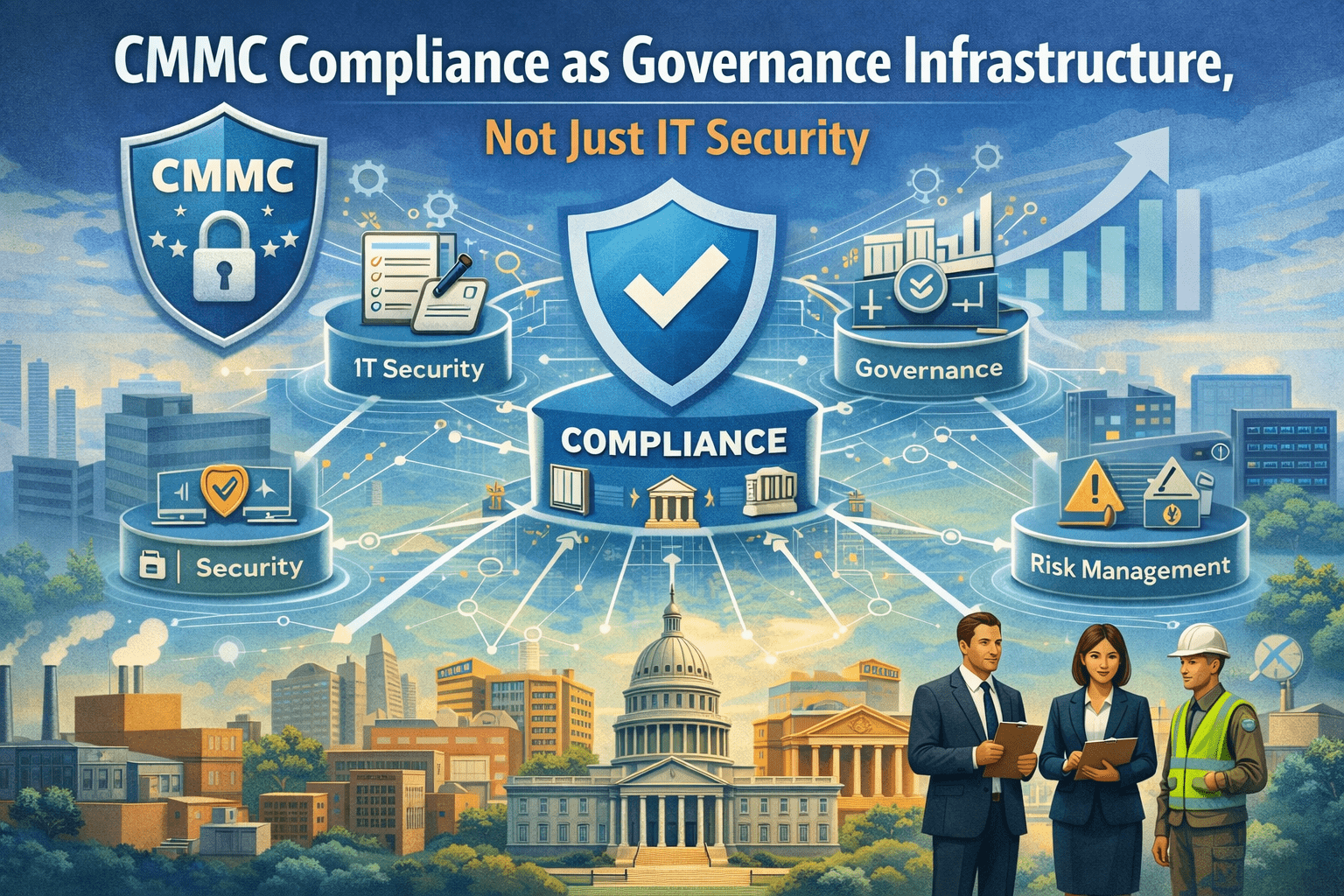
When CMMC compliance lives in the IT department, it produces a security program that protects the systems IT controls and leaves the compliance gaps that exist outside IT’s operational reach unaddressed. Procurement staff who receive CUI in email attachments and store it on personal drives. Legal teams that share contract documents through consumer file sharing tools. Finance staff who process DoD invoices on systems that are not in the CMMC system boundary. Business development teams that accumulate CUI in proposal files on laptops that are never enrolled in the organization’s endpoint management program.
These are not IT failures. They are governance failures — the result of treating CMMC as an IT security initiative rather than as the organizational compliance obligation it actually is.
CMMC compliance as governance infrastructure means that every function that touches CUI operates under defined procedures, has received role-appropriate training, understands their compliance responsibilities, and is accountable to an organizational governance structure that monitors compliance as an ongoing operational condition — not just as an IT security configuration.
Overview
CMMC compliance governance requires organizational structures, leadership accountability, cross-functional ownership, and business process integration that IT security programs alone do not produce. The 110 practices in CMMC Level 2 span domains that affect procurement, legal, HR, finance, operations, and business development — not just IT. A governance infrastructure that assigns CMMC compliance responsibility to those functions, establishes accountability at the leadership level, and integrates compliance requirements into business processes produces compliant operations. One that assigns it to IT and expects IT to control behavior it does not manage produces documented policies and undocumented workarounds.
- Leadership accountability for CMMC compliance must exist at the C-suite or senior leadership level — not delegated entirely to IT
- Cross-functional ownership assigns specific CMMC domain responsibilities to the functions best positioned to enforce them
- Business process integration embeds compliance requirements into workflows — not alongside them as separate compliance steps
- Training that reflects actual role-specific compliance responsibilities produces staff behavior that assessors verify as operational practice
- Governance monitoring ensures compliance is maintained continuously — not verified periodically during IT security reviews
The 5 Why’s
- Why does IT-only CMMC compliance produce systemic gaps despite technically sound security implementations? IT controls the systems it manages. It does not control the behavior of staff who handle CUI outside those systems, the business processes that determine how CUI flows through the organization, or the decisions that create new CUI handling situations without IT involvement. CMMC compliance that does not govern behavior and process outside IT’s managed environment leaves those gaps in the compliance program regardless of technical control quality.
- Why does CMMC compliance require C-suite accountability rather than IT ownership? CMMC compliance decisions affect contract eligibility, which is a business decision with revenue and strategic implications. CMMC incidents trigger reporting obligations to DoD contracting officers, which is a leadership-level obligation. CMMC POAMs require resource allocation for remediation, which requires budget authority. These are not IT-level decisions. Delegating them entirely to IT produces a compliance program without the organizational authority to enforce the decisions that make it work.
- Why does business process integration produce more durable compliance than policy documentation? A policy that says “CUI must be stored in approved systems” does not change behavior if the workflow that generates CUI doesn’t route it to approved systems. Business process integration embeds the approved system as the default step in the workflow — staff follow the compliant process because it is the process, not because they remember the policy. Behavior-changing compliance comes from process change, not policy issuance.
- Why is role-specific CMMC training more effective than general security awareness training for compliance purposes? General security awareness training produces awareness. Role-specific CMMC training produces behavior change — because it tells each staff member exactly what CMMC compliance means for the specific tasks they perform. Procurement staff who understand their CUI handling obligations for vendor data are more compliant than procurement staff who know CMMC exists but do not connect it to their work.
- Why do CMMC assessors look beyond IT systems for compliance evidence? C3PAO assessors are evaluating whether 110 practices are actually implemented across the organization — not whether IT has implemented technical controls correctly. They interview operational staff, review business process documentation, examine training records for non-IT functions, and look for evidence that CMMC compliance is an organizational condition rather than an IT security configuration. Organizations that have governance structures to support those inquiries pass. Those that have only technical implementations struggle with questions about governance that their IT team cannot answer on behalf of the business.
Building CMMC as Governance Infrastructure
Leadership Accountability Structure
- Executive CMMC owner — a senior leader with accountability for the organization’s CMMC compliance status, contract eligibility implications, and incident reporting obligations
- CMMC steering committee — cross-functional leadership body that reviews CMMC compliance status, approves resource allocation for remediation, and makes risk acceptance decisions
- CMMC compliance officer or program manager — operational owner responsible for coordinating compliance across functions, managing the POAM, and preparing assessment evidence
Cross-Functional Ownership Model
Assign CMMC domain ownership to the functions best positioned to enforce them:
- IT — AC, AU, CM, IA, SC, SI technical implementations; system-level compliance
- HR — AT domain (security awareness and training); personnel security practices; onboarding and offboarding CUI access procedures
- Legal/Contracts — MA domain for third-party CUI handling; contract clause flow-down compliance; incident notification obligations
- Operations — MP domain for physical CUI media handling; facility security for CUI areas; visitor access procedures
- Finance — CUI handling in financial workflows; DoD invoice processing compliance
Business Process Integration
For each business process that involves CUI handling, document and enforce:
- Where CUI enters the process (what triggers CUI classification)
- What approved systems and methods are used for CUI at each process step
- What personnel have authorized access at each step
- What happens to CUI when the process is complete (archival, disposal, transfer)
Governance Monitoring
- Monthly cross-functional CMMC compliance status review — not IT security review
- Quarterly business process compliance audit — verifying that CUI-handling processes are being followed as documented
- Annual governance structure review — assessing whether ownership assignments remain appropriate as the business evolves
What Governance Infrastructure Produces at Assessment
C3PAO assessors reviewing an organization with CMMC governance infrastructure encounter:
- Leadership who can speak to CMMC compliance status, recent POAM activity, and incident response obligations — not IT staff who can answer on leadership’s behalf
- Cross-functional staff in procurement, HR, legal, and operations who can describe their CUI handling responsibilities and demonstrate compliance with them
- Business process documentation that shows CUI handling is governed at the workflow level, not just at the system configuration level
- Training records that show role-specific CMMC training for functions beyond IT
Final Takeaway
CMMC compliance as governance infrastructure is not a more demanding version of IT security compliance. It is a different organizational design — one that assigns compliance responsibility to the functions that can enforce it, builds compliance requirements into business processes rather than alongside them, establishes leadership accountability for the business consequences of compliance status, and monitors compliance continuously as an organizational condition.
Organizations that build that governance infrastructure produce CMMC compliance that withstands C3PAO assessment because it reflects how the organization actually operates — not how the IT department is configured.
Build CMMC Governance Infrastructure With Mindcore Technologies
Mindcore Technologies works with DIB contractors to design and implement CMMC compliance as organizational governance infrastructure — leadership accountability structures, cross-functional ownership models, business process integration, role-specific training programs, and governance monitoring practices that make CMMC compliance an organizational condition rather than an IT project.
Talk to Mindcore Technologies About CMMC Governance Infrastructure →
Contact our team to assess your current CMMC governance structure and build the organizational framework that makes your compliance program defensible at every level.

