

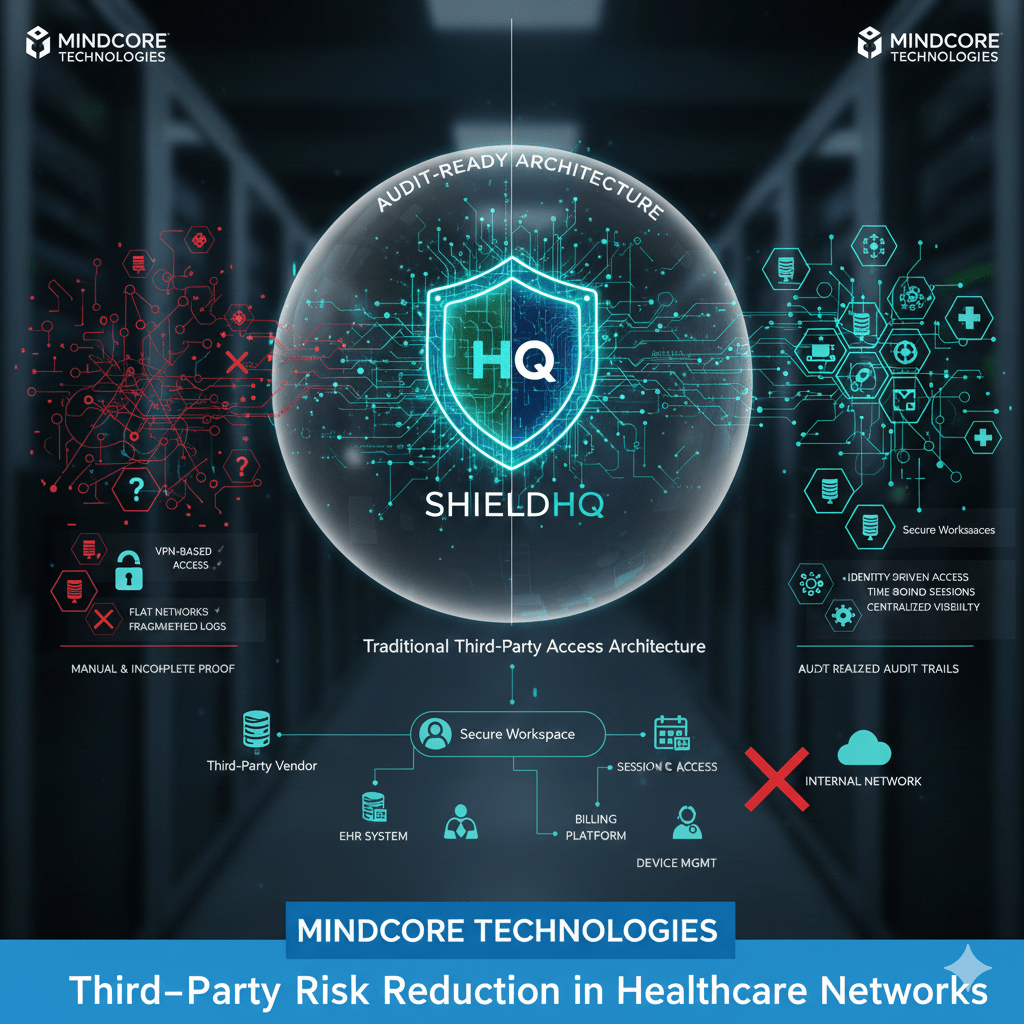
Most healthcare breaches do not originate from internal staff, which is why Managed IT Services for Healthcare prioritize Third Party Risk management in Healthcare and external exposure paths such as vendors, third parties, and connected systems. They originate from trusted third parties with excessive, persistent access. Vendors, billing partners, Managed IT Services for Healthcare teams, and device manufacturers often have more network visibility than necessary, creating critical third-party risk.
Third Party Risk management in Healthcare is not simply a vendor problem. It is a challenge Managed IT Services for Healthcare must address through proper access architecture.
At Mindcore Technologies, our Managed IT Services for Healthcare reviews consistently show that third-party access paths are one of the fastest ways attackers bypass perimeter defenses and move laterally into PHI systems.
What Third-Party Risk Really Means in Healthcare
Third Party Risk management in Healthcare in the context of Risk Reduction in Healthcare describes any situation where external users can access internal systems, highlighting why Managed IT Services for Healthcare must focus on reducing exposure and maintaining visibility.
This includes:
- IT vendors with VPN access
Broad network access granted for convenience, not necessity. - Medical device manufacturers and support teams
Persistent access to device networks and management interfaces. - Billing, coding, and revenue cycle partners
Access to PHI systems beyond scoped workflows. - Cloud and SaaS administrators
Elevated permissions with limited oversight.
The risk is rarely malicious intent. It is unbounded trust.
Why Healthcare Third Party Risk management in Healthcare Is So High
Healthcare environments amplify third-party risk because:
- Operations depend heavily on vendors
Clinical, administrative, and technical workflows rely on outside support. - Access is granted once and rarely reviewed
Temporary needs turn into permanent permissions. - VPN-based access extends full network trust
Vendors see more than they should. - Audit oversight focuses on contracts, not access paths
Compliance reviews often miss technical exposure.
This creates invisible risk that grows over time.
How Attackers Exploit Third-Party Access
Attackers target Third Party Risk management in Healthcare because they are efficient entry points.
Common exploitation paths include:
- Credential theft from vendor accounts
Phishing and infostealers target external users with elevated access. - Session hijacking of VPN connections
Persistent sessions are abused quietly. - Pivoting through trusted vendor networks
Third-party access bypasses many internal controls. - Lateral movement into EHR and file systems
Vendors often sit close to sensitive systems.
Once inside, attackers inherit vendor trust automatically.
Why Traditional Third-Party Controls Fail
Many organizations rely on paperwork instead of architecture.
Common failures include:
- Vendor risk questionnaires without enforcement
Policies do not restrict real access paths. - Flat or loosely segmented networks
Once connected, vendors can move freely. - Shared or generic vendor accounts
Accountability is lost. - Monitoring without containment
Alerts trigger after damage occurs.
Governance without technical restriction does not reduce risk.
Reducing Third-Party Risk Through Access Containment
Effective third-party risk reduction focuses on limiting reach, not monitoring behavior.
Key principles include:
1. Eliminating VPN-Based Vendor Access
VPNs create excessive trust.
Reducing risk requires:
- Removing vendor VPN access entirely
Vendors should not join internal networks. - Delivering application-level access only
Vendors access specific systems, not infrastructure. - Using session-based connectivity
Access exists only when approved and needed.
This immediately reduces exposure.
2. Scoping Vendor Access to Exact Workflows
Third parties should only access what they support.
This means:
- Restricting access to named applications or devices
No general system visibility. - Preventing lateral movement
Vendors cannot pivot across environments. - Aligning access duration with task completion
Access expires automatically.
Scope control removes opportunity for abuse.
3. Isolating Third Parties from PHI Where Possible
Many vendors do not need direct PHI access.
Risk is reduced by:
- Providing indirect or mediated access
Vendors support systems without touching data. - Containing PHI inside secure environments
Data does not leave controlled workspaces. - Blocking data export paths
Copy, download, and sync actions are restricted.
Less PHI access means less regulatory exposure.
4. Enforcing Strong Identity and Accountability
Third-party access must be attributable.
This requires:
- Unique identities for every vendor user
No shared credentials. - Strong authentication tied to identity
Access depends on verified users. - Clear session logging
Who accessed what and when is always visible.
Accountability deters misuse and simplifies audits.
5. Centralizing Visibility Across All Third-Party Access
Fragmented visibility hides risk.
Healthcare organizations need:
- One control plane for all vendor access
Not separate tools for each partner. - Consistent access policies across environments
Rules do not change by location. - Real-time session oversight
Risk can be addressed immediately.
Visibility supports enforcement, not just review.
Reducing Ransomware Risk from Third Parties
Third-party access is a common ransomware vector.
Containment reduces impact by:
- Preventing attackers from using vendors as pivot points
Lateral movement is blocked. - Limiting access to critical systems
Encryption scope is reduced. - Allowing instant session revocation
Compromised access is shut down immediately.
Ransomware becomes containable instead of catastrophic.
HIPAA Alignment Through Third-Party Risk Reduction in Healthcare
HIPAA expects healthcare organizations to control access and minimize exposure, regardless of who the user is.
Third-party risk reduction supports this by:
- Enforcing minimum necessary access
Vendors see only what they need. - Improving audit clarity
Vendor access is clearly logged and reviewable. - Reducing breach scope
Fewer systems and records are exposed.
Third-party access becomes defensible under audit.
How Mindcore Technologies Reduces Third-Party Risk in Healthcare
Mindcore reduces third-party Risk Reduction in Healthcare by:
- Mapping all existing vendor access paths
Revealing hidden exposure. - Replacing VPN access with secure workspace models
Removing network trust. - Designing scoped, session-based vendor access
Access is deliberate and temporary. - Containing PHI inside controlled environments
Data does not sprawl to vendor systems. - Providing centralized visibility and audit readiness
Compliance and security teams share one view.
The objective is enabling vendors without inheriting their risk.
A Simple Third-Party Risk Reality Check
Your third-party risk remains high if:
- Vendors use VPNs
- Vendor access is persistent
- Vendors can browse internal networks
- Shared credentials exist
- Audit evidence is manual
These are architectural weaknesses, not vendor failures.
Final Takeaway
Risk Reduction in Healthcare cannot be achieved through contracts or questionnaires alone; it requires enforceable access architecture that limits exposure by design. It must be addressed through access architecture that limits reach, enforces accountability, and contains exposure automatically.
Healthcare organizations that redesign third-party access reduce ransomware risk, simplify HIPAA compliance, and protect patient trust. Those that do not remain vulnerable through their most trusted connections.
Frequently Asked Questions
Why is third-party risk a major concern in healthcare networks?
Healthcare organizations rely heavily on vendors, cloud providers, billing platforms, medical devices, and external service providers that often have access to sensitive systems and protected health information. This increases operational exposure and expands the healthcare attack surface.
What are common third-party cybersecurity risks in healthcare?
Common risks include compromised vendor credentials, insecure remote access, weak access controls, outdated third-party software, ransomware exposure, and insufficient monitoring of connected external systems. These issues can significantly impact healthcare cybersecurity resilience.
How can healthcare organizations reduce third-party cybersecurity risk?
Healthcare organizations can reduce risk through vendor risk assessments, zero-trust access controls, continuous monitoring, least-privilege permissions, contract security requirements, and segmented network access. These controls help contain exposure and improve operational visibility.
Why is identity governance important for vendor access management?
Identity governance helps ensure third-party users only access authorized systems, sessions are monitored continuously, permissions are reviewed regularly, and unauthorized lateral movement is restricted. This strengthens zero-trust security architecture and accountability.
How does third-party risk impact healthcare compliance?
Weak third-party security controls can expose protected health information, disrupt patient care operations, and create HIPAA compliance violations that lead to regulatory penalties, operational disruption, and reputational damage. Strong governance and containment strategies help reduce compliance exposure.
Healthcare Third-Party Risk and Cybersecurity Governance Expertise from Matt Rosenthal
Matt Rosenthal, CEO of Mindcore Technologies, has extensive experience helping healthcare organizations strengthen cybersecurity resilience, vendor access governance, and operational continuity across complex healthcare ecosystems. His expertise in zero-trust architecture, identity governance, secure remote access, threat monitoring, compliance readiness, and operational risk management helps healthcare systems reduce third-party exposure while protecting sensitive patient information and critical clinical infrastructure. Matt’s leadership focuses on building proactive healthcare security frameworks that improve visibility, strengthen compliance alignment, reduce operational risk, and support long-term resilience against evolving cyber threats through advanced managed cybersecurity services.

