

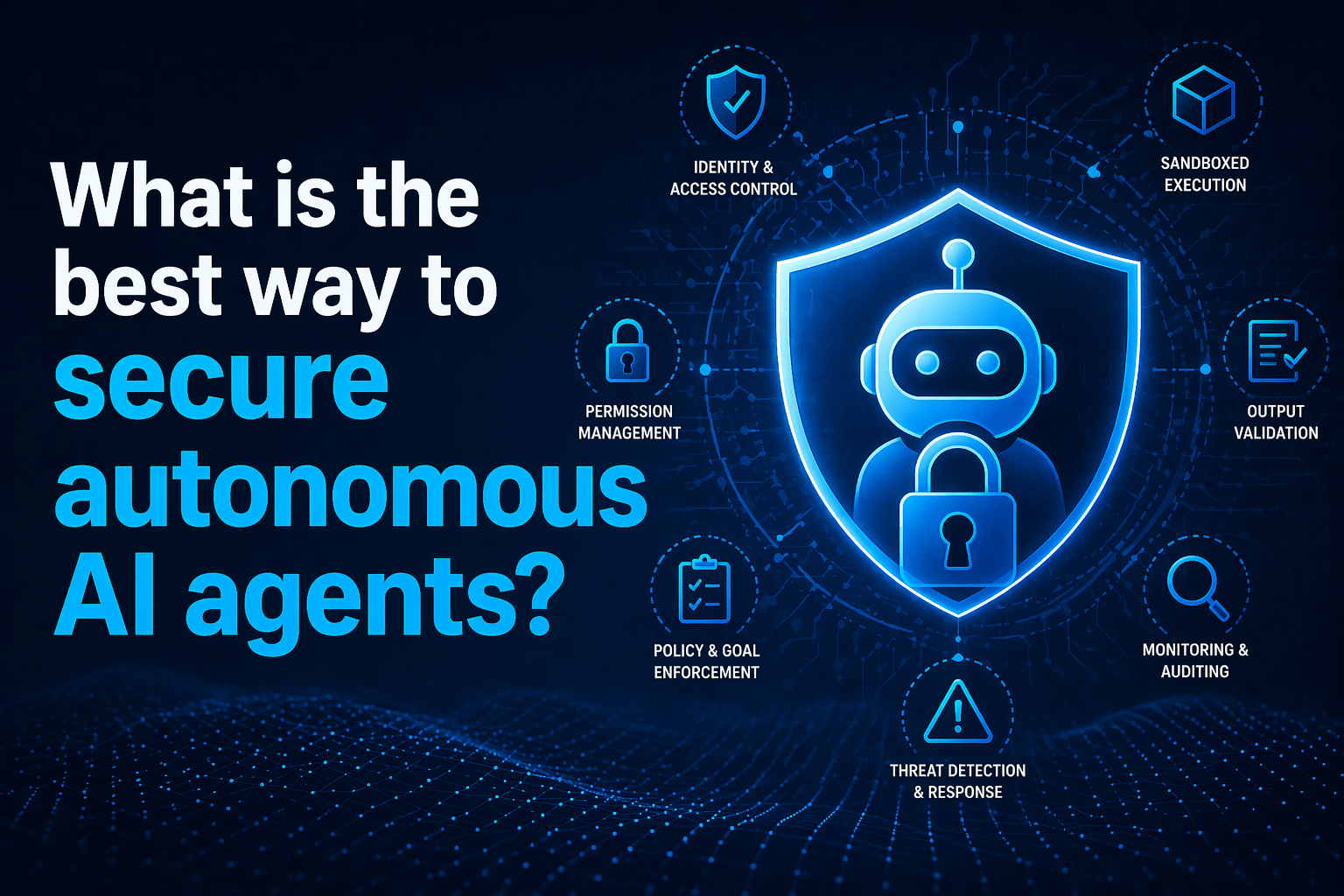
The best way to secure autonomous AI agents is to design security into the deployment from the beginning — not added after the fact, not addressed through a single control, and not delegated entirely to the AI platform provider. Autonomous AI agents operate with more consequence and less human oversight than interactive AI assistants, which makes their security architecture more critical and more specific.
The framework below reflects the current state of AI security best practice for enterprise deployments. No single element is sufficient. The combination provides meaningful protection against the realistic threat landscape.
Overview
Securing autonomous AI agents requires defense-in-depth across five dimensions: capability scope (what the agent can do), input and content controls (what the agent processes), instruction authority architecture (how instructions are trusted), behavioral monitoring (how the agent’s actions are observed), and governance (policies, training, and response). Each dimension addresses vulnerabilities that the others do not.
- Capability scope: minimum permissions, minimum capabilities, maximum consequence limitation
- Content controls: sanitization, source restriction, content isolation
- Instruction authority: privilege separation, system prompt hardening, context management
- Behavioral monitoring: action logging, output review, anomaly detection
- Governance: AI security policy, training, incident response, vendor management
The Foundational Principle: Minimal Viable Capability
Before designing any other security control, establish the minimum capability scope required for the agent’s specific task:
- What actions must the agent be able to take to accomplish its authorized purpose?
- What data must it have access to?
- What external services must it be able to call?
- What content sources must it be able to retrieve?
Grant only those capabilities. Remove everything else. This is the highest-leverage security decision in autonomous AI agent deployment — it determines the maximum consequence of any successful attack.
An agent that can only read and summarize documents from a defined set of sources cannot be used to send emails, call external APIs, or modify files, regardless of how sophisticated the injection attack against it is.
Dimension 1: Capability Scope Controls
Principle of least privilege: grant the agent the minimum permissions required for its task. Review granted permissions regularly and remove capabilities that are no longer needed.
API scope restriction: when integrating AI agents with external services through APIs, use OAuth scopes or API key permissions that restrict the agent to the specific operations it needs — read-only where write is not required, specific resource access rather than broad access.
Data access controls: limit the data the agent can query to what its task specifically requires. An agent summarizing public reports does not need access to internal financial systems.
Sandboxed execution: for agents that execute code, run execution in an isolated sandbox with restricted system access, network access controls, and resource limits.
Dimension 2: Input and Content Controls
Content sanitization pipeline: all external content — retrieved web pages, processed documents, API responses — should pass through a sanitization layer before the agent processes it. The sanitization layer strips known injection delivery mechanisms and flags suspicious content for review.
Domain allowlisting: restrict web-browsing agents to pre-approved domains where the use case allows. This is the most effective single control for indirect injection risk reduction.
Source trust attribution: tag content with its source before passing to the agent, enabling the agent to apply appropriate skepticism to external versus internal content.
File type restrictions: limit the file types the agent processes to those required for its task. Each file type adds potential injection delivery mechanisms.
Dimension 3: Instruction Authority Architecture
Privilege separation: architecturally distinguish operator instructions from processed content. Operator instructions (system prompt) have highest authority. User input has medium authority. Retrieved external content has lowest authority and cannot override operator instructions.
System prompt hardening: write system prompts that explicitly define the trust hierarchy, address injection resistance, and instruct the agent to report rather than follow adversarial instructions encountered in retrieved content.
Context management: implement context window management that limits how much processed content can accumulate in the agent’s context — limiting the scope of context poisoning attacks.
Dimension 4: Behavioral Monitoring
Comprehensive action logging: log every action at the tool-call level — not just conversations. Every API call, file operation, external communication, and web request should be logged with timestamp, parameters, and outcome.
Output review: implement automated output anomaly detection and periodic human review of agent outputs, particularly after the agent has processed content from new or unfamiliar sources.
Human approval workflows: require explicit human approval before the agent executes consequential actions. Define “consequential” for your specific deployment context — external communications, financial transactions, record modifications, escalations.
Session behavior analysis: review session-level behavioral patterns, not just individual outputs. Behavioral changes across a session after processing specific content may indicate successful context manipulation.
Dimension 5: Governance
AI security policy: establish explicit policy covering AI agent deployment, acceptable use, data handling, incident reporting, and vendor assessment. Cybersecurity compliance frameworks should incorporate AI-specific requirements.
Regular security reviews: review AI agent deployments on a regular schedule — at least quarterly — assessing capability scope, access permissions, content source exposure, and monitoring coverage against the current threat landscape.
Incident response procedures: define specific procedures for AI security events — session termination, log preservation, impact assessment, containment, and escalation to the cybersecurity team.
Vendor security assessment: assess AI platform vendors’ security practices, vulnerability disclosure, and update cadence. Stay current with platform updates that address known vulnerabilities.
Final Takeaway
The best way to secure autonomous AI agents is minimal viable capability scope, rigorous content handling, privilege-separated instruction architecture, comprehensive behavioral monitoring, and AI-specific governance — applied together, built in from deployment, and maintained as the threat landscape and deployment environment evolve.
Autonomous AI Agent Security From Mindcore Technologies
Mindcore designs and deploys AI agents with enterprise security architecture built from this framework. Our cybersecurity team ensures AI agent deployments reflect the current threat landscape rather than conventional security assumptions that do not apply to the AI context.

