

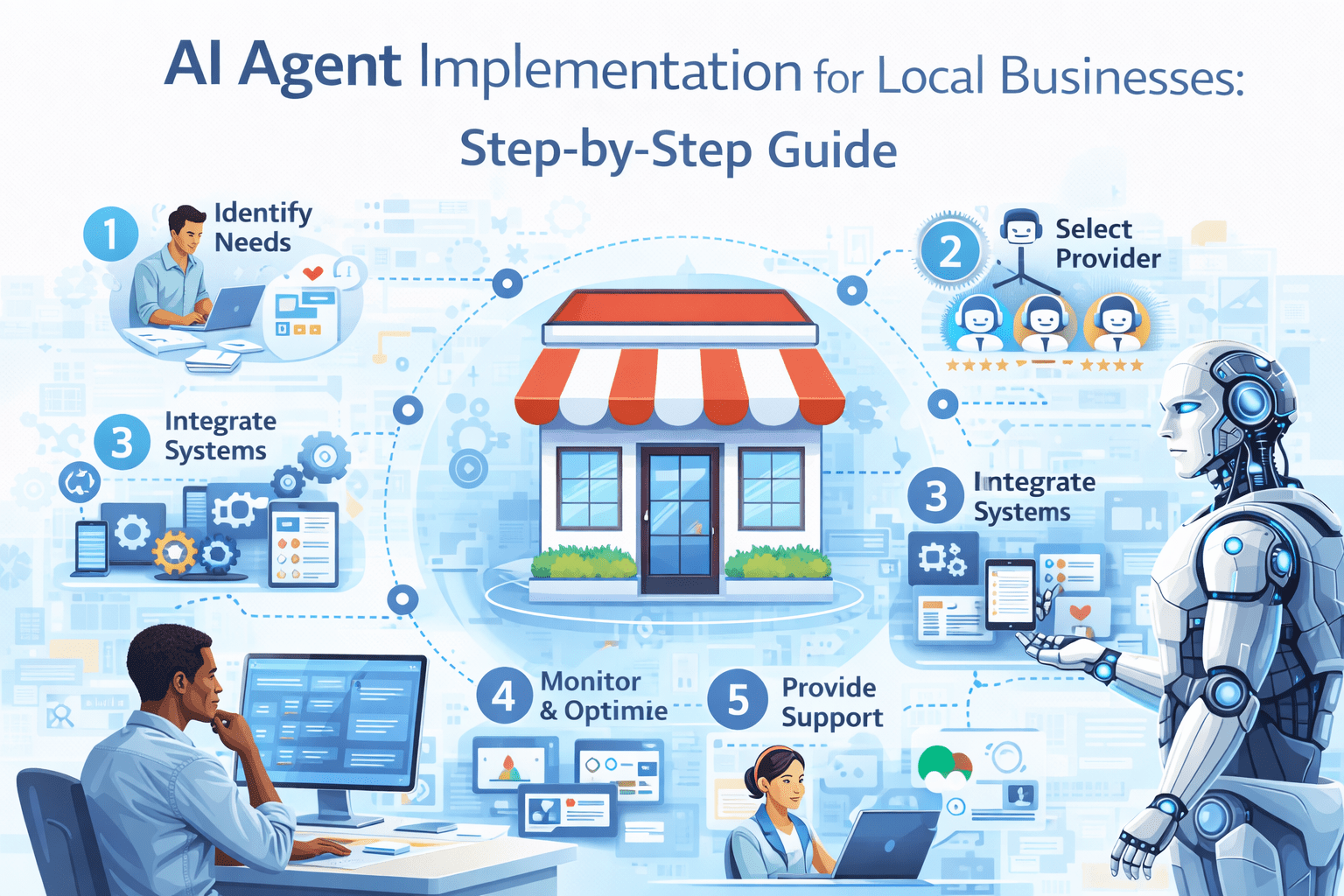
AI agents only create value when implemented correctly. Many local businesses purchase automation tools but fail to see results because rollout lacks structure. Implementation must be sequenced carefully to avoid workflow confusion, data inconsistencies, and unnecessary costs.
The overall automation framework is introduced in AI Agents for Local Businesses: Small Business Automation Guide, where AI is positioned as scalable operational support for small teams.
A step-by-step approach ensures AI delivers measurable results.
Step 1: Audit Current Workflows
Before automating anything, map existing processes.
Focus on:
• Customer inquiry handling
Identify response delays.
• Appointment scheduling
Detect booking bottlenecks.
• Invoice generation and reminders
Track payment cycles.
• CRM updates
Note manual data entry repetition.
This audit prevents automating broken workflows.
Strategic prioritization is reinforced in How Local Businesses Choose Affordable AI Agent Solutions.
Step 2: Clean and Standardize Data
AI agents depend on accurate information.
Data preparation should include:
• Removing duplicate customer records
Improve CRM accuracy.
• Standardizing naming conventions
Prevent automation errors.
• Verifying financial data accuracy
Protect reporting reliability.
Integration risk management is detailed in Local Business AI Integration: Overcoming Common Implementation Challenges.
Step 3: Select One High-Impact Workflow
Avoid overwhelming operations.
Start with:
• Automated appointment confirmations
• Invoice follow-up reminders
• Lead response automation
This controlled approach builds confidence.
Strategic rollout discipline is explained in Local Business AI Strategy: Starting Small and Scaling Up.
Step 4: Configure Integration Carefully
Ensure systems connect properly.
Verify:
• Accounting software synchronization
• CRM data updates
• Email platform compatibility
• Scheduling system alignment
Provider selection considerations are covered in AI Agent Providers for Small Business: Comparing Cost-Effective Options.
Step 5: Monitor and Test Performance
After deployment:
• Review automated responses
Ensure message accuracy.
• Track error rates
Identify workflow issues.
• Validate data consistency
Maintain reporting clarity.
• Confirm customer feedback
Measure satisfaction.
ROI measurement frameworks are expanded in Small Business AI ROI: Measuring Success with Limited Budgets.
Step 6: Expand Gradually
Once the first workflow performs reliably:
• Introduce additional automation
Build incrementally.
• Integrate reporting dashboards
Improve visibility.
• Add conditional logic
Enhance sophistication.
Approach comparison between DIY and guided implementation is discussed in AI Automation for Small Business: Professional vs. DIY Approaches.
Common Implementation Mistakes
• Automating too many processes at once
• Skipping data cleanup
• Ignoring integration compatibility
• Failing to test before scaling
• Not tracking ROI
Automation should simplify business operations, not complicate them.
Key Takeaways
AI agent implementation for local businesses succeeds when workflows are audited first, data is cleaned and standardized, one high-impact process is automated initially, integrations are validated carefully, performance is monitored consistently, and expansion occurs gradually. Structured rollout reduces risk, protects limited budgets, and ensures automation produces measurable improvements in efficiency, cash flow, and customer responsiveness.

