

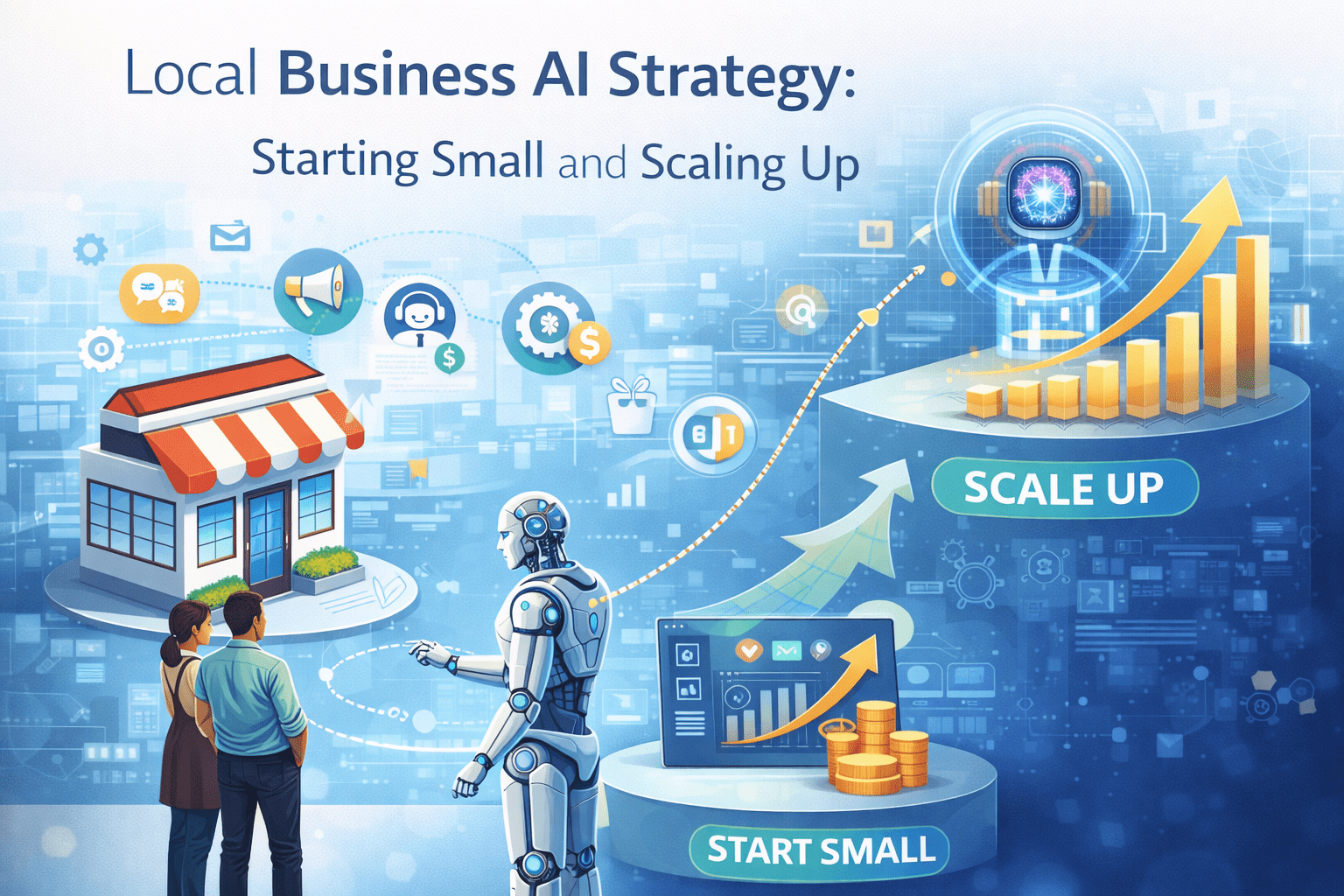
Small businesses succeed with careful AI marketing strategies for local business, adopting automation gradually rather than moving too fast. A structured strategy allows local businesses to adopt AI confidently without overwhelming staff, systems, or budgets.
The broader framework is outlined in AI Agents for Local Businesses: Small Business Automation Guide, where AI is positioned as practical operational leverage.
Starting small creates stability. Scaling gradually creates sustainability.
Phase 1: Identify One High-Impact Workflow
When implementing AI marketing strategies for local business, starting with measurable workflows like lead response automation, appointment confirmations, or invoice reminders sets a strong foundation.
Strong starting points include:
• Lead response automation
Capture inquiries immediately.
• Appointment confirmations
Reduce no-show rates.
• Invoice reminder workflows
Improve payment consistency.
This disciplined start prevents system overload.
Selection strategies are reinforced in How Local Businesses Choose Affordable AI Agent Solutions.
Phase 2: Validate Integration Stability
Part of effective AI marketing strategies for local business is validating integration stability across accounting, CRM, and email systems before scaling automation.
Validate:
• Accounting synchronization
Ensure financial accuracy.
• CRM updates
Prevent data duplication.
• Email communication flow
Maintain consistent messaging.
Integration discipline is detailed in Local Business AI Integration: Overcoming Common Implementation Challenges.
Phase 3: Measure and Optimize
After deployment:
• Track time savings
Quantify administrative relief.
• Monitor error rates
Improve reliability.
• Review customer feedback
Evaluate experience improvement.
ROI tracking frameworks are explained in Small Business AI ROI: Measuring Success with Limited Budgets.
Phase 4: Expand Automation Gradually
Once the first workflow performs consistently, expand to:
• Inventory monitoring alerts
Prevent stock shortages.
• Marketing scheduling support
Maintain visibility.
• CRM enrichment automation
Improve customer tracking.
Implementation sequencing is structured in AI Agent Implementation for Local Businesses: Step-by-Step Guide.
Phase 5: Evaluate Professional Support When Scaling
As operations grow, complexity increases.
Expert support enhances AI marketing strategies for local business when:
• Multiple systems require integration
• Reporting complexity increases
• Workflow dependencies expand
Approach comparison is covered in AI Automation for Small Business: Professional vs. DIY Approaches.
Phase 6: Align Scaling with Budget Discipline
To maintain ROI, AI marketing strategies for local business should align scaling with:
Monitor:
• Subscription tier upgrades
Ensure ROI justifies cost.
• Integration expansion expenses
Avoid unnecessary tool duplication.
• Operational time savings
Confirm efficiency gains continue.
Provider evaluation discipline is reinforced in AI Agent Providers for Small Business: Comparing Cost-Effective Options.
Common Scaling Mistakes
• Expanding too quickly
• Ignoring performance metrics
• Adding tools without integration review
• Overcomplicating simple workflows
• Failing to maintain data accuracy
Sustainable scaling requires patience.
Key Takeaways
Local business AI strategy succeeds when automation begins with one measurable workflow, integration stability is validated, ROI is tracked consistently, and expansion occurs gradually in alignment with operational growth and budget discipline. Starting small reduces risk, builds internal confidence, and creates a stable foundation for scaling automation in a controlled and cost-effective manner.
Frequently Asked Questions
How should a local business start with AI automation?
Begin with one high-impact workflow, such as lead response automation, appointment confirmations, or invoice reminders. Starting small prevents system overload and allows measurable evaluation of ROI AI Agents Guide.
Why is integration stability important before scaling AI?
Integration stability ensures AI workflows synchronize accurately with accounting systems, CRM platforms, and email communications. Stable integrations prevent errors, duplication, and operational disruption Integration Challenges Guide.
How can businesses measure AI automation effectiveness?
Track time savings, monitor error rates, and review customer feedback. Consistent evaluation ensures workflows deliver administrative relief and improved efficiency AI ROI Measurement.
When should professional support be considered for AI scaling?
Professional support is valuable when multiple systems require integration, reporting complexity grows, or workflow dependencies expand. Expert guidance maintains ROI during growth Professional vs DIY AI.
How can businesses scale AI automation cost-effectively?
Monitor subscription tier upgrades, avoid unnecessary tool duplication, and confirm operational time savings. Budget discipline ensures sustainable expansion without overspending Cost-Effective AI Providers.
Matt Rosenthal’s Expertise in Local Business AI Strategy
Matt Rosenthal, CEO of Mindcore Technologies, brings decades of IT, AI, cloud, and business technology leadership experience. He helps organizations implement AI agents gradually, validate integration stability, measure ROI, expand automation responsibly, and maintain cost discipline. Under his leadership, local businesses start small, build internal confidence, and scale AI-driven workflows sustainably, reducing operational risk while maximizing efficiency Mindcore AI Agents.

