

Compliance monitoring has a fundamental scaling problem. The documentation volume that regulated enterprises must review — inspection photos, facility condition records, equipment status images, visual audit evidence — grows with the scope of operations. The staff available to review that documentation does not grow at the same rate.
The result is a compliance monitoring program where the documentation exists but the review is inconsistent — high-priority items get reviewed thoroughly, lower-priority items get spot-checked, and the visual evidence of compliance conditions accumulates faster than it can be evaluated at the depth the monitoring program requires.
Claude Vision addresses that scaling problem by applying consistent analytical attention to every piece of visual compliance documentation — not replacing the compliance professional’s judgment but ensuring that the visual evidence review is thorough, consistent, and structured before that judgment is applied.
Overview
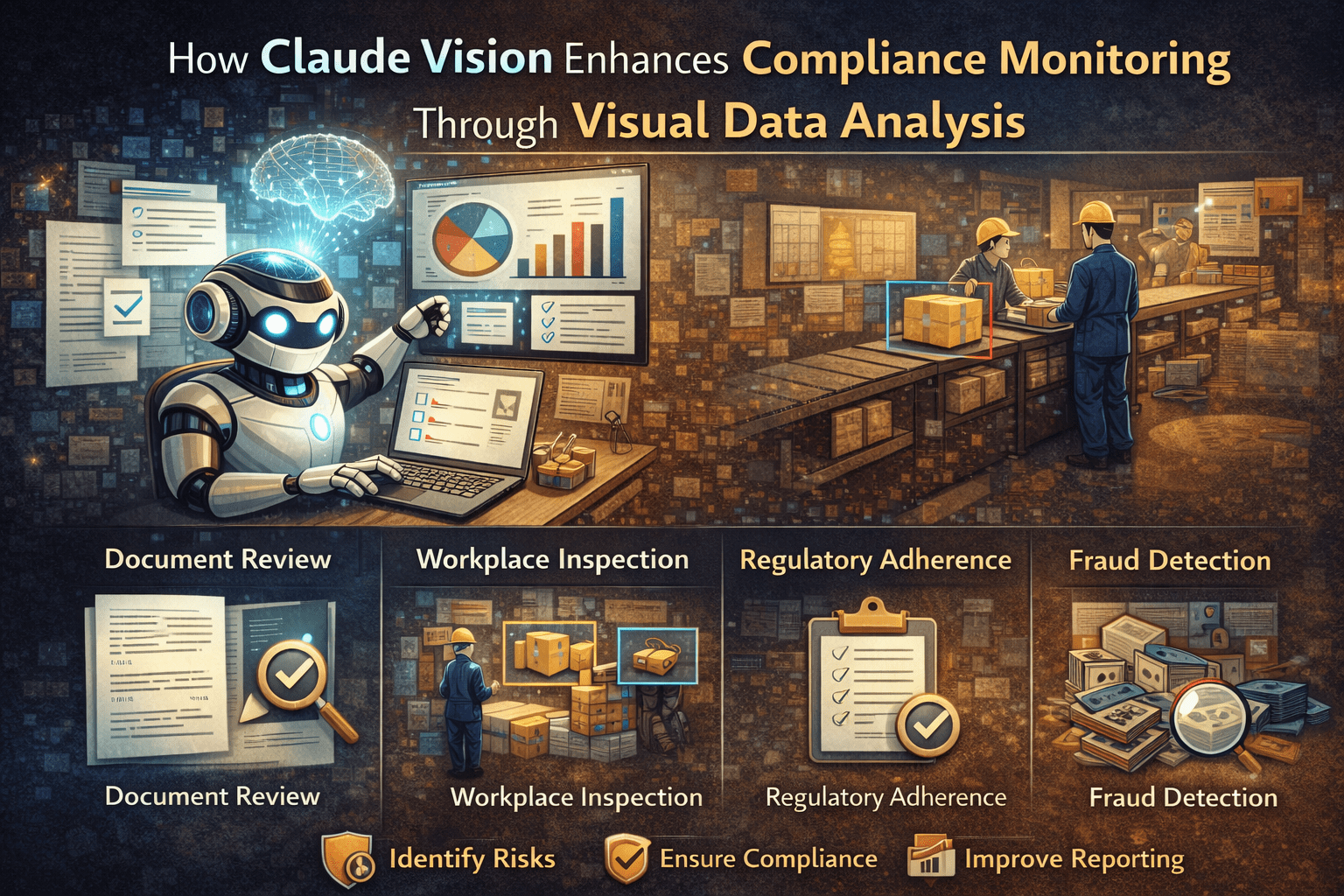
Claude Vision enhances compliance monitoring by providing consistent, structured analysis of visual compliance evidence at volumes that manual review cannot match with the same consistency. The compliance professional retains accountability for determinations. Claude Vision handles the initial analysis layer — reviewing visual documentation against defined compliance criteria, identifying conditions that require professional attention, and generating structured review outputs that make the compliance decision faster and better documented.
- Consistent analysis across full documentation volume rather than sampled review under resource constraints
- Structured review outputs that make compliance determinations faster and better documented
- Automated flagging of conditions that require compliance professional review — reducing the triage burden
- Audit trail generation from visual compliance evidence analysis is built into the workflow
- Integration with existing compliance documentation systems adds visual intelligence without replacing current processes
The 5 Why’s
- Why is compliance monitoring a high-value target for visual AI, not just documentation management? Compliance conditions have consequences — regulatory findings, operational sanctions, liability exposure. Visual compliance documentation is the evidence that determines whether those conditions are identified and addressed. AI-driven analysis that ensures every piece of visual evidence is reviewed at consistent depth has direct compliance outcome implications.
- Why does consistency matter specifically in compliance monitoring? Compliance monitoring that is inconsistent — reviewing some documentation thoroughly and other documentation superficially — creates defensible gaps in the monitoring record. A compliance program that can demonstrate consistent analytical attention to all visual evidence, with structured documentation of what was reviewed and what was found, is more defensible than one that relies on spot-check sampling.
- Why does structured output from visual analysis improve compliance decision quality? A compliance professional reviewing a flag generated by Claude Vision — with the specific conditions identified, the criteria they were assessed against, and the visual evidence referenced — makes a faster and more thoroughly documented determination than one reviewing raw visual documentation without that analytical preparation. Structured preparation improves decision quality and reduces the time the professional needs to spend per determination.
- Why does visual compliance monitoring require AI reasoning, not just pattern detection? Compliance criteria are expressed in regulatory language and professional standards — not as image patterns. Whether a facility condition meets a specific regulatory standard requires understanding what the standard requires and reasoning about whether the visual evidence satisfies it. Pattern detection identifies what is present. Reasoning determines whether what is present is compliant.
- Why does audit trail generation from visual analysis strengthen compliance documentation? Compliance audit evidence requires demonstrating not just that visual documentation exists but that it was reviewed, against what criteria, with what findings. Automated audit trail generation from Claude Vision compliance analysis creates that evidence as a standard output of the monitoring process — not as a documentation effort that competes with the monitoring work itself.
Compliance Monitoring Applications
Healthcare Facility and Equipment Compliance
Healthcare facilities operate under Joint Commission, state health department, and CMS compliance requirements that include physical facility conditions, medical equipment status, safety system functionality, and infection control documentation. Visual compliance evidence — inspection photographs, equipment status images, facility condition documentation — is generated continuously.
Claude Vision applied to that visual evidence can:
- Review facility inspection images against defined compliance criteria
- Flag conditions that do not meet regulatory standards for compliance officer review
- Verify that required safety equipment is present and in apparent working condition
- Generate structured compliance documentation from visual evidence review
Environmental Health and Safety Compliance
EHS compliance programs require visual documentation of safety conditions — personal protective equipment use, hazardous material storage, emergency equipment accessibility, signage compliance. That documentation is typically reviewed through periodic audit sampling.
Claude Vision enables consistent review of EHS visual documentation as it is generated — identifying conditions that do not meet safety standards before the next periodic audit, rather than discovering them during it.
Financial and Operational Compliance Documentation
Financial institutions and operational compliance programs generate visual documentation of process compliance — transaction documentation completeness, audit evidence image quality, record condition verification. Claude Vision can review that documentation for completeness and quality before it enters the compliance record — reducing the back-end audit work that incomplete or inadequate documentation creates.
Building Visual Compliance Monitoring Workflows
- Criteria definition — translate compliance standards into specific visual assessment criteria that Claude Vision can apply consistently
- Documentation intake — integrate visual compliance documentation into processing pipelines that route images to Claude Vision analysis as they are received, not in periodic batch reviews
- Analysis output structure — define structured output formats that capture what was assessed, what criteria were applied, what conditions were identified, and what professional review is recommended
- Review routing — route flagged conditions to the appropriate compliance professional with the Claude Vision structured analysis as the review brief
- Audit trail integration — integrate analysis logs with existing compliance management systems to create complete audit trails that combine visual evidence with analysis records
A Simple Visual Compliance Monitoring Readiness Check
Your compliance monitoring program is ready for Claude Vision if:
- Visual compliance documentation volume exceeds the consistent review capacity of current compliance staff
- Compliance criteria can be expressed explicitly enough to configure Claude Vision analysis — not just as general standards but as specific assessable conditions
- Review routing infrastructure can receive structured analysis outputs and route flagged items to appropriate compliance professionals
- Audit trail requirements for compliance evidence review have been defined and infrastructure designed to meet them
- Compliance and legal teams have reviewed the AI-assisted monitoring model and confirmed that it meets applicable standards for compliance program documentation
Final Takeaway
Visual compliance monitoring at scale requires consistent analytical attention that manual review programs cannot sustain across full documentation volume under resource constraints. Claude Vision provides that consistency — applying defined compliance criteria to every piece of visual evidence at the depth the monitoring program requires, with structured outputs that make compliance determinations faster, and audit trails that document the review process for regulatory purposes.
The compliance program that cannot demonstrate it reviewed all its visual evidence consistently is less defensible than the one that can. Claude Vision is how enterprises get there at the scale their documentation volume demands.
Enhance Your Compliance Monitoring With Mindcore Technologies
Mindcore Technologies works with enterprise compliance and operations teams to design Claude Vision compliance monitoring workflows — criteria definition, documentation intake integration, structured output design, review routing, and audit trail infrastructure that strengthen compliance programs without adding to the manual review burden that already limits them.
Talk to Mindcore Technologies About Visual Compliance Monitoring With Claude Vision →
Contact our team to assess your visual compliance documentation volume and design the monitoring workflow that addresses it systematically.

