

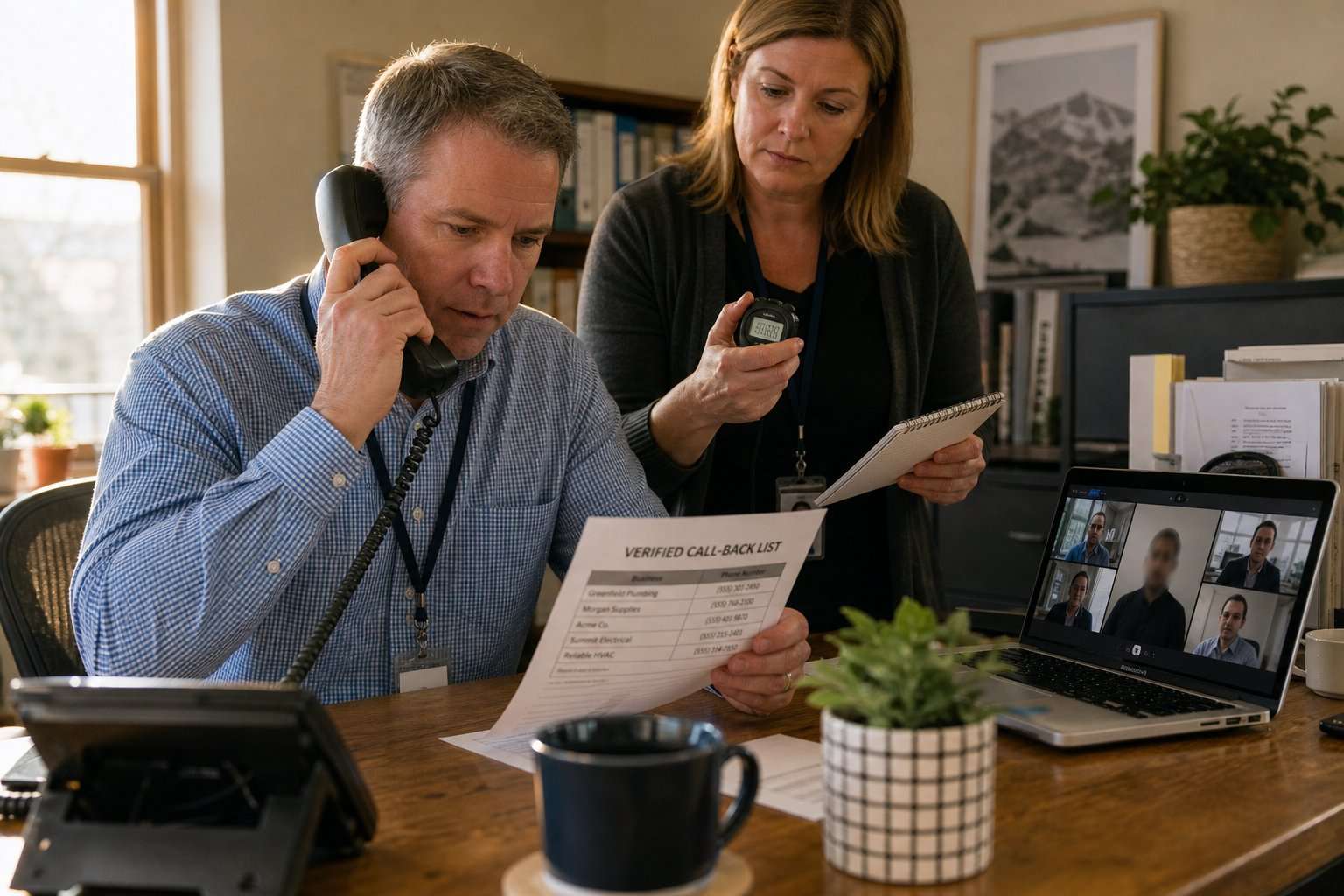
The price of a deepfake attack is whatever one fooled person can release in a single afternoon, a payment, a password reset or a new hire’s system access, plus the weeks of cleanup after it. A 30-minute security training drill that rehearses that moment costs about 15 staff hours a year for a company that practices with only the people who can move money or grant access. This guide is for owners and the people who approve payments and resets at companies of 10 to 200 people. It prices four short drills in staff time, shows how to run each one, and adds a South Florida section on bilingual teams, closing days and storm-season vendors.
Five Points to Settle Before You Fund a Drill
These five points summarize the approach for owners and approvers.
- The cost of a deepfake attack is set by the largest action one person can complete alone, so measure that number first.
- A fake voice or face works because the request arrives with authority, urgency and a plausible reason, and a drill rehearses the pause that breaks that pattern.
- A drill tests your process, not anyone’s ear, so it still works when the fakes improve.
- Four 30-minute drills a year, held with only the people who hold the power, cost roughly 15 staff hours in our worked example.
- Every dollar figure here is an example input. Replace the wage rate and the payment limit with your own.
Why Deepfake Fraud Cost Lands on One Person’s Afternoon
Deepfake fraud cost concentrates on a single person because the attacker needs only one approver to say yes, and a convincing voice or face removes the usual reason to say no.
The approval that works is the expensive one
The FBI’s 2024 Internet Crime Complaint Center report lists $2.77 billion in reported business email compromise losses for the year, and a fake executive request is one of the oldest versions of that crime. The case owners remember is Arup, the engineering firm whose Hong Kong finance employee made transfers of about $25 million (HK$200 million) after a video call in which the other participants were AI-generated copies of colleagues, as CFO Dive reported. The employee was first suspicious of an emailed request, and the call was what settled the doubt. The loss surfaced only when the employee checked with headquarters.
The opposing view deserves a hearing: Arup is a large firm, and a 40-person company will never face a staged video room of fake executives. That is partly true. The version a smaller firm sees is a short voice message or a single call from a “vendor”, and the lesson transfers anyway: the money moved because nobody on the call had a rehearsed way to stop and verify.
The reset that sounds right opens everything else
A password reset or a new multi-factor method registered for the wrong person hands over a mailbox, and a mailbox hands over payment approvals. BleepingComputer’s review of help desk impersonation notes that password resets and remote support are routine activities that give attackers openings when requests are not properly verified, and it recommends trusted authentication over security questions an attacker may already know. It also recounts Marks & Spencer’s 2025 incident, in which the company said attackers got in by deceiving employees at a third-party contractor and estimated a hit of around 300 million pounds to operating profit before mitigation.
A small firm will not carry a number like that, and a fair reader might say the comparison proves nothing for a 25-person office. What does transfer is the entry point: a human on a phone being persuaded to skip a step.
The hire who is not who they say
In a January 2025 public service announcement, the FBI warned that North Korean IT workers have used artificial intelligence and face-swapping technology during video job interviews to hide who they are. It advises identity verification during interviewing, onboarding and throughout employment, cross-checking applicants who share resume content or contact details, and completing as much of hiring in person as possible. A fake employee costs a different way, in payroll, in access to your systems and in the cleanup when the access is traced, and it belongs in the same drill program as the payment and reset scenarios.
How to Price the Drill Against Deepfake Fraud Cost
Pricing the drill takes two numbers: the staff hours the drill consumes and the largest payment or access grant a single person can release without a second set of eyes.
The arithmetic, in staff hours
Start with who attends. In our example the live drills involve six people: two in finance, two on the help desk or IT, the owner and the office manager. The hiring drill involves three: the recruiter, the hiring manager and the owner. A facilitator spends one hour per drill on preparation and delivery.
| Item | Staff hours per year |
|---|---|
| Three live drills, six people, 30 minutes each | 9.0 |
| One hiring drill, three people, 30 minutes | 1.5 |
| Facilitator, four drills, one hour each | 4.0 |
| Total | 14.5 |
At an example loaded cost of $45 an hour, that is about $650 a year. Put your own hourly figure in place of ours. Then write down the largest payment one person at your company can release alone, and the most sensitive account one reset can unlock. The drill budget is small beside that number, which is the point of pricing it this way.
Why 30 minutes beats a half-day seminar
A half-day annual seminar feels thorough and fades by spring, because nobody rehearses the moment of the request. A short, repeated drill builds a reflex that survives a busy Thursday. The counterargument is real: 30 minutes is too short to teach how voice cloning works, and a longer session can explain the technology. We would put the explanation in a ten-minute briefing and keep the drill itself for practice, since the technology will change before the next quarter and the habit of pausing will not.
Who sits in the room
Hold the live drills for the people who hold the power, and give everyone else the short briefing. A receptionist who cannot release funds or reset accounts needs awareness, and the approver and the help desk need repetition. That split keeps the cost near 15 hours instead of the 80 or more hours it would take to put 40 people through each quarter.
Four Drills, Four Doors an Impersonator Uses
Each drill below is a 30-minute rehearsal with a facilitator who plays the impersonator, a written script and a scorecard, and each tests a different door into the company.
Drill one: the voice call to finance
The facilitator phones an approver, claims to be the owner, names a real vendor and asks for a payment today, with a reason that sounds plausible. The approver’s job is to stop, use a number from the verified list and ask for a second approval. We run it twice in one session: once as a polite request and once as an angry one, because pressure is the real test. Our managed security services team pairs this drill with a two-person call-back rule so the approver has a script to fall back on.
Drill two: the reset request to the help desk
The facilitator calls the help desk as a staff member who has lost a phone and needs a new sign-in method registered right now. The caller knows the manager’s name and says the boss is waiting. The help desk passes by ending the call and calling the employee back on the number in the directory, or by requiring a manager to confirm through a second channel. Our guidance on multi-factor authentication explains why new sign-in methods deserve the strictest check, and a company that runs 24/7 emergency help desk coverage should drill the after-hours technician too, because that person has the least backup.
Drill three: the vendor on video
A familiar vendor contact joins a video call, asks to change bank details and says the next invoice is urgent. The finance team practices the hold: no bank change takes effect until it has been verified through contact details already on file and approved by a second person. This is where a wire fraud cost ledger belongs in the room, since seeing the bills that follow a bad wire makes the pause feel worth its minutes.
Drill four: the candidate on camera
The hiring team runs through an interview where the facilitator, playing the candidate, raises the usual red flags: a phone number that matches another applicant, a request to skip the live identity check and a reluctance to meet in person at any stage. Follow the FBI’s advice in the drill itself: verify identity at interview, at onboarding and again later, compare applicants’ contact details, and meet in person when you can. We do not ask staff to spot glitches in a video, because detection by eye is unreliable and the process steps do the real work.
South Florida Drills: Two Languages, Closing Days and Storm-Season Vendors
A South Florida drill program has to reflect how businesses here actually operate, with bilingual teams, real estate closings and vendors who appear in force after a storm.
Run the script in both languages
Many Boca Raton and Fort Lauderdale offices work in English and Spanish daily, and an impersonator can switch languages to build rapport with whoever answers. Write each drill script in both languages, and make sure the verification step, whether a code word or a call-back, works the same way in either one. If only the English speakers have rehearsed the pause, the attack will simply find the other desk. A company that has trained on security awareness training in one language should repeat the material in the other.
Rehearse closing day and the week after a storm
Real estate closings run on wire instructions that arrive at the last minute, and attackers like a deadline that excuses skipping a call. Make closing-day verification part of drill one for any firm that handles escrow or deposits. The same applies to the weeks after a hurricane, when new contractors appear, existing vendors change banks, and seasonal staff come and go. Give those moments their own variation of the vendor video drill, and keep a verified list of storm-season contacts compiled before June. Our Florida cybersecurity services team sees how quickly urgency changes behavior in this region.
Scoring a Drill Without Blaming Anyone
A drill score should measure the process and belong to the team, because a drill that embarrasses people teaches them to hide mistakes.
Three numbers to write down
Record whether the approver used the number from the verified list, how many minutes passed before the request reached a second person, and whether the help desk ended the call to return it. Those three numbers tell you more than a pass or a fail. Track them across the four quarters, and report only the team total to staff. A rise in the minutes-to-escalation figure tells you that the hand-off is unclear long before a real attacker finds out.
What to fix first, and what it costs
Most gaps the drills reveal are fixed with paperwork and a short meeting rather than new software. A verified phone list costs an afternoon to build and a few minutes a quarter to maintain. A second approver above a set limit costs a rule and a short delay. A help desk check that ends the call and calls back costs a few minutes per request. The tools that sit behind these habits, such as email filtering that catches the first message and monitoring that flags a new sign-in method, are where email security and managed monitoring add protection that a drill cannot supply. A drill is not a replacement for those controls, and the controls are not a replacement for practice, so budget for both.
Frequently Asked Questions
How much does deepfake fraud cost a small business?
The cost depends on the largest payment or access grant one person can complete alone, plus the weeks of cleanup afterward. Published figures vary widely by survey, so use your own approval limit and your own wage rates. Our worked example shows the prevention side costing about 15 staff hours a year.
How long should a deepfake drill take?
Thirty minutes is enough for one scenario, played once politely and once under pressure. Longer sessions tend to turn into lectures, and the goal is practice of the pause, not instruction on the technology.
Do we need special software to run a drill?
No. A facilitator, a phone, a written script and a scorecard are all that is required. A video call can stand in for the vendor and candidate drills, and nothing in the drill depends on cloning anyone’s voice.
Who should play the impersonator?
Pick someone the staff do not report to, such as an outside provider or a manager from another department, and tell the whole company in advance that drills are part of the year. Our security awareness training guide covers how to announce a program without making it feel like a trap.
What if the drill reveals that someone failed?
Treat the result as a gap in the process and fix the process. Thank the person, adjust the script or the rule, and repeat the drill next quarter. Naming individuals ends the honesty that makes drills useful.
Who Stands Behind This Advice
Mindcore Technologies is a managed IT and cybersecurity firm with offices in Boca Raton, Florida and Fairfield, New Jersey, and the drills in this guide reflect the conversations we have with owners and finance teams about payments, resets and hiring. Our CEO, Matt Rosenthal, asks our team to give owners numbers they can check and steps they can run themselves. Use the arithmetic, change the inputs and decide for yourself.
Book a Free Strategy Call and Run Your First Drill
Pick the scenario that matches your biggest exposure, write down the largest action one person can complete alone, and schedule the first 30-minute drill within the month. If you would like a partner to plan and facilitate it, our team can run the drills as part of security awareness training, pair them with managed security services, and review your approval limits and reset checks with you. Book a free strategy call at mind-core.com/schedule-a-consultation and bring your payment limit and your headcount.

