

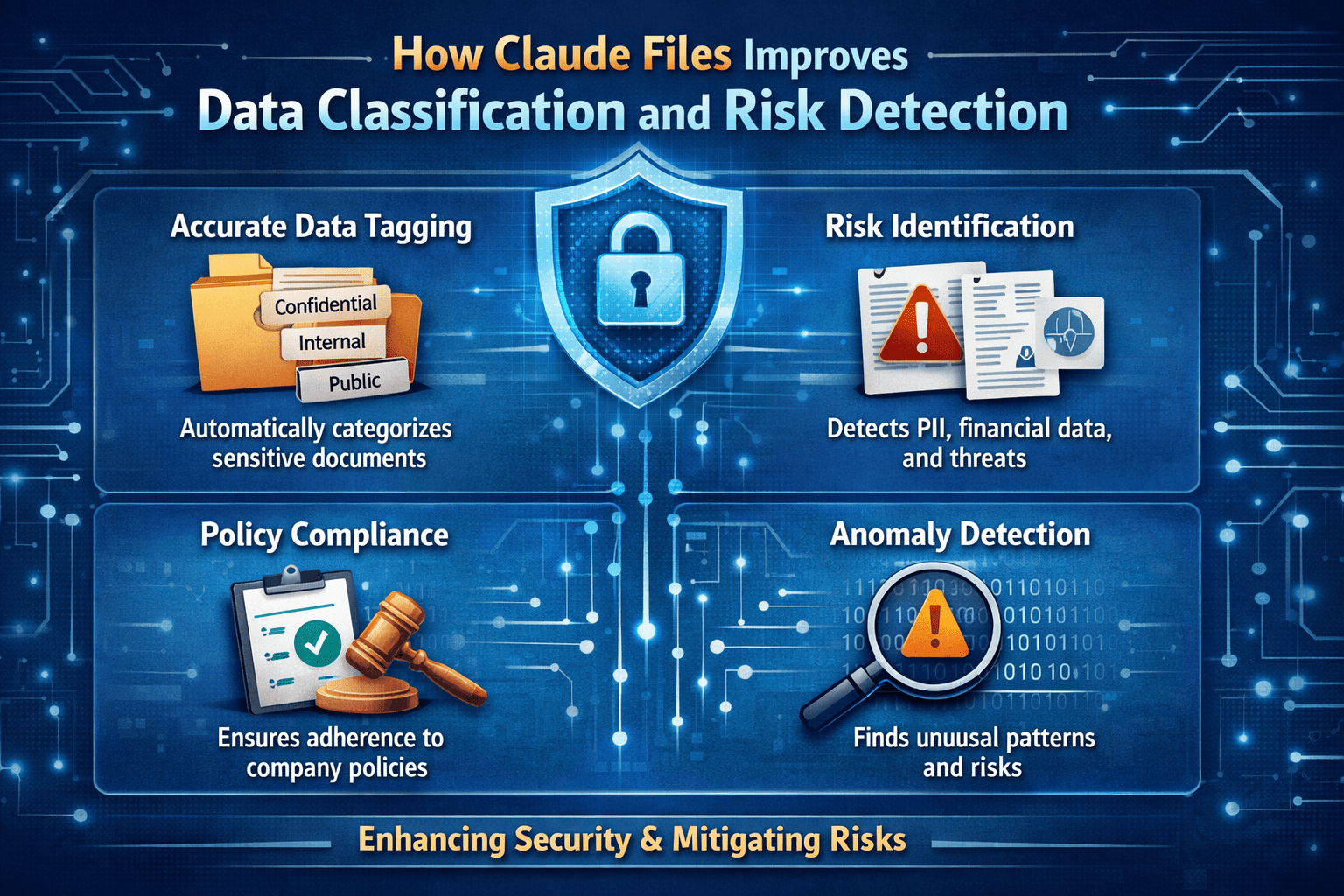
Data classification and risk detection programs have a common failure mode: they rely on pattern matching against defined criteria when the data they need to classify and the risks they need to detect do not always conform to defined patterns.
A document that contains PHI without using standard field labels. A contract that creates liability through an unusual combination of standard clauses. A communication that suggests fraud through implication rather than explicit statement. Pattern matching finds what it was programmed to look for. It misses what it was not.
Claude Files brings contextual reasoning to data classification and risk detection — understanding what documents contain based on what they mean, not just what patterns they match. That difference is where the classification and risk detection gaps that pattern-based tools create are closed.
Overview
Claude Files improves data classification and risk detection by applying the same contextual reasoning to document content that a knowledgeable human reviewer would apply — understanding the meaning of content, not just its surface patterns. Classification decisions are based on what a document actually contains and what handling it requires. Risk detection identifies conditions that represent actual risk in context, not just conditions that match predefined risk patterns.
- Contextual classification handles documents where sensitive content does not appear in standard labeled fields
- Risk detection identifies conditions that represent risk through their combination and context, not just their individual pattern matches
- Classification coverage extends to document types and content variations that predefined rules were not built for
- Risk flagging specificity is higher — less noise from false positives on content that matches patterns but does not represent actual risk
- Audit documentation of classification and risk assessment decisions supports data governance program defensibility
The 5 Why’s
- Why does pattern-based classification fail on the data that is actually most sensitive? The most sensitive data is often the data that appears in unusual forms — PHI documented in clinical narrative rather than labeled fields, financial data embedded in free-text correspondence, PII mentioned contextually in documents that have no standard PII fields. Pattern matching finds the labeled, structured, expected instances. Contextual reasoning finds the embedded, narrative, unexpected ones.
- Why does contextual risk detection reduce false positive rates compared to pattern-based approaches? Pattern-based risk detection flags everything that matches the pattern — including benign instances that match the pattern coincidentally. Contextual reasoning assesses whether the pattern match represents actual risk in context — understanding that a reference to cash transactions in a financial compliance document is different from a reference to cash transactions in an unusual operational communication. Lower false positive rates mean risk review queues contain actual risks, not noise.
- Why is classification coverage breadth a risk management concern, not just an operational one? Data that is not classified correctly is not governed correctly. Documents containing sensitive data that escape classification because they do not match predefined patterns are handled as general records — without the access controls, retention policies, and audit requirements that their content requires. Classification gaps are governance gaps.
- Why does risk detection that understands context produce better outcomes than detection that identifies patterns? Risk is contextual. The same clause in a contract may or may not represent a risk depending on what other clauses surround it, what the counterparty relationship is, and what the transaction context is. Pattern detection flags the clause. Contextual reasoning assesses the risk the clause represents in its actual context — which is the assessment the risk reviewer needs to make a useful determination.
- Why does audit documentation of AI-assisted classification and risk assessment decisions matter for data governance? Classification and risk assessment decisions that cannot be explained or documented are difficult to defend in regulatory examinations. Classification decisions made by contextual AI reasoning that is logged and attributed — “this document was classified as confidential because it contains the following content assessed as PHI” — produce the documented evidence that governance programs require.
How Claude Files Improves Data Classification
Content-Based Classification Beyond Pattern Matching
Claude Files classifies documents based on what they contain — assessing the full document content against classification criteria that describe what each classification level means, not just what patterns it contains:
- A document containing a clinical narrative that describes patient treatment without using labeled PHI fields is classified as PHI-containing because the content represents protected health information, not because it matched a field label pattern
- A document containing financial projections in a memo format is classified at the appropriate financial data level because the content represents material non-public financial information, regardless of whether it is formatted as a financial statement
Multi-Criteria Classification Decisions
Documents that require multiple classification criteria to be assessed simultaneously are handled by contextual reasoning that weighs those criteria together:
- A document that contains both public business information and confidential terms is classified at the highest applicable classification level based on the combination of its content
- A document that contains de-identified data that could be re-identified in context is classified for the re-identification risk that its context creates, not just for the surface-level absence of identifying fields
How Claude Files Improves Risk Detection
Contractual Risk Detection
Contract risk detection requires understanding how clause combinations, counterparty relationships, and transaction contexts interact — not just identifying individual clauses that appear on risk pattern lists:
- Liability exposure from unusual combinations of limitation of liability, indemnification, and termination clauses
- Compliance risk from contractual terms that conflict with regulatory obligations that apply to the organization’s operations
- Financial risk from payment terms, penalty provisions, and performance obligation combinations that create unusual exposure under specific conditions
Operational Risk Detection
Operational risk in documents is often embedded in narrative content, process descriptions, and correspondence:
- Fraud indicators in financial and operational communications that suggest unusual transaction patterns or authorization bypasses
- Compliance exceptions in operational records that indicate process deviations with regulatory implications
- Safety and liability indicators in operational documentation that suggest conditions requiring management attention before they become incidents
Classification and Risk Detection Governance
- Classification decision logging — every classification decision generated by Claude Files is logged with the content assessment that supported it, not just the classification label assigned
- Risk flag documentation — every risk flag includes the content that triggered it, the risk criteria applied, and the confidence level of the assessment — enabling reviewers to make efficient, well-supported determinations
- False positive tracking — risk flags that reviewers determine are not actual risks are logged to support ongoing calibration of risk detection criteria
- Classification override tracking — human overrides of AI-generated classifications are logged for quality monitoring and criteria refinement
A Simple Classification and Risk Detection Readiness Check
Your data classification and risk detection program is ready for Claude Files if:
- Classification gaps have been identified where sensitive content is appearing in documents that current classification tools do not flag
- Risk detection false positive rates are high enough that reviewer fatigue is reducing the effectiveness of the risk review program
- Document types exist that current classification rules were not built for and do not correctly classify
- Risk criteria can be expressed in contextual terms — not just as pattern lists but as descriptions of what makes a condition risky in context
- Audit documentation requirements for classification and risk assessment decisions have been defined and infrastructure designed to support them
Final Takeaway
Data classification and risk detection that rely exclusively on pattern matching have coverage gaps wherever sensitive content and risk conditions appear in forms those patterns were not built to recognize. Claude Files closes those gaps by applying contextual reasoning — understanding what documents contain and what that content means for classification and risk purposes, not just whether it matches a predefined pattern.
The governance programs that benefit most are the ones where classification gaps and false positive noise are the current limitations. Claude Files addresses both — improving coverage and specificity simultaneously because both are products of the same underlying capability: reasoning about content rather than matching it.
Improve Data Classification and Risk Detection With Mindcore Technologies
Mindcore Technologies works with enterprise data governance, compliance, and risk teams to integrate Claude Files into classification and risk detection programs — criteria definition, detection logic design, governance documentation architecture, and false positive calibration processes that improve coverage and specificity from the first deployment.
Talk to Mindcore Technologies About AI-Driven Classification and Risk Detection →
Contact our team to assess your current classification and risk detection gaps and design the Claude Files integration that closes them.

