

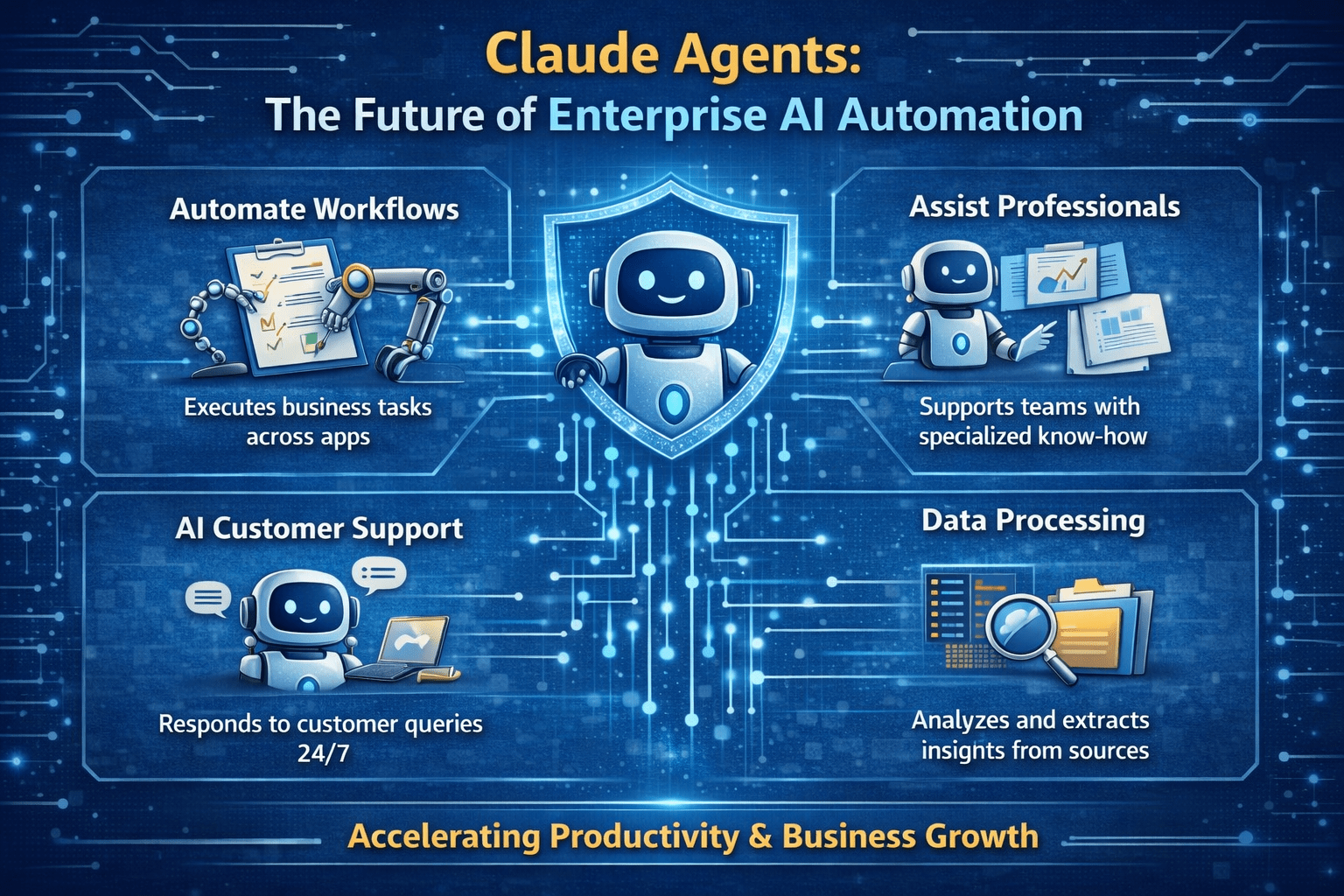
Enterprise AI automation has gone through two phases. The first was access — giving employees AI tools they could use when they chose to use them. The second was workflow integration — embedding AI into defined process steps. Both produced value. Neither produced the kind of autonomous operational capability that enterprise leaders have been expecting AI to deliver.
The third phase is agents. AI systems that do not wait for a prompt, do not execute a single defined step, and do not require human direction at each stage of a multi-step process. Claude Agents plan, reason, take sequential actions across enterprise systems, and complete complex workflows end to end — with human oversight at the points where it matters and autonomous execution everywhere it does not.
That is what the future of enterprise AI automation looks like. It is also what is available today.
Overview
Claude Agents are AI systems built on Claude’s reasoning and action capabilities that can autonomously execute multi-step workflows, coordinate actions across enterprise systems, maintain context across complex task sequences, and complete operational work end to end without requiring human direction at each step. They represent a categorical advance over AI tools and AI workflow integration — not because the underlying model is more capable, but because the deployment architecture enables autonomous, goal-directed operation across the enterprise.
- Claude Agents operate autonomously toward defined goals — not waiting for prompts at each step
- Multi-step workflow execution across enterprise systems is handled within a single agent operation
- Context is maintained across the full task sequence — the agent understands what has been done and what remains
- Human oversight is built into agent governance at the points where it adds value — not at every step by default
- The enterprise automation potential of agents scales with the complexity and volume of workflows they are designed for
The 5 Why’s
- Why do Claude Agents represent a categorical advance over AI workflow integration? AI workflow integration embeds AI into defined process steps — the AI executes a specific task when triggered, and the output passes to the next defined step. Agents execute entire workflows — planning the sequence, adapting to intermediate results, taking actions across multiple systems, and completing the goal without requiring each step to be pre-defined and pre-triggered. The difference is the gap between a tool that helps with a step and a system that completes a goal.
- Why does goal-directed operation change what AI automation can address? Tool-based AI handles the tasks you define and invoke. Goal-directed agents handle the objectives you specify — taking the actions required to achieve them without requiring you to enumerate every step in advance. That difference is what makes agents capable of handling the workflows that are too complex, too variable, or too multi-step to define completely in advance.
- Why is context maintenance across complex task sequences a defining capability? Many enterprise workflows involve sequential steps where each step depends on the results of the previous one. An agent that loses context between steps treats each step as an independent task — losing the thread that connects the workflow and producing disconnected outputs. An agent that maintains context across the full sequence operates as a coherent workflow participant, not a series of isolated task executers.
- Why does governance design matter more for agents than for other AI deployments? Agents take actions autonomously across enterprise systems. The scale of potential impact — from beneficial automation to unintended operational consequences — is higher than for AI that produces outputs for human review. Governance that defines what agents can do, what requires approval, and what is always reserved for human judgment is not a limitation on agent capability. It is the design that makes autonomous operation trustworthy at enterprise scale.
- Why is now the right time for enterprise agent deployment rather than future-state planning? The capability, the infrastructure, and the governance frameworks required for enterprise agent deployment are available today. Organizations that treat agents as a future-state technology while competitors deploy them operationally are not being cautious — they are ceding automation capacity that is already achievable with currently available tools.
What Claude Agents Can Do in Enterprise Operations
IT Service Management
An IT service management agent handles the full ticket lifecycle — intake classification, priority assignment, knowledge base search for resolution, automated resolution for defined issue types, escalation with full context for issues requiring human intervention, and ticket closure with resolution documentation. The IT team handles the escalated issues. The agent handles the volume.
Finance Operations
A finance operations agent handles invoice processing end to end — document intake, field extraction, GL coding, approval routing, exception escalation, payment scheduling, and reconciliation record generation. Finance staff handles the exceptions and approvals. The agent handles the routine volume.
Customer Operations
A customer operations agent handles inquiry intake, account context retrieval, response generation for routine inquiry types, escalation with full context for complex or sensitive inquiries, follow-up scheduling, and case closure documentation. Customer service staff handles the judgment-dependent cases. The agent handles the routine volume at the speed customers expect.
Compliance Monitoring
A compliance monitoring agent continuously monitors defined data sources for compliance conditions, classifies findings, generates structured compliance documentation, routes non-compliant conditions to compliance officers with findings pre-documented, and tracks remediation through to closure. The compliance team handles determinations and remediation oversight. The agent handles continuous monitoring.
The Governance Architecture That Makes Agents Enterprise-Ready
- Capability scope limits — explicit definition of what systems and data the agent can access and what action types it can execute
- Authorization tiers — actions tiered by impact level, with automated execution for routine operations, notification for moderate-impact actions, and human approval for high-impact ones
- Audit trail completeness — every agent decision, action, and outcome logged with full context for compliance and security review
- Failure mode handling — defined behavior for every failure condition, including graceful degradation to human handoff rather than silent failure
- Human override capability — any agent operation can be interrupted and redirected by authorized users at any point in the execution sequence
A Simple Agent Readiness Assessment
Your enterprise is ready to evaluate Claude Agent deployment if:
- High-volume multi-step workflows have been identified where human time is consumed in execution steps that do not require judgment
- Governance frameworks can be established for agent capability scope and authorization tiers
- Enterprise systems that agents would operate in have the API or MCP connectivity required for agent action execution
- Leadership is committed to governance-first agent design — not maximum autonomy, but appropriate autonomy with clear human oversight at defined decision points
Final Takeaway
Enterprise AI automation has been waiting for agents. Not because the model capability was insufficient — it was not — but because the deployment architecture and governance frameworks to make autonomous operation trustworthy at enterprise scale have taken time to develop.
Claude Agents are the deployment architecture that resolves that wait. Goal-directed, multi-step, context-maintaining, governance-bounded autonomous operation across enterprise systems. The future of enterprise AI automation is not a future state. It is an available deployment decision — one that the organizations making it now are building the operational advantage that later adopters will need to work significantly harder to match.
Deploy Claude Agents in Your Enterprise With Mindcore Technologies
Mindcore Technologies works with enterprise teams to design and deploy Claude Agents — workflow identification, governance architecture, capability scope definition, system connectivity, and operational monitoring that makes autonomous agent deployment trustworthy and measurably impactful from day one.
Talk to Mindcore Technologies About Claude Agent Deployment →
Contact our team to identify your highest-value agent deployment opportunities and build the governance architecture that makes them operational.

