

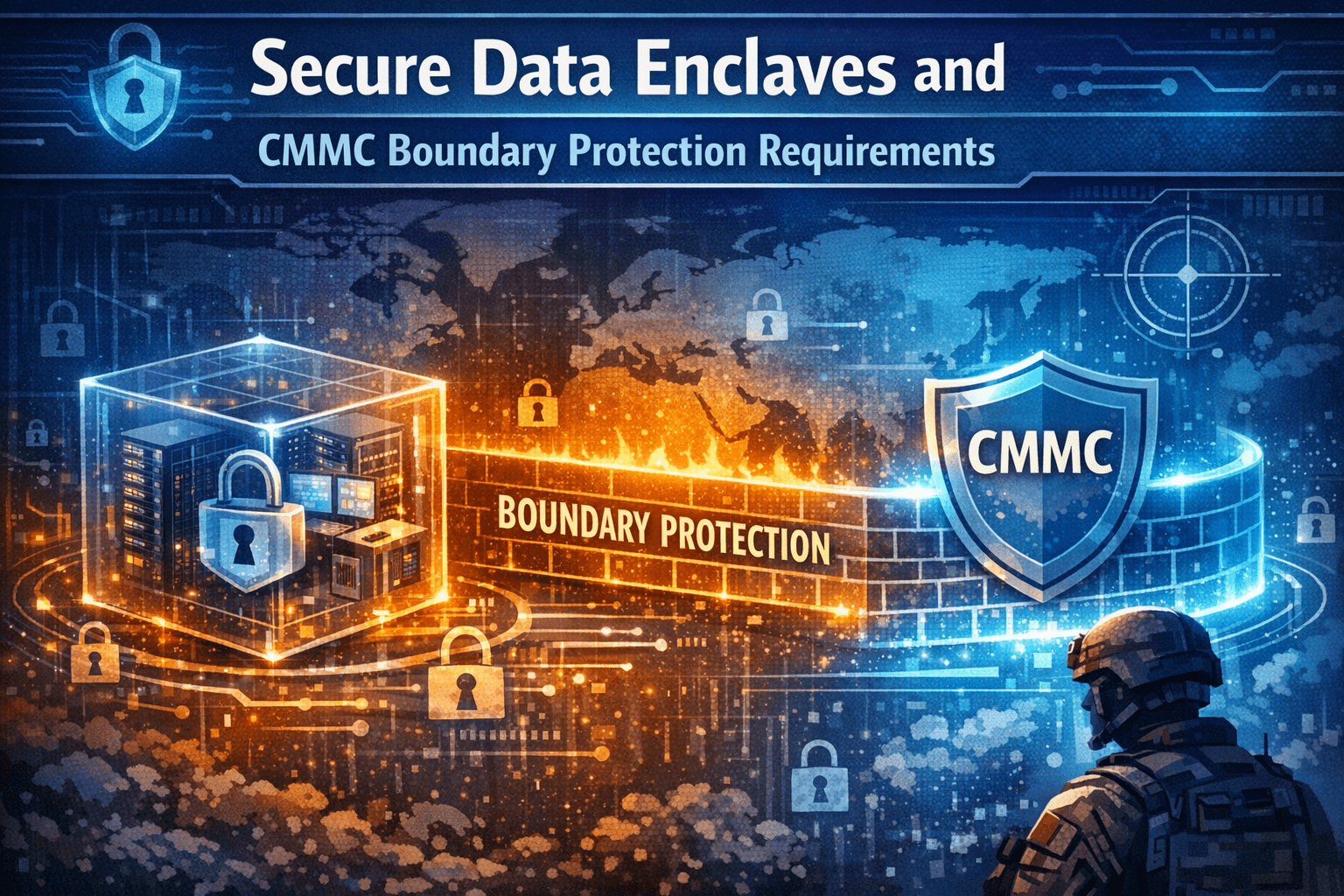
Boundary protection under CMMC is not a firewall configuration exercise. It is a CUI containment strategy — the architectural decision that determines where CUI lives, who can reach it, under what conditions, and what prevents an attacker who has breached the perimeter from reaching it.
Most DIB contractors approach boundary protection with perimeter thinking: the firewall separates inside from outside, and what is inside is trusted. CMMC SC domain requirements reject that model explicitly. They require that CUI environments have managed interfaces, that communications are monitored and controlled, and that the boundary between CUI systems and everything else is enforced continuously — not assumed based on network location.
Secure data enclaves are the architectural implementation of that requirement. CUI lives in a defined, access-controlled environment with explicit boundaries, managed access paths, and monitoring that covers every interaction at the enclave perimeter.
Overview
A secure data enclave for CMMC purposes is a logically or physically isolated environment that contains CUI, enforces managed access to that CUI, monitors all communications crossing the enclave boundary, and generates the audit evidence that CMMC SC domain requirements mandate. It is not a VLAN — VLANs are network segmentation, not boundary management. It is not a cloud tenant — cloud infrastructure alone does not implement the managed interfaces and traffic monitoring CMMC SC requires. It is an architectural decision that implements CUI boundary protection as an operational condition rather than a network configuration.
- Enclave boundaries define the CUI environment explicitly — not assumed by network segment membership
- Managed interfaces control and monitor what crosses the boundary — inbound and outbound
- Access to the enclave requires explicit authorization — not network adjacency
- Communications monitoring detects anomalous boundary crossing behavior during attacker dwell time
- Enclave architecture produces the boundary documentation that CMMC SC assessments require
The 5 Why’s
- Why does CMMC boundary protection require more than network segmentation? CMMC SC.1.175 (boundary protection) and SC.3.177 (managed interfaces) require that external and internal communications traversing CUI system boundaries are monitored and controlled. Network segmentation with VLANs separates traffic — it does not implement the managed interfaces, traffic monitoring, and access authorization that CMMC SC domain controls require. The difference is between a boundary that exists on a network diagram and one that is actively managed and monitored.
- Why is perimeter trust incompatible with CMMC SC requirements? Perimeter trust grants internal network access to authenticated entities without further authorization checks. CMMC SC requirements for managed interfaces, least-functionality, and boundary protection require that every communication crossing the CUI environment boundary is authorized, monitored, and logged — regardless of whether the source is internal or external. Perimeter trust makes the managed interface requirement unmeetable by design.
- Why do data enclaves provide better CUI protection than distributed CUI handling across the general IT environment? When CUI is distributed across the general IT environment — workstations, file shares, email archives, cloud storage — the boundary protection perimeter is the entire enterprise network. Every system in the enterprise becomes a potential CUI boundary. Consolidating CUI into a defined enclave creates a bounded perimeter that can be managed, monitored, and assessed — and that limits the CUI exposure surface to the systems that need to handle it.
- Why does enclave boundary monitoring matter specifically for CMMC incident response? CMMC IR requirements depend on having the visibility to detect when a CUI environment has been breached and to contain the breach. Enclave boundary monitoring that captures all inbound and outbound communications at the CUI environment perimeter provides the detection capability that IR response times require. Without it, breach detection depends on endpoint-level detection that typically fires after significant damage has occurred.
- Why does enclave documentation matter for CMMC assessment outcomes? CMMC SC domain assessments require organizations to demonstrate that they have implemented boundary protection controls. Organizations with defined enclave architecture, documented managed interfaces, and boundary monitoring logs can demonstrate compliance against specific SC practices. Organizations with general network segmentation produce documentation that assessors cannot map cleanly to specific SC requirements.
Designing a CMMC-Compliant Secure Data Enclave
Enclave Scope Definition
The first design decision is what belongs in the enclave:
- All systems that store, process, or transmit CUI — not just systems that primarily handle CUI
- Systems that provide services to CUI-handling systems that would expose CUI through those service relationships (authentication systems, backup infrastructure, monitoring systems)
- Systems that third-party vendors use to access CUI
Systems that have no CUI handling role are explicitly outside the enclave boundary. Minimizing enclave scope minimizes the boundary protection perimeter and the management burden.
Managed Interface Implementation
Every path into and out of the enclave is a managed interface that requires:
- Explicit authorization — who can cross the boundary, under what conditions
- Traffic inspection — what is allowed to cross; what is blocked; what generates alerts
- Logging — every crossing event logged with source, destination, protocol, and authorization basis
Managed interfaces include:
- User access paths (application delivery systems, not VPN)
- Administrative access paths (jump hosts with session recording, not direct admin protocol exposure)
- Data transfer paths (defined, monitored channels; not general file sharing)
- Integration paths to non-enclave systems (API connections with defined traffic scope)
Communications Monitoring at the Boundary
Boundary monitoring for CUI enclaves requires:
- Inbound traffic inspection — all traffic entering the enclave inspected against defined allow-list criteria; anomalous traffic blocked and alerted
- Outbound traffic monitoring — data leaving the enclave monitored for volume anomalies and unauthorized data transfer patterns; exfiltration detection capability
- East-west traffic monitoring — lateral movement within the enclave visible and alertable; compromise that enters the enclave does not move invisibly to high-value CUI stores
Enclave Architecture for Cloud CUI Environments
CMMC-compliant CUI handling in cloud environments requires enclave architecture that the shared cloud infrastructure model does not provide by default:
- Dedicated cloud tenancy — CUI enclave in a dedicated cloud tenant or account with no resource sharing with non-CUI workloads
- Network controls at the tenant boundary — cloud-native network controls (security groups, network ACLs, private endpoints) implementing the managed interface requirements at the tenant perimeter
- Cloud-native monitoring integration — cloud logging and monitoring services configured to capture the required boundary event types in CMMC AU-compliant formats
- Data residency controls — CUI data residency restricted to US regions as required by CMMC and underlying contract requirements
Assessment Evidence From Enclave Architecture
Well-designed enclave architecture produces CMMC SC assessment evidence directly:
- Enclave boundary diagrams demonstrating that CUI is contained within a defined environment with explicit boundaries
- Managed interface documentation showing what crossing paths exist, what controls govern each, and what monitoring is in place
- Boundary monitoring logs demonstrating that communications crossing the enclave perimeter are captured and reviewed
- Access authorization records demonstrating that enclave access is explicitly authorized, not inherited from general network access
Final Takeaway
Secure data enclaves are not an advanced security architecture reserved for prime contractors. They are the correct implementation of CMMC boundary protection requirements for any DIB contractor handling CUI — because the alternative, distributing CUI across a general IT environment with perimeter-based boundary protection, cannot meet the managed interface, traffic monitoring, and access authorization requirements that CMMC SC domain controls mandate.
The enclave architecture is the boundary protection. Everything else is documentation of a boundary that does not operationally exist.
Design Your CMMC-Compliant Data Enclave With Mindcore Technologies
Mindcore Technologies works with DIB contractors to design and implement secure data enclave architectures for CMMC compliance — enclave scope definition, managed interface implementation, boundary monitoring configuration, and assessment evidence documentation for SC domain requirements.
Talk to Mindcore Technologies About Secure Data Enclaves for CMMC →
Contact our team to assess your current CUI boundary protection architecture and design the enclave model that meets CMMC SC requirements.

