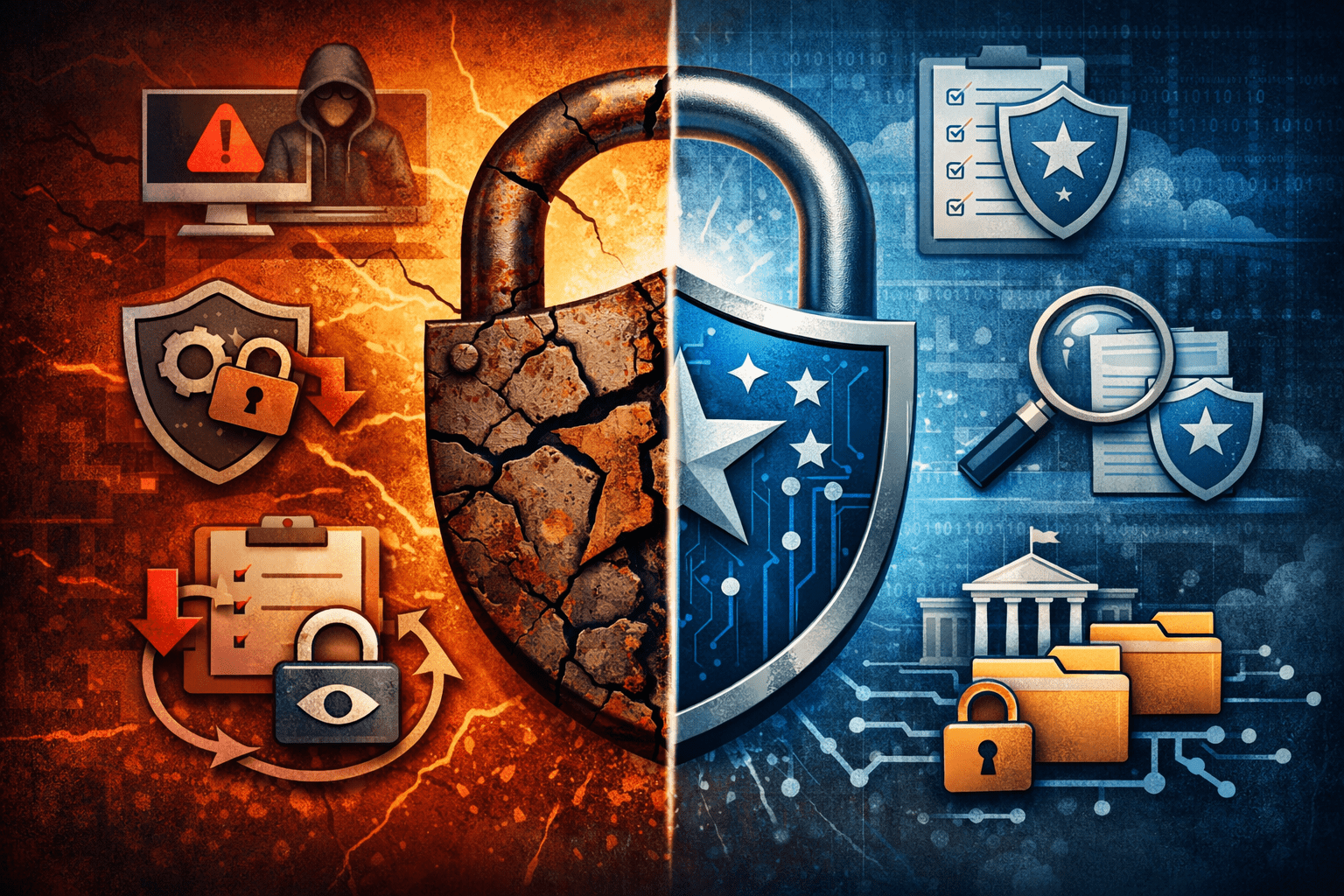
Traditional IT security was designed to protect networks, not enforce compliance. Firewalls, VPNs, endpoint tools, and monitoring platforms were built to defend against threats, not to prove that controls are consistently enforced across every system.
CMMC changes the requirement. It is not enough to detect threats or respond to incidents. Organizations must demonstrate that access is controlled, data is protected, and activity is fully visible at all times.
We see companies invest heavily in security tools, yet fail audits because their architecture allows too much exposure, inconsistent access, and fragmented visibility. The issue is not effort. It is the model.
CMMC exposes the limitations of traditional security.
What Traditional IT Security Is Built For
Traditional models focus on perimeter defense and reactive protection.
• Firewalls, designed to block unauthorized traffic at the network boundary but not control internal access
• VPNs, created to extend network access to remote users but often increasing exposure
• Endpoint security tools, focused on protecting devices rather than controlling system-level access
• Detection and response systems, built to identify threats after they occur rather than prevent access
These controls are necessary, but they do not enforce compliance requirements.
Where Traditional Security Breaks Under CMMC
CMMC requires enforceable controls across all systems and environments.
We see traditional environments fail because:
• Access is too broad, allowing users to move across systems beyond their role
• Infrastructure is visible, making systems discoverable and easier to target
• Monitoring is fragmented, limiting visibility into user and system activity
• Control enforcement is inconsistent, varying across cloud, on-prem, and endpoints
These gaps create immediate audit findings.
Security vs Compliance Enforcement
Traditional Security Model (Reactive Defense)
Security focuses on detecting and responding to threats.
This reduces impact but does not prevent exposure.
Enhanced Security Model (Layered Tools)
Organizations add more tools to improve protection.
This increases coverage but does not ensure consistent enforcement.
Compliance-Driven Model (CMMC Requirement)
Controls must be enforced consistently across all systems.
This requires architecture that supports continuous validation.
Key Areas Where Traditional Security Fails CMMC
Access Control
• Broad network access, allowing users to access multiple systems once authenticated
• Lack of least privilege enforcement, giving users more permissions than necessary
• Inconsistent access policies, creating gaps across systems
Identity and Authentication
• Authentication only at login, failing to validate identity during active sessions
• Weak MFA enforcement, reducing effectiveness of identity controls
• Limited session control, allowing prolonged or unmanaged access
Data Protection
• Data stored on endpoints, increasing risk of unauthorized access or loss
• Inconsistent encryption, leaving data exposed in certain environments
• Uncontrolled data movement, allowing sensitive data to leave secure systems
Monitoring and Visibility
• Fragmented logging, making it difficult to track activity across systems
• Limited real-time visibility, delaying detection of issues
• Incomplete audit trails, failing to meet compliance requirements
Infrastructure Exposure
• Public-facing systems, increasing attack surface and audit risk
• Persistent access paths, such as VPNs, creating ongoing entry points
• Lack of isolation, allowing lateral movement across environments
Why Adding More Tools Does Not Fix the Problem
Many organizations respond to CMMC by adding more security tools.
We see this approach fail because:
• Tools operate independently, creating gaps between systems
• Enforcement varies, depending on configuration and integration
• Complexity increases, making it harder to maintain consistent control
• Visibility remains fragmented, reducing audit readiness
The issue is not the number of tools. It is how the environment is structured.
What CMMC Requires Instead
CMMC requires enforceable, architecture-level control.
Identity-Centered Access Control
• Multi-factor authentication, ensuring strong and consistent user verification
• Role-based access control, limiting access based on job function
• Least privilege enforcement, reducing unnecessary permissions and exposure
Controlled and Isolated Environments
• Protects sensitive data, keeping it within secure and controlled systems
• Limits lateral movement, preventing attackers from moving across environments
• Improves containment, isolating incidents and reducing impact
Centralized Monitoring and Visibility
• Consolidates logs, providing a unified and reliable source of activity data
• Improves detection, enabling faster identification of anomalies and threats
• Supports compliance, ensuring audit-ready reporting and traceability
How ShieldHQ Replaces Traditional Security Limitations
ShieldHQ Powered by Dispersive® Stealth Networking addresses the structural gaps in traditional security models.
• Secure workspaces centralize applications and data, reducing reliance on endpoints and improving control
• Stealth networking removes infrastructure from discovery, eliminating attack surface and exposure
• Identity-driven access enforces strict authentication, aligning with Zero Trust and CMMC requirements
• Centralized monitoring provides audit-ready visibility, ensuring consistent control enforcement
This shifts security from reactive defense to enforced compliance.
How Mindcore Technologies Transforms Security for CMMC
Mindcore Technologies helps organizations move beyond traditional security models.
• Assess current environment, identifying gaps in exposure and control enforcement
• Map CMMC requirements to systems, ensuring alignment with compliance standards
• Design architecture for enforceable security, reducing reliance on fragmented tools
• Implement ShieldHQ, enabling controlled access and visibility
• Prepare for audits, ensuring readiness for assessment
• Provide ongoing support, maintaining compliance over time
Execution determines whether compliance is achieved.
Final Takeaway
Traditional IT security fails CMMC compliance because it is built around perimeter defense, endpoint protection, and reactive detection, rather than enforcing consistent control across access, data, and systems. While these tools provide protection, they do not eliminate exposure, restrict access effectively, or deliver the visibility required for compliance, which leads to gaps during assessment. CMMC requires architecture that enforces identity-driven access, isolates environments, and centralizes monitoring so that controls are continuously applied and auditable. Organizations that continue relying on traditional models will struggle with compliance, while those that adopt architecture-driven approaches align security with CMMC requirements by design.
If your organization is evaluating why its current security model is not meeting compliance expectations, schedule a free strategy call with Mindcore Technologies to assess your environment and define a path forward.