

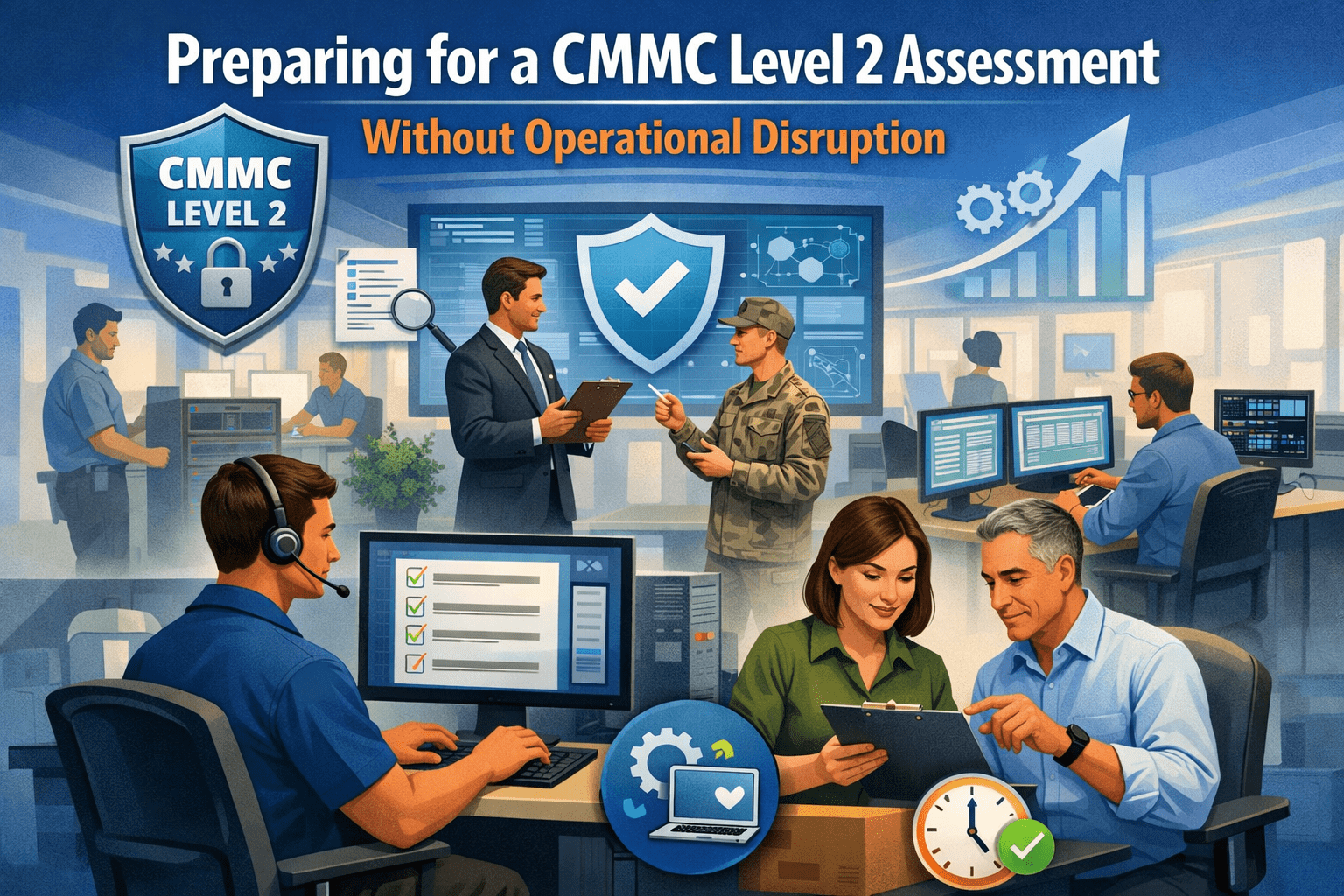
CMMC Level 2 C3PAO assessments are high-stakes events. They determine contract eligibility, require significant evidence preparation, and involve external reviewers examining the security infrastructure that runs the business. For organizations that treat assessment preparation as a separate project requiring dedicated resources and operational pauses, they are also disruptive.
They do not need to be.
Organizations that approach CMMC assessment preparation as a continuous maturation program — not a pre-assessment sprint — arrive at assessment week with evidence that accumulated naturally, controls that are operational rather than recently deployed, and staff that understand their security responsibilities because those responsibilities are part of how the organization operates, not something they were briefed on before the assessors arrived.
Overview
CMMC Level 2 assessment preparation without operational disruption requires three things: a realistic gap assessment performed early enough to allow continuous remediation rather than a last-minute rush, evidence management practices that accumulate assessment-ready artifacts as a byproduct of normal operations, and a remediation sequencing approach that prioritizes controls by assessment impact and operational risk rather than alphabetically by domain. Organizations that establish those three practices well before their assessment window experience assessment as a verification event, not a crisis.
- Early gap assessment identifies remediation scope before timeline pressure forces shortcuts
- Continuous evidence accumulation produces assessment artifacts naturally rather than through pre-assessment compilation sprints
- Remediation sequencing by assessment impact and operational risk prevents disruptive last-minute changes
- Staff security awareness that is operational rather than pre-assessment briefing produces assessor interviews that reflect actual practice
- Mock assessment exercises identify presentation and documentation gaps before the actual C3PAO visit
The 5 Why’s
- Why does last-minute assessment preparation create operational disruption that continuous preparation avoids? Last-minute preparation compresses remediation, evidence compilation, and staff preparation into a short window while business operations continue. That compression produces context switching, staff distraction, rushed implementations with higher failure rates, and evidence packages that were assembled rather than accumulated. Continuous preparation eliminates the compression by distributing those activities across the full preparation timeline.
- Why do organizations consistently underestimate the evidence compilation burden in CMMC assessments? CMMC Level 2 requires evidence across 110 practices covering 14 domains. Each practice may require policy documentation, implementation evidence, and operational records demonstrating ongoing compliance. Organizations that have not been continuously accumulating that evidence discover during pre-assessment preparation that compiling it takes weeks — not because they are not compliant, but because the evidence exists in fragmented form across systems that were never designed to produce assessment packages.
- Why is remediation sequencing by assessment impact more effective than domain-by-domain remediation? Domain-by-domain remediation produces an environment where some domains are assessment-ready and others are not — which creates the last-minute compression problem. Sequencing by assessment impact — addressing the practices most likely to generate findings first — produces an environment where the highest-risk gaps are closed early and remaining remediation items are lower-stakes by the time the assessment arrives.
- Why do assessor interviews with operational staff produce different results than technical evidence review alone? C3PAO assessors verify not just that controls are documented but that staff implement them in practice. Staff who were briefed on security procedures specifically for the assessment produce interview responses that reflect the briefing, not operational practice — a discrepancy that experienced assessors recognize. Staff whose daily work reflects the security controls they describe produce consistent, credible interview responses without special preparation.
- Why is a mock assessment the most valuable pre-assessment preparation activity? A mock assessment conducted by an objective internal team or third party reveals the presentation and documentation gaps that are invisible to staff who know the environment too well to see it as an assessor would. Findings from a mock assessment produce targeted remediation of high-impact gaps with enough lead time for effective closure before the actual C3PAO visit.
The Non-Disruptive Assessment Preparation Sequence
18+ Months Before Assessment: Gap Analysis and Roadmap
- Conduct a gap analysis against the full CMMC Level 2 practice set using C3PAO assessment standards — not self-assessment standards
- Produce a remediation roadmap that sequences gap closure by assessment impact and operational complexity
- Identify evidence management practices needed to accumulate assessment artifacts naturally — what systems, procedures, and records need to be created or formalized
12 Months Before Assessment: Foundation Controls
- Implement access control, identification and authentication, and audit logging foundation controls — these underpin assessor verification of nearly every other domain
- Establish continuous monitoring procedures and begin accumulating operational records
- Initiate staff security awareness program that reflects actual security responsibilities, not pre-assessment briefing content
6 Months Before Assessment: Evidence Architecture
- Verify that evidence for implemented controls exists in assessor-verifiable format
- Identify and close documentation gaps — policy documents, procedure records, configuration baselines
- Conduct tabletop exercises for incident response and configuration change management — these produce records that demonstrate operational practice
3 Months Before Assessment: Mock Assessment
- Conduct a full mock assessment against the CMMC Level 2 practice set
- Identify presentation gaps (controls implemented but not easily demonstrable) and documentation gaps (controls implemented but without adequate evidence)
- Prioritize final remediation on mock assessment findings
6 Weeks Before Assessment: Assessment Logistics
- Organize evidence packages for each domain — assessors should be able to locate evidence for any practice without staff guidance
- Brief staff on assessment logistics (not security procedures — those should already be operational)
- Verify that systems assessors will review are in their normal operational state — not in a specially configured pre-assessment state that does not reflect how they operate
What to Avoid in Assessment Preparation
- Last-minute control deployments — controls deployed in the weeks before assessment generate new operational risk and produce evidence records that show recent implementation rather than operational maturity
- Evidence fabrication — back-dating records, creating retrospective documentation, or representing controls as implemented when they are recently deployed produces findings that are far more serious than the original compliance gap
- Pre-assessment configuration changes — assessing a system in a configuration different from its normal operational state produces assessment results that do not reflect operational compliance
- Staff script preparation — preparing staff with scripted answers rather than operational understanding produces inconsistent responses under assessor follow-up questioning
Final Takeaway
CMMC Level 2 C3PAO assessment preparation does not disrupt operations when it is structured as a continuous maturation program rather than a pre-assessment sprint. The organizations that arrive at assessment week with operational controls, accumulated evidence, and staff who demonstrate security awareness through practice rather than briefing are the organizations that complete assessments without business disruption — because assessment is verifying what they have been doing, not auditing what they rushed to implement.
Prepare for CMMC Level 2 Assessment With Mindcore Technologies
Mindcore Technologies works with DIB contractors to structure CMMC Level 2 assessment preparation as a continuous maturation program — gap analysis, remediation sequencing, evidence architecture, continuous monitoring implementation, mock assessments, and assessment logistics that produce C3PAO readiness without operational disruption.
Talk to Mindcore Technologies About CMMC Level 2 Assessment Preparation →
Contact our team to assess your current CMMC readiness and build the preparation roadmap that gets you to assessment-ready without disrupting the operations that depend on the contracts you are protecting.

