

Business automation has a platform problem. The tools that are easy to use are expensive at scale and restrictive about data handling. The tools that give organizations control require developer resources to build and maintain. The tools that integrate well with enterprise systems do not have the accessibility that operational teams need to build and modify workflows independently.
n8n resolves that tension. It combines the accessibility of a visual workflow builder with the data control of self-hosted open-source deployment, the integration depth of a developer-grade platform, and the AI capability that makes modern automation genuinely intelligent. That combination is not incremental improvement on the existing automation tool landscape — it is a different point in the solution space that the landscape has been converging toward.
Overview
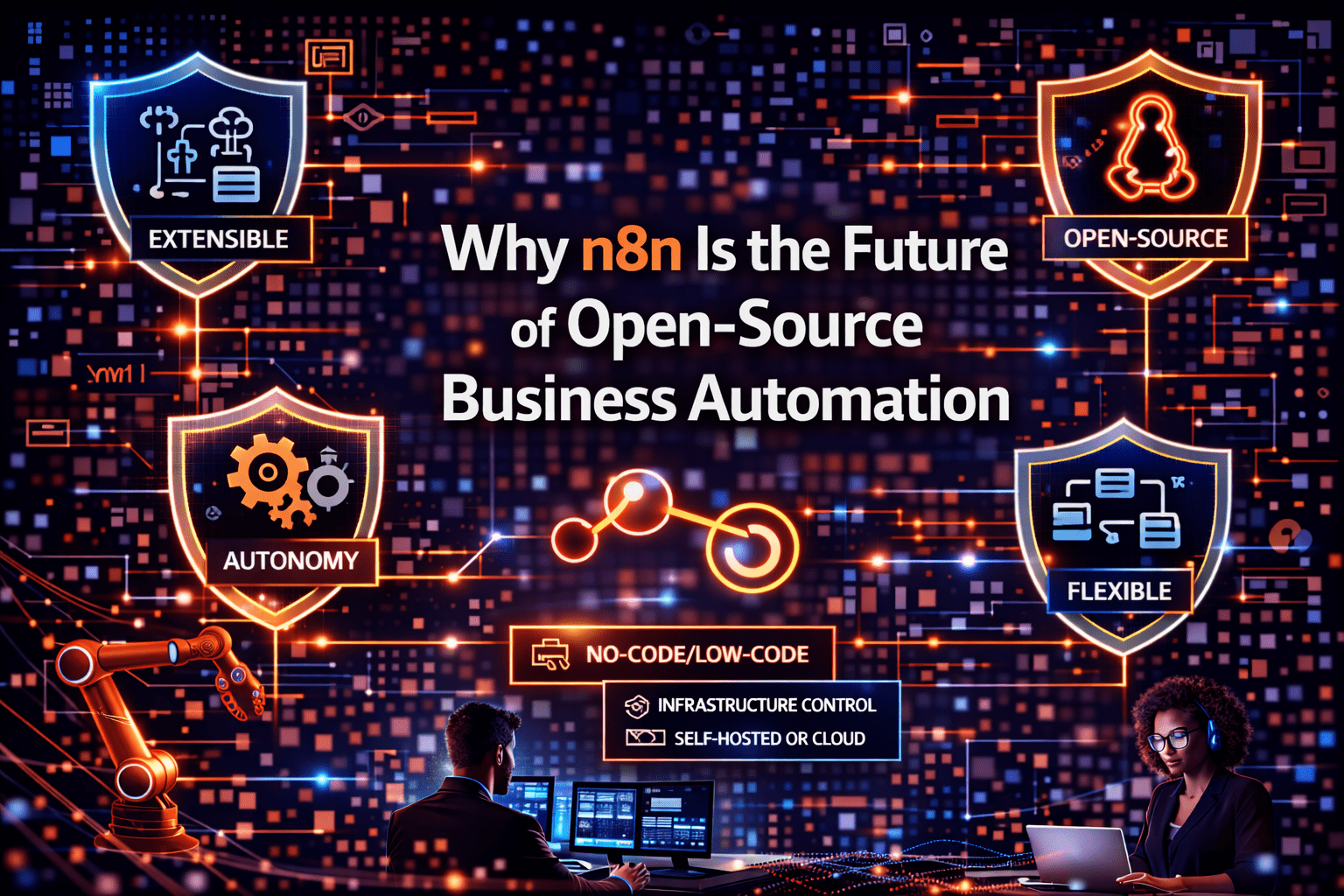
n8n occupies the position that enterprise automation has needed but not had: a platform accessible enough for operational teams to build workflows without developer involvement, flexible enough to handle the complexity of real business processes, open enough to deploy on your own infrastructure with full data control, and forward-looking enough that AI-driven workflow capability is native rather than bolted on. Those characteristics together explain why n8n is not just a growing automation platform — it is the direction the automation category is moving.
- Open-source architecture with self-hosting gives businesses data sovereignty that SaaS platforms cannot provide
- Visual workflow builder with code escape hatch makes automation accessible without sacrificing capability
- 400+ native integrations plus custom API support covers the full enterprise technology stack
- Native AI node support enables AI-augmented workflows without separate AI platform integration complexity
- Active development community produces capability improvements faster than proprietary platforms
This aligns with modern AI automation strategies and enterprise transformation initiatives.
The 5 Why’s
Why does open-source specifically matter for business automation platforms now, when it mattered less before?
Business automation workflows handle sensitive operational data — customer records, financial transactions, HR information, and proprietary process data. SaaS automation platforms process that data on third-party infrastructure under terms of service that organizations cannot fully control. As data privacy regulations tighten and enterprise procurement scrutiny increases, the ability to run automation on owned infrastructure is moving from a preference to a requirement. n8n’s open-source, self-hostable architecture directly addresses that requirement.
Why is n8n’s node-based architecture more future-proof than trigger-action automation platforms?
Trigger-action platforms (Zapier, Make, and equivalents) are optimized for two-step workflows. Business automation needs — especially AI-augmented workflows, multi-system orchestration, and complex conditional logic — require more architectural flexibility than trigger-action platforms provide. n8n’s node architecture handles arbitrarily complex workflows natively. As automation use cases evolve toward AI agents, multi-step orchestration, and real-time event processing, n8n’s architecture accommodates those patterns without requiring platform replacement.
Why does n8n’s combination of visual building and code support represent the right capability balance for enterprise adoption?
Visual-only platforms limit what business users can build without developer involvement. Code-only platforms exclude business users from the automation process entirely. n8n’s model — visual workflow building for the majority of use cases, code nodes for the cases that require custom logic — allows IT and business teams to work together on automation without creating developer dependency for routine workflow maintenance.
Why is native AI integration specifically a forward-looking differentiator for n8n?
Most automation platforms that support AI do so through HTTP request nodes that call external AI APIs — which works but requires custom configuration for every AI workflow and does not benefit from the platform’s native workflow context. n8n’s native AI nodes support LLM calls, agent-based automation, and AI-augmented data processing within the same workflow model used for non-AI automation. As AI becomes standard in operational automation, platforms with native AI integration will have fundamental workflow design advantages over those adding AI as an afterthought.
Why does the n8n community development model accelerate capability growth in ways proprietary platforms cannot match?
n8n’s open-source community contributes integrations, workflow templates, and capability improvements at a rate that a proprietary development team cannot match. Organizations building on n8n benefit from community-developed nodes for niche integrations, community-shared workflow templates for common use cases, and community-identified improvements that are incorporated into the platform through the open-source contribution model. That development velocity is a structural advantage over closed platforms with fixed development roadmaps.
What Makes n8n the Future Rather Than Just the Present
AI-Native Workflow Architecture
n8n’s AI integration goes beyond API calls to AI services. It supports:
- LangChain integration for building AI agent workflows within the n8n workflow model
- Memory management for multi-turn AI interactions within workflows
- Tool-use patterns where AI agents trigger n8n workflow steps based on reasoning
- Retrieval-augmented generation workflows that combine AI reasoning with enterprise data access
Self-Sovereign Automation Infrastructure
The regulatory and procurement trend toward data sovereignty in enterprise software extends directly to automation platforms. n8n’s self-hosted deployment model positions it as the default choice for:
- Regulated industries where workflow data cannot leave enterprise infrastructure
- Enterprises with data residency requirements that SaaS platforms cannot satisfy
- Organizations that have experienced vendor lock-in with SaaS automation platforms and are prioritizing infrastructure independence
The Open-Source Network Effect
n8n’s open-source model creates a network effect that proprietary platforms cannot replicate: every integration, template, and workflow pattern contributed by the community is available to every user. As the n8n community grows, the practical capability of the platform grows with it — not through a single vendor’s development team, but through the cumulative contribution of thousands of organizations building on the platform.
Final Takeaway
n8n is the future of open-source business automation because it resolves the trade-offs that have defined the automation platform landscape — data control without sacrificing accessibility, visual building without sacrificing flexibility, integration depth without developer dependency, and AI capability without architectural complexity. Those resolutions are not marginal improvements on existing platforms. They define the direction the automation category is moving, and n8n is already there.
Build on n8n’s Open-Source Platform With Mindcore Technologies
Mindcore Technologies designs and deploys n8n automation on your infrastructure — self-hosted architecture, workflow development, AI integration, and ongoing platform management that gives you the capability of enterprise automation with the data control and cost structure that open-source deployment provides.
Schedule your free strategy call to assess your automation strategy and design your deployment.

