

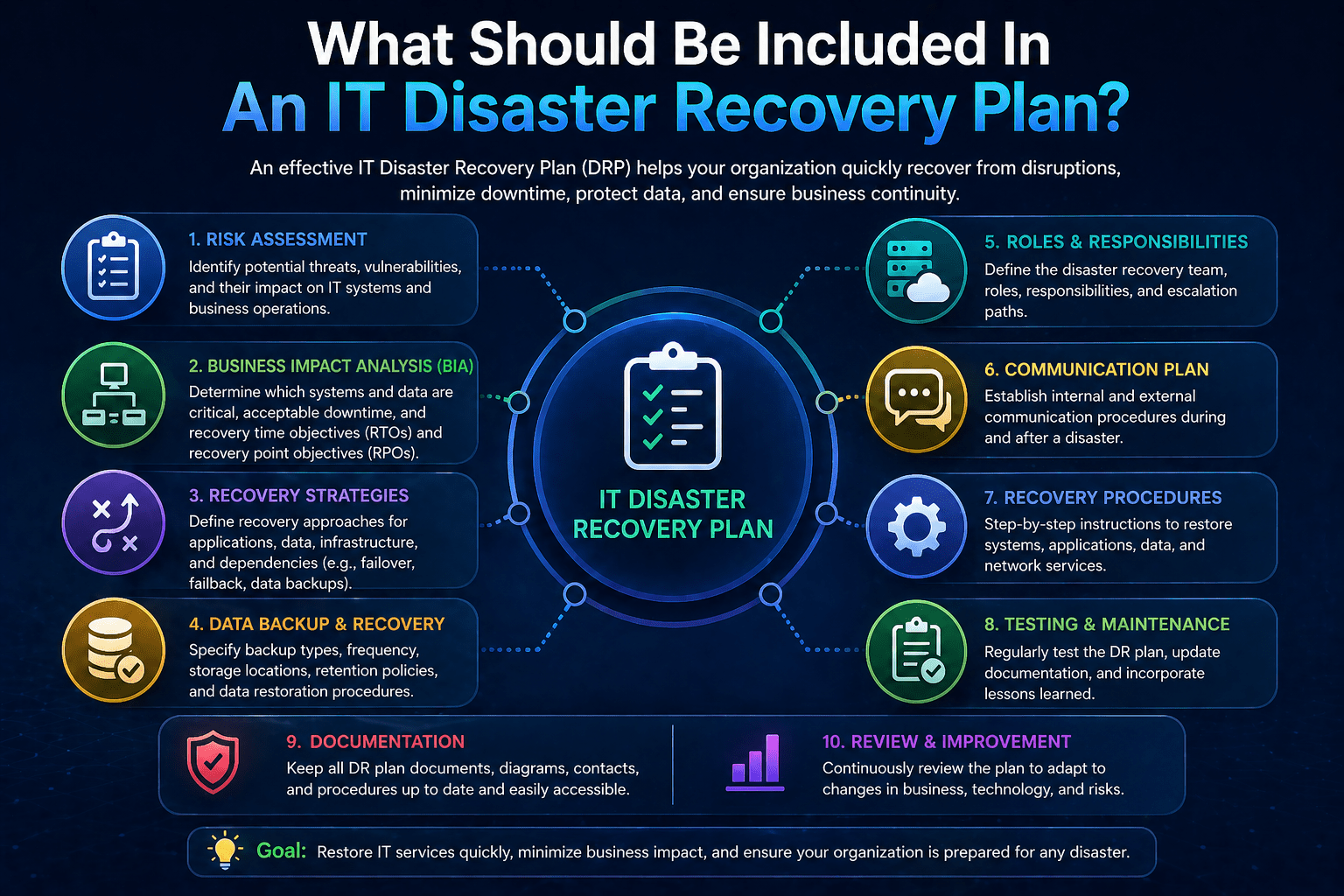
An IT Disaster Recovery Plan that covers recovery procedures but omits contact information, escalation paths, and vendor support details is a plan that stalls in execution when someone cannot reach the right person at 2 AM. One that defines recovery objectives but does not assign clear roles produces a recovery effort where everyone is waiting for someone else to make decisions.
A complete IT DRP is not just a technical document — it is an operational manual designed to function effectively during a crisis, when stress is high, information is incomplete, and the people executing it may not be the same ones who wrote it.
Overview
A complete IT Disaster Recovery Plan includes five categories of content: foundational documentation (scope, objectives, assumptions), critical system inventory and prioritization, technical recovery procedures, roles and responsibilities, and communication protocols. Each category addresses a different failure mode of improvised disaster response. Together, they provide everything needed to execute coordinated recovery without relying on real-time decisions that crisis conditions make unreliable.
- Foundational documentation establishes the scope and standards against which recovery is measured
- System inventory and prioritization determines what gets recovered first and why
- Technical procedures define exactly how each critical system is recovered
- Role assignments ensure accountability and coordination during execution
- Communication protocols manage internal and external communication during and after the event
The 5 Why’s
- Why must the DRP include contact information when most people have phones with contacts saved? During a significant IT disaster — particularly ransomware that encrypts systems — normal communication channels may be unavailable: email is down, internal systems are offline, and staff may be panicking. A physical or offline-accessible contact list with personal phone numbers, escalation paths, and vendor support contacts that does not depend on systems that might be unavailable is an essential operational component.
- Why does system prioritization specifically matter in a DRP rather than recovering everything simultaneously? Recovering everything simultaneously is rarely possible — resources are limited, dependencies create sequencing requirements, and some systems must be operational before others can start. System prioritization based on business impact analysis ensures that the systems most critical to business operations are recovered first, and that the recovery sequence respects the dependencies between systems (Active Directory before dependent applications, database servers before application servers, etc.).
- Why must recovery procedures be specific enough for someone unfamiliar with the system to execute them? The IT staff member most familiar with a specific system may be unavailable during a disaster — on vacation, unreachable, or affected by the same event that caused the disaster. Recovery procedures written at the level of “restore the system” are not executable by a backup staff member. Procedures written at the level of specific commands, specific tool workflows, and specific validation tests can be executed by someone following the document even without deep system familiarity.
- Why do vendor and service provider contacts specifically require their own section in the DRP? Recovery often requires engaging hardware vendors for replacement equipment, software vendors for license recovery, cloud providers for support escalation, and cybersecurity firms for incident response assistance. The contacts for those engagements — support phone numbers, account numbers, existing support agreement details — are needed under conditions when normal business systems may not be available. They must be in the DRP, not just in someone’s email.
- Why does the DRP require a testing schedule rather than just a plan for testing “when possible”? Testing “when possible” means testing never happens, or happens only when a compelling event forces it. A scheduled testing requirement — annual tabletop exercises, technical recovery tests after major infrastructure changes, full DR exercises periodically — converts testing from an intention into an obligation with accountability.
Complete DRP Component Checklist
1. Plan Administration
- Document version, date, and change history
- Review and approval signatures
- Distribution list — who has access to the current plan
- Review schedule — when the plan is reviewed and updated
2. Purpose, Scope, and Objectives
- What the plan covers — which systems, which locations, which scenarios
- Recovery Time Objectives (RTO) per system tier
- Recovery Point Objectives (RPO) per system tier
- Key assumptions and limitations of the plan
3. Business Impact Analysis Summary
- Identification of critical business processes and the IT systems that support them
- Impact analysis — what it costs the business per hour/day for each critical system to be unavailable
- Recovery priority tiers based on business impact
4. Critical System Inventory
- Inventory of all systems covered by the DRP
- System descriptions — purpose, dependencies, data classification
- Recovery priority assignment (Tier 1: must recover within RTO; Tier 2: recover within 24 hours; Tier 3: recover within 48-72 hours)
- Current configuration documentation — hardware specifications, software versions, network configuration
5. Recovery Procedures
For each critical system:
- Disaster declaration trigger — what conditions trigger initiating recovery for this system
- Pre-recovery checklist — steps before recovery begins (notify stakeholders, preserve evidence, etc.)
- Step-by-step recovery procedure — specific commands, tools, and actions
- Recovery validation tests — how to verify the system is functional after recovery
- Escalation path — who to contact if the procedure fails or produces unexpected results
6. Roles and Responsibilities
- Disaster Recovery Coordinator — overall accountability for recovery execution
- Technical Recovery Team — system-specific recovery execution
- Communications Lead — internal and external communications management
- Business Liaison — coordination with business unit leaders on priorities and status
- Executive Decision Authority — who can authorize resource expenditure and recovery priority changes
Include: primary and backup contacts for each role; contact information for each person.
7. Contact Directory
- Internal: all DR team members with personal phone numbers and after-hours contacts
- Vendors and service providers: hardware vendors (with account numbers and support line), software vendors, cloud providers, internet service provider, cybersecurity incident response firm
- External parties: insurance contact, legal counsel, regulatory notification contacts (if applicable)
8. Communication Protocols
- Internal notification procedure — how and when to notify employees
- Customer and partner communication — templates, approval requirements, communication channels
- Media and public communication — who is authorized to speak externally, approved messaging
- Regulatory notification — applicable notification requirements and timelines (HIPAA breach notification, GDPR, etc.)
9. Vendor and Third-Party Procedures
- Service provider contacts and escalation procedures
- Hardware replacement procedures and lead times
- Cloud provider support escalation
- Cybersecurity incident response engagement procedures
10. Testing and Maintenance
- Testing schedule — tabletop exercises, technical tests, and full DR test frequency
- Testing procedures — how tests are conducted and what they validate
- Plan review schedule — when the plan is reviewed and updated
- Change triggers — events that require plan review (major infrastructure changes, acquisitions, staff changes in key roles)
Final Takeaway
A complete IT Disaster Recovery Plan is comprehensive by design — not because thoroughness is its own reward, but because disaster recovery fails when the person executing it cannot find the contact they need, does not know their role, or is following a procedure that has not been validated. Every component in the checklist above addresses a real failure mode of incomplete DRP documentation. The plan that covers all of them is the one that works when it matters.
Develop a Complete IT Disaster Recovery Plan With Mindcore Technologies
Mindcore Technologies works with organizations to develop complete, tested IT Disaster Recovery Plans — business impact analysis, system prioritization, recovery procedure documentation, role assignment, and testing programs that produce DR capability you can depend on.
Talk to Mindcore Technologies About IT Disaster Recovery Planning →
Contact our team to assess your current DRP completeness and develop the plan your business operations require.

