

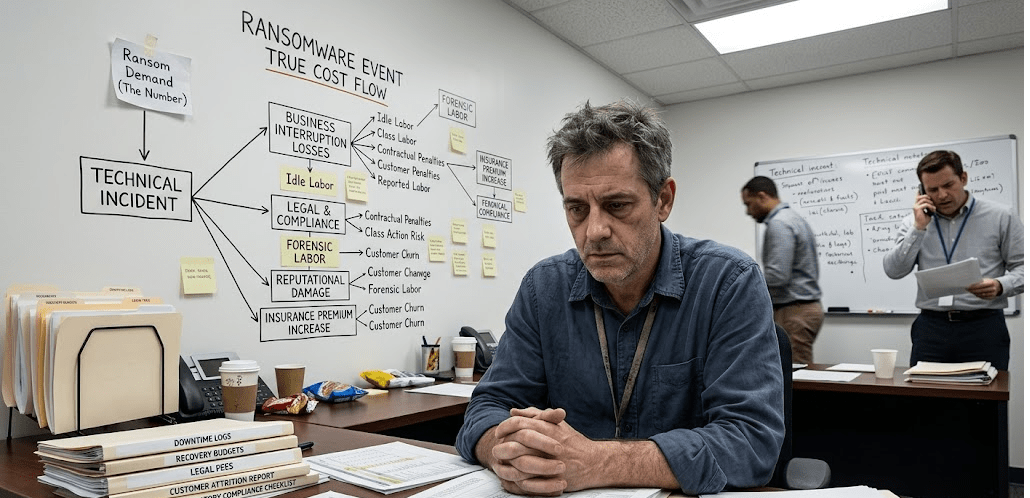
The ransom demand is the number that gets reported. It is not the number that determines what a ransomware event actually costs.
Organizations that evaluate the ransom payment decision by comparing the demand against the perceived cost of recovery are working with incomplete information. The ransom demand is one line item in a cost structure that includes downtime losses, recovery labor, regulatory penalties, legal fees, cyber insurance implications, customer attrition, and reputational damage that accumulates long after the technical recovery is complete.
The gap between the ransom demand and the true total cost of a ransomware event is significant in every industry and at every organization size. Understanding that gap changes the calculus on both the payment decision and, more importantly, the preparation investment.
This article breaks down every component of ransomware cost, what drives each component, and how preparation investments reduce the total across all of them.
Organizations strengthening ransomware preparedness should also evaluate cybersecurity services, ransomware protection, and managed IT services.
The Cost Components Most Organizations Undercount
When executives discuss ransomware cost, they typically focus on the ransom demand and the immediate recovery expenses. Both are real. Neither captures the full picture.
The cost components that most organizations undercount are the ones that accumulate over weeks and months rather than in the first days of the incident.
Downtime and Business Interruption
Downtime is the largest single cost component in most ransomware events, and it is the component most directly determined by preparation.
Organizations with tested backup infrastructure and documented recovery procedures restore in days. Organizations without them restore in weeks or months.
Business interruption cost includes:
- Revenue impact
- Idle labor
- Missed customer commitments
- Contractual penalties
- Spoilage of time-sensitive materials
- Opportunity costs from transactions that cannot be completed
For mid-size organizations, daily downtime costs frequently range from tens of thousands to hundreds of thousands of dollars depending on industry and revenue volume.
Organizations reducing downtime risk should also evaluate business continuity planning.
Recovery Labor and Incident Response
The labor cost of ransomware recovery is consistently underestimated because it includes categories that are not visible in the initial cost assessment.
Cost categories include:
- Internal IT labor working extended hours
- External incident response firm fees
- Forensic investigation costs
- Legal counsel fees
- Specialized vendor costs for OT system recovery
External incident response and forensic investigation engagements for mid-size enterprise environments can run from tens of thousands to hundreds of thousands of dollars depending on complexity and dwell period length.
Organizations improving response readiness should also review incident response services.
Ransom Payment and Negotiation
The ransom demand is the publicized number, but the payment economics are more complex.
Organizations that consider payment often also face:
- Negotiation fees
- Cryptocurrency transaction costs
- Emergency acquisition costs for cryptocurrency
- Risk of non-functional decryption keys
- Risk of partial recovery
Payment is not a shortcut out of the recovery process. It is an additional expense on top of the recovery process.
Regulatory Penalties and Compliance Costs
Regulatory penalties following a ransomware event depend on the frameworks that apply to the organization and whether the organization met its compliance obligations before and during the incident.
Healthcare organizations may face HIPAA civil monetary penalties. Financial services organizations may face SEC, FINRA, DFS, and state regulatory exposure. Defense contractors may face CMMC-related contract performance risk and potential debarment exposure.
Compliance remediation costs may also include:
- Documentation updates
- Control implementation
- Legal representation
- Third-party assessments
- Regulatory response support
Organizations managing regulatory exposure should also evaluate cybersecurity compliance services and CMMC consulting services.
Legal Fees and Litigation
Legal costs begin in the first hour with regulatory advice and may continue for years after the technical recovery is complete.
Legal cost components include:
- Outside counsel fees
- Regulatory notification management
- OFAC sanctions screening
- Litigation defense
- Securities litigation defense
- Employment matters connected to security failures
Class action litigation following major ransomware events has become a standard follow-on consequence in industries where large numbers of individuals were affected by data exposure.
Customer Attrition and Revenue Impact
Customer attrition following a ransomware event does not appear on an immediate expense line, but it accumulates over months and years.
Customer attrition is highest in industries where trust is central to the relationship, including:
- Financial services
- Healthcare
- Legal services
The revenue impact compounds with the cost of acquiring replacement customers, which is usually higher than the cost of retaining existing customers.
Reputational Damage and Market Impact
Reputational damage affects the organization’s ability to:
- Attract new customers
- Retain existing customers
- Recruit talent
- Maintain premium pricing
- Preserve market trust
For public companies, stock price impact following a material ransomware disclosure is an immediate measurable cost. For private companies, reputational damage appears in sales cycle delays, partnership concerns, and talent acquisition challenges.
Cyber Insurance Premium Impact
A ransomware claim affects the cyber insurance relationship beyond the claim itself.
Post-incident insurance impacts may include:
- Premium increases
- Coverage condition changes
- New control requirements
- Lower ransomware sub-limits
- Higher deductibles
The premium impact of a ransomware claim is a multi-year cost that appears in each renewal cycle following the incident.

How Preparation Reduces Total Cost Across Every Component
The relationship between preparation investment and total ransomware cost is direct across every cost component.
Organizations that invest in backup infrastructure, tested recovery procedures, network segmentation, and incident response planning reduce their total cost in every category.
- Downtime cost is reduced by faster recovery timelines.
- Recovery labor cost is reduced by documented and practiced recovery processes.
- Regulatory penalty exposure is reduced by documented security programs and implemented controls.
- Legal cost is reduced by pre-established counsel relationships and notification processes.
- Customer attrition is reduced by faster, more transparent response.
- Reputational damage is reduced by credible remediation and clear communication.
Organizations improving long-term resilience should also review co-managed IT services, cloud services, and secure workspace architecture.
Building the Total Cost Model
Organizations that want to understand their true ransomware cost exposure need a total cost model that includes all components rather than just the ransom demand and immediate recovery costs.
A complete total cost model for a mid-size organization estimates:
- Downtime cost based on daily revenue impact multiplied by a realistic recovery timeline.
- Recovery labor based on internal IT hours, external incident response, forensic investigation, and legal counsel fees.
- Regulatory exposure based on applicable frameworks and current security program gaps.
- Legal costs based on outside counsel, notification work, and litigation reserve.
- Customer attrition based on customer lifetime value and estimated post-incident attrition.
- Insurance premium impact based on current premium and realistic post-claim increase.
This model usually produces a total expected cost significantly higher than the ransom demand and frequently higher than the annualized cost of the preparation investments that would reduce it.
Meet Our CEO, Matt Rosenthal
With more than 30 years of experience in business and technology leadership, Matt Rosenthal has helped organizations across healthcare, finance, legal, manufacturing, and defense understand the true cost of ransomware risk and build the preparation investments that reduce that cost before an incident makes it real.
As President and CEO of Mindcore Technologies, Matt leads a team that provides cybersecurity services and managed IT services designed to close the security gaps that determine ransomware outcomes.
Matt’s approach to ransomware cost is straightforward: the organizations that understand what ransomware actually costs make different preparation decisions than those that think of it as a ransom demand problem.
Frequently Asked Questions
What is the average total cost of a ransomware attack for a mid-size organization?
Published research on ransomware costs varies significantly by methodology, industry, and organization size. Figures from incident response firms and insurance industry data consistently show total costs in the range of several times the ransom demand when all components are included.
For mid-size organizations, total costs including downtime, recovery, legal, and regulatory components frequently reach seven figures even for incidents where the ransom demand itself was in the low six figures.
Does cyber insurance cover all of these cost components?
Cyber insurance policies vary significantly in what they cover. Most policies provide some coverage for breach response costs, business interruption losses, regulatory defense costs, and ransom payments.
Coverage limits, deductibles, and sub-limits mean that even comprehensive policies may not cover the full total cost of a significant ransomware event.
How do we calculate downtime cost for a business continuity analysis?
Downtime cost calculation starts with the organization’s revenue per business day, then adjusts for the specific functions affected by the outage and the extent to which those functions can be maintained through manual or alternative processes.
Adding idle labor cost, missed commitment penalties, and spoilage costs produces a more complete downtime cost figure than revenue impact alone.
Is the reputational cost of ransomware quantifiable?
Reputational cost is difficult to quantify precisely because its effects are distributed across future revenue and relationship outcomes rather than appearing as discrete expenses.
For private companies, customer retention tracking, new customer acquisition rate comparison, and pipeline conversion analysis before and after the incident provide operational measures of reputational impact.
How does preparation investment compare to ransomware cost as a return on investment calculation?
The ROI calculation for ransomware preparation is the expected value of the ransomware cost reduction enabled by the preparation, compared against the cost of the preparation.
For most organizations in targeted industries, the annual probability of a significant ransomware event is not negligible, and the total cost of an unprepared response is large enough that even modest preparation investments produce positive ROI.
Understand the True Cost Before You Set the Preparation Budget
Every conversation about ransomware preparation investment eventually comes down to a number: what does it cost to build the backup infrastructure, implement the controls, and develop the incident response capability that reduces ransomware risk?
That number looks different when it is compared against the true total cost of a ransomware event than when it is compared against just the ransom demand.
The preparation investment that seems expensive compared to a ransom demand looks very different compared to the total cost model that includes downtime, recovery labor, regulatory penalties, legal fees, customer attrition, and reputational damage across the full incident lifecycle.
Mindcore’s cybersecurity services and managed IT services help organizations across healthcare, finance, legal, manufacturing, and defense build the preparation investments that reduce ransomware cost across every component.
If your organization has not modeled its true ransomware cost exposure and compared it against the cost of the preparation that would reduce it, contact Mindcore to start that conversation.
Source content adapted from uploaded file. :contentReference[oaicite:0]{index=0}

