

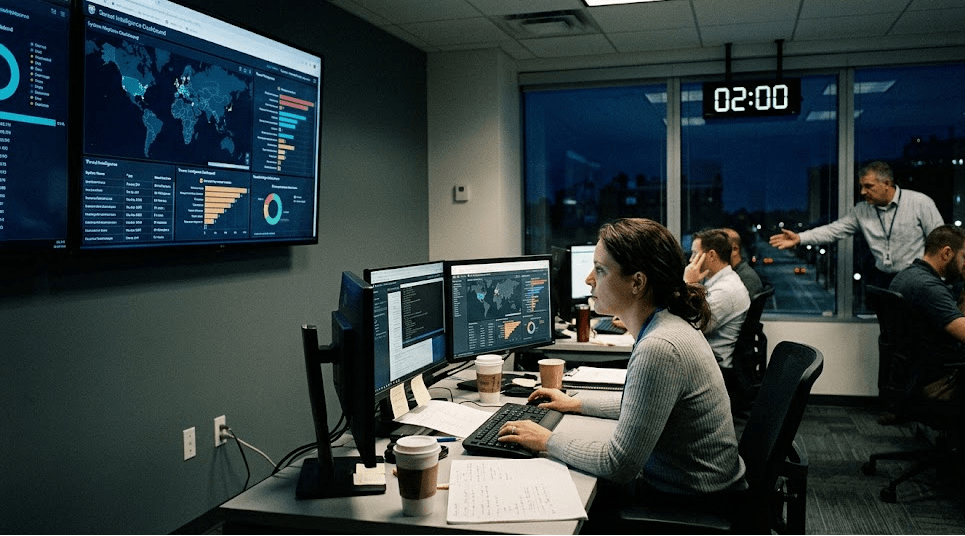
Ransomware operators time their attacks deliberately. Analysis of ransomware deployment patterns consistently shows that encryption events are disproportionately triggered outside business hours, on weekends, and during holidays. This is not coincidence. It is strategy.
The attacker has already completed the preparation work during the dwell period: mapping the network, compromising credentials, identifying and targeting backup infrastructure, and staging the ransomware payload. The only decision remaining is when to trigger the encryption. The attacker chooses the moment when detection is least likely and response is slowest. For most organizations, that moment is 2am on a Saturday.
The response time gap between when encryption begins and when qualified help is engaged determines the scope of the encryption event, the volume of data affected, and ultimately the cost and duration of recovery. Every hour of that gap is additional encryption across systems your team has not yet contained. Every hour of that gap is additional time the attacker maintains access and potentially continues exfiltration. Every hour of that gap is an hour further from the forensic evidence that degrades with time.
This article covers why response time determines recovery outcome, what 24/7 response capability actually requires, where most organizations fall short, and what the investment in genuine 24/7 capability produces in terms of recovery outcomes.
Organizations improving ransomware readiness should also review cybersecurity services, managed IT services, and incident response services.
The Relationship Between Response Time and Recovery Scope
The mathematical relationship between response time and ransomware damage is direct and quantifiable, which makes it one of the clearest cases for security investment in enterprise risk management.
Modern ransomware encryption operates at speeds that make manual detection and response inadequate without automated monitoring infrastructure. Ransomware variants optimized for speed can encrypt tens of thousands of files per minute on modern hardware. An organization with 500,000 files accessible from an infected system and no automated detection can lose the entire dataset before a human analyst reviewing a morning alert queue is even aware an incident occurred.
The containment actions that limit encryption scope, network isolation of infected systems, disabling of remote access infrastructure, and segmentation of affected network areas, must execute at a speed that matches the encryption speed. Human-dependent containment that activates only after a person reviews an alert, determines it is a genuine incident, escalates through an approval chain, and then executes containment actions cannot match the pace of automated encryption.
What automated, continuously monitored detection and response capability provides is the ability to activate containment at machine speed rather than human speed. Automated containment responses triggered by confirmed ransomware indicators can isolate systems, disable accounts, and generate alerts for human review within seconds of detection. The encryption event that would compromise an entire environment in hours against a human-response organization may be contained to a handful of systems against an organization with automated detection and response capability.
The scope difference between those two outcomes is the scope difference between a recoverable contained incident and an enterprise-wide encryption event. That difference is the financial justification for 24/7 monitoring and response investment.
Organizations improving monitoring coverage should also evaluate network security monitoring and ransomware protection services.
What 24/7 Response Actually Requires
The phrase 24/7 monitoring is used loosely in the security industry to describe services that range from genuine continuous security operations to automated alert generation that no one reviews until the next business day. Understanding what genuine 24/7 response requires clarifies what organizations should look for and what they are actually getting from their current arrangements.
Continuous Human Monitoring of Security Alerts
Genuine 24/7 response requires human analysts actively monitoring security alerts at all hours, not automated systems generating alerts that queue for morning review. The distinction matters because ransomware events generate alerts that require human judgment to confirm, prioritize, and act on. Automated alert generation without active human monitoring produces the same operational result as no alerting at all for incidents that occur outside business hours.
A security operations center with staffed overnight shifts and weekend coverage maintains the human judgment component of continuous monitoring. Organizations that have deployed detection tools but have not staffed the monitoring function have detection without response, which means the detection generates records of what happened rather than enabling action that limits what happens.
For organizations that cannot staff a 24/7 security operations center internally, managed detection and response services provide the staffed monitoring function as a service. MDR providers maintain SOC operations continuously and apply human analyst judgment to alerts across their client base at all hours. The per-client cost of MDR services is a fraction of what staffing an equivalent internal SOC would require, which makes the service economically accessible for organizations that would otherwise lack continuous human monitoring.
Defined and Practiced Response Playbooks
Continuous monitoring without defined response playbooks produces analysts who know an incident is occurring but must determine appropriate response actions in real time under pressure. Response playbooks that define the specific actions to take for specific alert types, the authority to take those actions without escalation approval, and the sequence in which actions must occur allow analysts to execute containment at the speed the incident requires rather than the speed that real-time decision-making under pressure allows.
Playbooks must be specific to the alert types generated by the tools in your environment, practiced through tabletop exercises and simulated incidents, and updated as the environment and threat landscape evolve. Generic playbooks that describe response categories without specific action sequences do not provide the operational guidance that enables fast response.
Pre-authorized response actions are particularly important for overnight and weekend incidents where escalation chains are extended. An analyst who must wake a manager, brief them on the incident, and wait for authorization before executing containment actions adds time to the containment window that pre-authorized playbooks eliminate. The most time-critical containment actions, network isolation of confirmed-infected systems, must be pre-authorized for immediate execution by the monitoring analyst without escalation.
Organizations building response playbooks should also review business continuity planning.
Tested Technology Infrastructure
The monitoring and response technology that supports 24/7 capability must be tested outside business hours to confirm it functions as expected when it is needed. Monitoring infrastructure that has never been tested during overnight hours may have coverage gaps, tool failures, or alert routing problems that are not discovered until an incident occurs during those hours.
Endpoint detection and response tools must be deployed and actively reporting on all managed systems, including systems that may be less frequently monitored such as servers in secondary locations, backup systems, and specialized workstations. Coverage gaps in EDR deployment mean the monitoring function cannot see activity on uncovered systems.
SIEM correlation rules must be tuned to generate actionable alerts without the false positive volume that causes alert fatigue in overnight analysts who may be monitoring a larger portfolio of clients with fewer staff. Alert fatigue that causes analysts to begin dismissing alerts without full investigation is a coverage failure that is indistinguishable from no monitoring for the incidents that slip through dismissed alerts.
Communication infrastructure for alerting on-call personnel and escalating to client contacts must be tested regularly to confirm it functions at the hours it is most needed. An alerting system that has never been tested at 2am may not reliably reach the people it is supposed to reach at 2am.

Where Most Organizations Fall Short
The gap between the 24/7 response capability that ransomware risk requires and what most organizations actually have in place is the operational exposure that attackers systematically exploit by timing their attacks to the hours when that gap is largest.
Business Hours Security Operations
The most common organizational security operations model is business hours monitoring with on-call escalation for after-hours incidents. This model provides detection and response capability during business hours and degraded capability outside them.
The degradation is significant. On-call coverage means that an analyst is reachable but is not actively monitoring. An incident that generates alerts at 2am reaches an analyst who must be woken, briefed, and connected to monitoring systems before they can begin assessing and responding. The time from alert generation to active analyst engagement in this model is typically 20 to 60 minutes.
For ransomware events timed to begin at 2am, 20 to 60 minutes of unmonitored encryption time before analyst engagement begins represents a significant portion of what would become the total encryption scope. An environment that would have been contained to five systems with immediate response may have 50 or 500 systems affected by the time an on-call analyst has finished waking up, connecting to monitoring systems, and confirming the incident.
Deployed Tools Without Monitored Response
Many organizations have deployed endpoint detection and response tools, network monitoring, and SIEM platforms that generate alerts without having the operational infrastructure to act on those alerts promptly. The tools generate records of what is happening. Without active monitoring, those records are reviewed after the fact rather than acted on in real time.
This is perhaps the most common security investment gap: organizations that have spent significantly on detection technology and have not invested in the monitoring and response function that makes the technology operationally effective. The technology investment produces compliance documentation and post-incident forensic records. It does not produce the operational protection that requires a human analyst actively monitoring and responding to what the technology detects.
The investment calculus that produces this gap typically involves comparing the visible cost of monitoring and response capability against the less visible cost of the coverage gap. The technology purchase is a line item. The monitoring and response capability gap is an operational risk that does not appear in a budget comparison until an incident occurs during the hours that gap covers.
Incomplete Coverage of Critical Systems
Even organizations with genuine 24/7 monitoring capability frequently have coverage gaps for specific system categories that are outside the primary monitoring scope. Backup systems are among the most commonly monitored inadequately, which is operationally significant because backup infrastructure is a primary attacker target during the dwell period.
If backup systems are not monitored with the same continuous coverage as production systems, an attacker can compromise backup infrastructure during overnight hours without generating alerts that the monitoring function would act on. The next morning, the monitoring team sees clean production systems while the backup infrastructure that would have enabled recovery has been compromised.
OT systems in manufacturing environments, specialized medical devices in healthcare environments, and legacy systems in financial services environments are other common coverage gaps. These systems may not support the agents required for endpoint monitoring, may have been excluded from monitoring scope for operational stability reasons, or may be on network segments not covered by the organization’s monitoring infrastructure.
Organizations improving recovery resilience should also review air-gapped backup strategies and cloud services.
What 24/7 Response Capability Produces in Recovery Outcomes
The difference in recovery outcomes between organizations with genuine 24/7 response capability and those without it is documented in the incident response data that firms publish and in the insurance industry data that tracks claim amounts by incident category.
The consistent finding across this data is that organizations with continuous monitoring and rapid response capability experience significantly smaller blast radii when ransomware events occur, significantly shorter recovery timelines, and significantly lower total incident costs than organizations with limited monitoring capability.
The mechanisms through which these outcome differences occur are specific and predictable.
Smaller blast radius results from containment that activates within minutes of encryption beginning rather than hours. Ransomware that is contained to five systems before an analyst escalates to the client is a materially different recovery scope than ransomware that has run for four hours before discovery and containment.
Faster forensic completeness results from analysts who were monitoring when the incident began having access to alert data, log records, and system telemetry from the earliest moments of the incident. Post-incident forensic investigators who arrive after the fact must reconstruct what happened from whatever artifacts remain. Analysts who were watching in real time have contemporaneous records that accelerate the investigation and produce more complete findings.
Earlier regulatory notification results from incidents that are detected and characterized faster. The regulatory notification timelines that apply to healthcare, financial services, and defense contracting organizations begin at discovery. Organizations that discover incidents faster through continuous monitoring have more of their notification window available for the notification process rather than having consumed it in the detection gap.
Reduced dwell period results from the correlation of alert data across the monitoring period that identifies attacker presence before the encryption event. Continuous monitoring that generates and correlates alerts from the entire dwell period can identify attacker activity that occurred days before the encryption event, enabling earlier disruption of attacks that have not yet reached the encryption phase.
Organizations with regulatory exposure should also evaluate cybersecurity compliance services and CMMC consulting services.
Building Genuine 24/7 Capability
Organizations that want to build genuine 24/7 ransomware response capability have three primary options, each with different cost structures and operational characteristics.
Internal Security Operations Center
An internal SOC with continuous staffing provides the highest level of organizational control over monitoring and response. Internal analysts have direct access to organizational leadership for escalation decisions, are deeply familiar with the specific environment they monitor, and can act with organizational authority without the communication overhead that managed service coordination requires.
The cost of an internal 24/7 SOC is significant and scales with the organization rather than with monitoring volume. Staffing requirements for continuous coverage include a minimum of four to five analysts per shift to account for coverage across holidays, vacations, and illness, plus management, tool administration, and training overhead. Annual personnel costs for an internal SOC team at mid-market scale typically range from several hundred thousand to over a million dollars, before technology costs.
For organizations large enough to justify this investment, the internal SOC provides the most operationally capable 24/7 response. For the majority of mid-market organizations, the cost is prohibitive relative to what managed alternatives provide.
Managed Detection and Response
MDR services provide the SOC function as a managed service, distributing the infrastructure, tool, and personnel costs across the service provider’s client base. The per-client cost is a fraction of equivalent internal capability, and the service provides access to analysts, tools, and threat intelligence that most individual organizations cannot maintain independently.
MDR service quality varies significantly across providers. The factors that most affect operational quality are analyst-to-client ratios, which determine how much attention each client’s alerts receive from the monitoring team, the depth of the provider’s ransomware-specific expertise and playbooks, the quality of the communication and escalation process that reaches client contacts when incidents are detected, and the provider’s experience with the specific regulatory frameworks applicable to your industry.
Evaluation of MDR providers should include specific questions about overnight and weekend coverage staffing, response time commitments and how they are measured, the playbooks used for ransomware-specific alerts, and references from clients in your industry who have experienced actual incidents while under the provider’s monitoring.
Co-Managed IT With Security Operations Extension
Co-managed IT arrangements that extend an existing managed IT provider’s service to include continuous security monitoring provide a middle path that leverages the managed provider’s environmental familiarity while adding the monitoring capability that standard managed IT services typically do not include.
The operational advantage of this model is that the monitoring function is provided by a team that already knows the client’s environment, which reduces the alert investigation time that unfamiliarity with the environment adds to response time. The limitation is that not all managed IT providers have genuine SOC capability, and evaluating the specific security operations depth of the provider’s 24/7 offering requires the same scrutiny as evaluating a standalone MDR service.
Mindcore’s managed IT services and cybersecurity services include security monitoring capability that provides the continuous coverage organizations need without the cost of building equivalent internal infrastructure.
What to Do Right Now If Your Coverage Has Gaps
If your organization does not currently have genuine 24/7 monitoring and response capability, the following immediate actions reduce your exposure while building toward more comprehensive capability.
Evaluate your current monitoring coverage honestly by asking: who is watching security alerts at 2am on a Sunday, and what authority do they have to take containment actions without escalation? If the honest answer is no one or on-call coverage with escalation requirements, you have a coverage gap that ransomware operators are specifically positioned to exploit.
Implement the foundational controls that reduce initial compromise risk, specifically multi-factor authentication on all remote access, current patching of internet-facing systems, and backup isolation. These controls reduce the probability that an attacker gains and maintains the access required to deploy ransomware regardless of your monitoring capability.
Establish an incident response retainer with a firm that has 24/7 emergency response capability. While this does not provide continuous monitoring, it eliminates the engagement delay and coverage gaps that cold engagement during an active incident creates.
Evaluate MDR service options that fit your budget and operational requirements. The cost of MDR services for mid-market organizations is typically far lower than the cost of a single unmonitored ransomware event that occurred during overnight hours.
Organizations that need extended internal capacity should also evaluate co-managed IT services.
Meet Our CEO, Matt Rosenthal
With more than 30 years of experience in business and technology leadership, Matt Rosenthal has guided organizations across healthcare, finance, legal, manufacturing, and defense through ransomware events where monitoring coverage, or its absence, determined how fast the incident was detected, how far the encryption spread, and how long recovery took. As President and CEO of Mindcore Technologies, Matt leads a team that provides managed IT services and cybersecurity services designed around the continuous monitoring and response capability that ransomware risk requires.
Matt’s approach to 24/7 response capability is grounded in the recognition that the question is not whether ransomware will be attempted against your organization. The question is whether it will be detected and contained quickly enough to limit the damage to a manageable scope or allowed to spread to the scale that defines the worst recovery outcomes.
Frequently Asked Questions
How do we measure whether our current monitoring is genuinely 24/7?
The most direct test is a simulated incident outside business hours. Generate a benign alert that should trigger the same response as a ransomware indicator and measure how long it takes for a human analyst to investigate and respond. The time from alert generation to analyst engagement, the quality of the investigation, and the escalation that follows reveal whether your 24/7 monitoring is continuous human monitoring or automated alert generation with delayed human review.
What is a reasonable response time target for 24/7 ransomware monitoring?
Alert acknowledgment within 15 minutes and active investigation within 30 minutes are reasonable benchmarks for genuine 24/7 monitoring capability. Containment action authorization for confirmed ransomware indicators should occur within 30 to 60 minutes of initial alert, including the time required for analyst confirmation of the incident and escalation to client contact for authorization of aggressive containment actions. Service level agreements that measure response time in hours rather than minutes do not reflect the operational requirements of ransomware response.
Does 24/7 monitoring require deploying new tools or can it work with existing tools?
Genuine 24/7 monitoring requires that the tools generating alerts are actively monitored at all hours, which is an operational requirement rather than a tool requirement. Existing tools including EDR, SIEM, and network monitoring can support 24/7 coverage if the monitoring function is staffed continuously. The tool investment and the monitoring function investment are separate: many organizations have made the tool investment without making the monitoring function investment. Adding continuous monitoring to existing tools is often achievable without significant additional tool investment.
How does 24/7 monitoring interact with our existing IT team’s on-call coverage?
24/7 security monitoring and IT on-call coverage serve different functions and should be designed to complement each other rather than overlap confusingly. Security monitoring detects and investigates security incidents. IT on-call coverage manages infrastructure failures and operational issues. For ransomware events, the security monitoring function detects the incident and initiates the response, while IT on-call personnel execute the containment actions and recovery work that the monitoring function directs. Clear escalation paths that define when security monitoring escalates to IT on-call personnel, and what authority each function has to act independently, prevent the coordination failures that slow response during actual incidents.
What is the cost difference between business hours security operations and genuine 24/7 coverage?
For internal security operations, the cost difference between business hours coverage and genuine 24/7 coverage is roughly three times the business hours cost, reflecting the personnel required to staff three shifts rather than one. For managed services, the cost difference between business hours MDR and 24/7 MDR varies by provider but typically represents a 40 to 80 percent premium over business hours service. Against the cost of a single overnight ransomware event that was allowed to run for four hours before detection, the premium for 24/7 coverage is consistently justified by the recovery cost reduction it enables.
The Investment in 24/7 Capability Pays for Itself the First Time It Catches What Business Hours Coverage Would Have Missed
The organizations that experience catastrophic ransomware outcomes are not always the ones with the worst security programs. They are frequently the ones with adequate business hours security that experienced an incident during the hours that coverage did not apply.
A ransomware event that begins at 2am in an environment with genuine 24/7 monitoring is detected, escalated, and contained before the encryption reaches critical systems. The same event in the same environment without 24/7 monitoring runs for four hours before the morning team discovers it and begins the response. The total cost difference between those two outcomes is the financial case for 24/7 monitoring, and it closes the investment calculation for most organizations in targeted industries.
Mindcore’s managed IT services and cybersecurity services provide organizations across healthcare, finance, legal, manufacturing, and defense with the continuous monitoring and response capability that determines whether ransomware is a contained incident or an extended crisis. If your organization’s current monitoring capability has coverage gaps outside business hours, contact Mindcore to assess what genuine 24/7 capability would require and what it would produce in terms of reduced ransomware exposure.
Source content adapted from uploaded file. :contentReference[oaicite:0]{index=0}

