

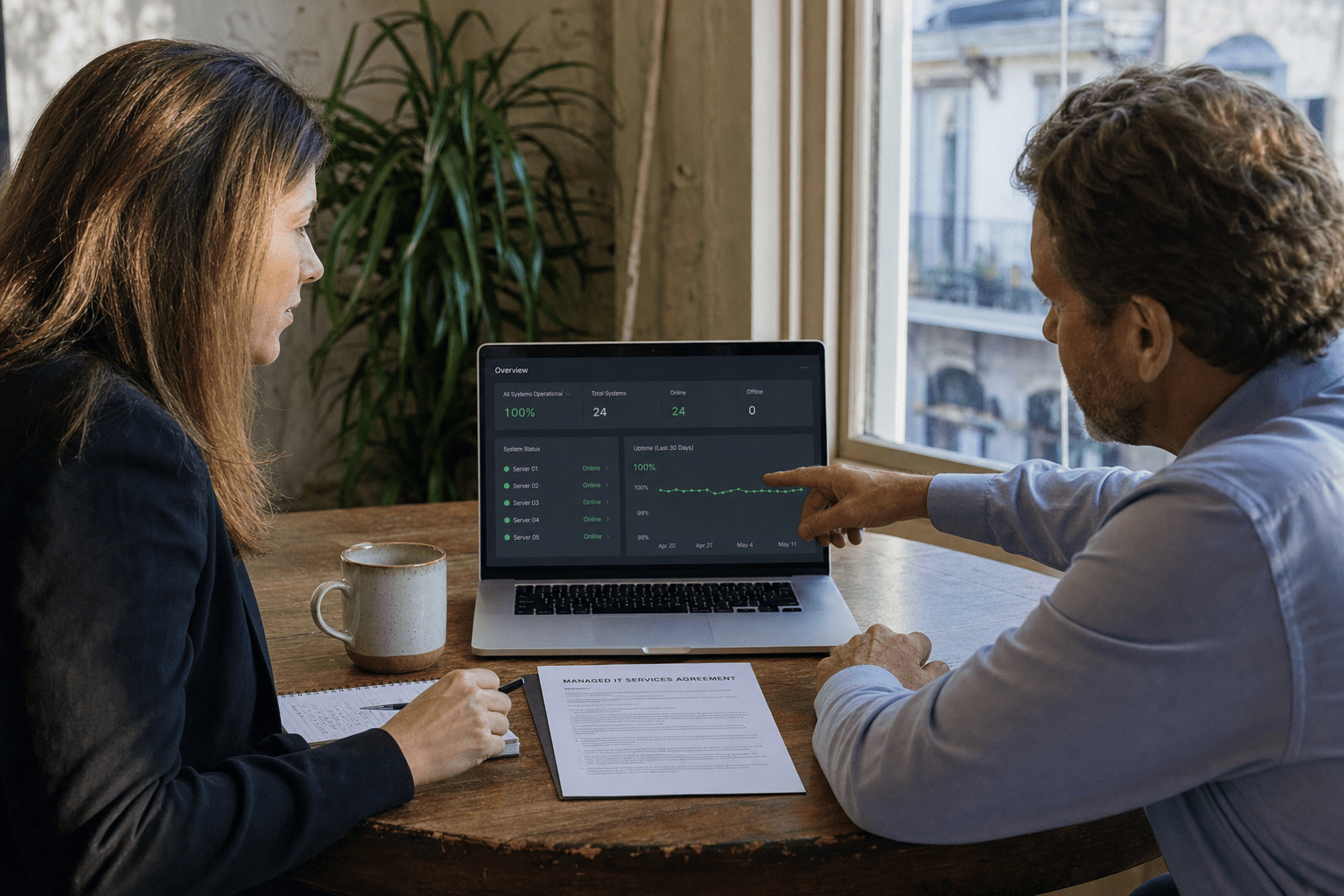
Managed IT services in New Orleans LA give small businesses a full technology team for a flat monthly fee, covering help desk support, network monitoring, cybersecurity, backup, and hurricane-season disaster recovery. For a small business on the Gulf Coast, the value is not the feature list every provider prints on their site. It is whether that provider can put a technician on your problem fast when a storm knocks out half the parish, and whether your data comes back the same day. That single test, local response time plus proven recovery, is what separates a real partner from a vendor with a nice brochure.
The Five Things New Orleans Small Businesses Should Weigh First
Before you compare providers, get clear on what actually protects your business in this market. These five points decide whether a contract is worth signing.
- Local response time is the real product. A four-hour on-site window means little during hurricane season when roads flood. Ask for average response times measured over the last storm season, not a marketing number.
- Disaster recovery has to be documented, not promised. You want a written recovery plan with tested restore times, offsite backups, and a failover you have actually seen run.
- The talent pool here is thin. Skilled IT staff are hard to hire and harder to keep in a mid-sized market, so a managed provider often gives you deeper coverage than a single in-house hire.
- Security is not optional for small firms. Attackers target small businesses because they assume the defenses are weak. Your provider should treat security as a baseline, not an upsell.
- Flat, predictable pricing protects cash flow. Break-fix billing punishes you exactly when things go wrong. A monthly model aligns your provider with keeping you running.
Hold these next to any proposal you receive. If a provider dodges the response-time and recovery questions, you have your answer.
Why Small Businesses in New Orleans Need a Local Managed IT Partner
Small businesses in New Orleans need a local managed IT partner because the risks here are regional, not generic. A firm running IT from another state can sell you monitoring, but it cannot get boots on the ground when a transformer blows in Metairie or when floodwater takes out a server room in the Warehouse District. We have watched national providers miss service windows during storms because their nearest technician was six hours away by clear road, and there were no clear roads.
The Gulf Coast adds a layer most IT advice ignores. Hurricane season runs June through November every year, and it forces a question inland businesses rarely face: if your office is dark for a week, does your business keep running or does it stop? Ready.gov’s business continuity guidance treats a tested continuity plan as core, not a nice-to-have. For a New Orleans small business, that plan is the difference between reopening Monday and losing customers to a competitor who stayed online.
How Local Response Time Actually Changes Outcomes
Local response time changes outcomes because IT problems compound by the hour, and distance turns a small incident into a shutdown. When a point-of-sale system fails at a busy restaurant, an hour of downtime is lost covers and frustrated staff. A provider with a technician already in the metro can triage remotely and dispatch same-day. A provider without local presence leans entirely on remote tools, which works until the internet line itself is the problem.
There is a fair counterpoint. Plenty of issues genuinely resolve over a remote session, and a strong remote team can outperform a slow local one. Remote-first support is legitimate and often faster for software fixes. The honest position sits in the middle: you want a provider whose remote support is excellent and who can still show up when the problem is physical. Both matter. A New Orleans small business that plans only for remote support will be stranded the first time a storm cuts connectivity, and one that pays for local hands it never needs is overspending. The right answer is a provider strong on both, with the local coverage documented.
Why the Local Talent Shortage Favors a Managed Model
The local talent shortage favors a managed model because a small business rarely needs, or can keep, a full IT department. Hiring one systems administrator in New Orleans is expensive, and that person takes vacations, gets sick, and eventually leaves for a larger firm. When they go, your institutional knowledge walks out with them. A managed provider spreads coverage across a team, so no single departure leaves you exposed.
The other side deserves a hearing. An in-house hire knows your business intimately and is always your priority, never split across a dozen clients. That closeness is real value, and some firms genuinely outgrow a shared model. For most small businesses here, though, the math favors the team. Our managed IT services give a five-person or fifty-person company the same senior-level coverage a large enterprise buys, without the payroll of a full department. When a business already has one IT person and wants to extend them rather than replace them, co-managed IT keeps that person and adds depth behind them.
What Managed IT Services Include for a New Orleans Small Business
Managed IT services for a New Orleans small business include four core layers: proactive monitoring, a responsive help desk, layered security, and tested backup and recovery. A provider worth hiring runs all four as one system rather than selling them as separate add-ons. When you review our managed IT services in New Orleans, you are looking at how those layers connect, because a gap between them is where most breaches and outages start.
Proactive Monitoring and Help Desk Support
Proactive monitoring and help desk support are the daily backbone of managed IT, catching failures before they reach your staff. Monitoring watches servers, network gear, and endpoints around the clock and flags a failing drive or a spike in failed logins before it becomes an outage. The help desk handles the human side, the password reset, the printer that quit, the email that will not send.
The debate here is about depth versus speed. A help desk optimized for fast ticket closure can rush a fix that returns next week, while one optimized for root cause is slower per ticket but quieter over time. Neither extreme serves a small business well. We aim for first-contact resolution on routine issues and genuine root-cause work on recurring ones, and we track both so the pattern is visible. For a New Orleans small business, the practical test is simple: are the same tickets coming back? If they are, the monitoring is cosmetic.
Cybersecurity Built for Small-Business Reality
Cybersecurity for a small business has to assume you are a target, because attackers automate their way to whoever is unprotected. Small firms often believe they are too small to notice, and that belief is exactly what ransomware crews count on. The CISA Cyber Essentials guidance is blunt that small organizations face the same threat classes as large ones with far fewer defenders.
The reasonable pushback is cost. A small business cannot fund an enterprise security stack, and over-buying tools you cannot manage is its own risk. That tension is real, and the answer is proportion, not maximalism. We start with the controls that stop the most common attacks: multi-factor authentication everywhere, endpoint detection that actually responds, patched systems, and email filtering. Our managed security services scale from that baseline as a business grows, aligned to the NIST Cybersecurity Framework so the coverage is structured rather than a pile of disconnected products.
Backup and Disaster Recovery for Hurricane Season
Backup and disaster recovery for a New Orleans business must be built around the certainty of storms, not the possibility. Every year, hurricane season forces the question of whether your business survives a week without its office. A backup that has never been restored is a hope, not a plan. We test restores on a schedule and keep copies offsite and out of region, so a storm hitting the Gulf Coast cannot take both your office and your recovery in one blow.
There is a legitimate counterargument about spending. Full geographic redundancy and instant failover cost real money, and a very small firm may not need the fastest recovery tier. Fair enough. The right recovery target depends on how long your specific business can afford to be down, and forcing a corner store into an enterprise recovery plan wastes money. What is not negotiable is that the plan exists, is written down, and has been tested. A small business that knows its systems come back the same day sleeps through hurricane season. One that assumes the backup works finds out at the worst possible moment.
Frequently Asked Questions
How much do managed IT services in New Orleans LA cost?
Managed IT services for small and mid-sized businesses in the New Orleans area typically run between roughly $1,000 and $3,000 per month, with larger or more complex environments paying more. Most providers price per user or per device on a flat monthly model, which makes budgeting predictable. The right number depends on your headcount, your security needs, and your recovery requirements, so a quick assessment beats a blind quote.
What is the difference between managed IT and break-fix support?
Managed IT is a proactive, flat-fee model where a provider monitors and maintains your systems continuously, while break-fix bills you each time something goes wrong. Break-fix can look cheaper until an outage hits, because it charges you exactly when you are least able to absorb the cost and gives the provider no reason to prevent the next failure. Managed IT aligns the provider with keeping you running.
Do small businesses in New Orleans really need cybersecurity?
Yes, small businesses need cybersecurity because automated attacks do not check your company size before targeting you. Attackers scan for unpatched systems and weak logins across every business online, and small firms are hit precisely because they assume they are too small to matter. A baseline of multi-factor authentication, endpoint protection, and email filtering stops the majority of common attacks.
How fast should a New Orleans managed IT provider respond?
A managed IT provider should offer defined response times in writing, usually measured in minutes for critical issues and a few hours for on-site needs. For a Gulf Coast business, ask specifically how those times held during the last hurricane season, since that is when response matters most. A provider with local technicians can dispatch same-day even when remote access is down.
Can a managed IT provider work alongside our current IT person?
Yes, a co-managed IT arrangement keeps your existing IT staff and adds a provider’s team, tools, and after-hours coverage behind them. This suits a growing business that values its in-house knowledge but needs more depth, security expertise, or vacation and sick-day coverage than one person can give. Your staffer handles the daily relationship while the provider backstops the heavy lifting.
Talk to a New Orleans Managed IT Team That Shows Up
Choosing managed IT services in New Orleans LA comes down to one honest question: when a storm hits or a system fails, who is actually going to be there? Features and price matter, but they are easy to match on paper. What is hard to fake is a local team with tested recovery plans and a track record of showing up when the Gulf Coast is having its worst week. A small business that gets this decision right stops thinking about IT as a source of stress and starts treating it as something that quietly works.
That is the position we want every New Orleans small business we serve to be in: monitored, secured, and ready for hurricane season before it arrives, with support that answers fast and hands that show up when the problem is physical. If you are weighing providers or just want a clear read on where your current setup stands, book a free strategy call with our team. We will walk through your response-time needs, your recovery plan, and your security baseline, and tell you plainly what is solid and what is exposed.

