

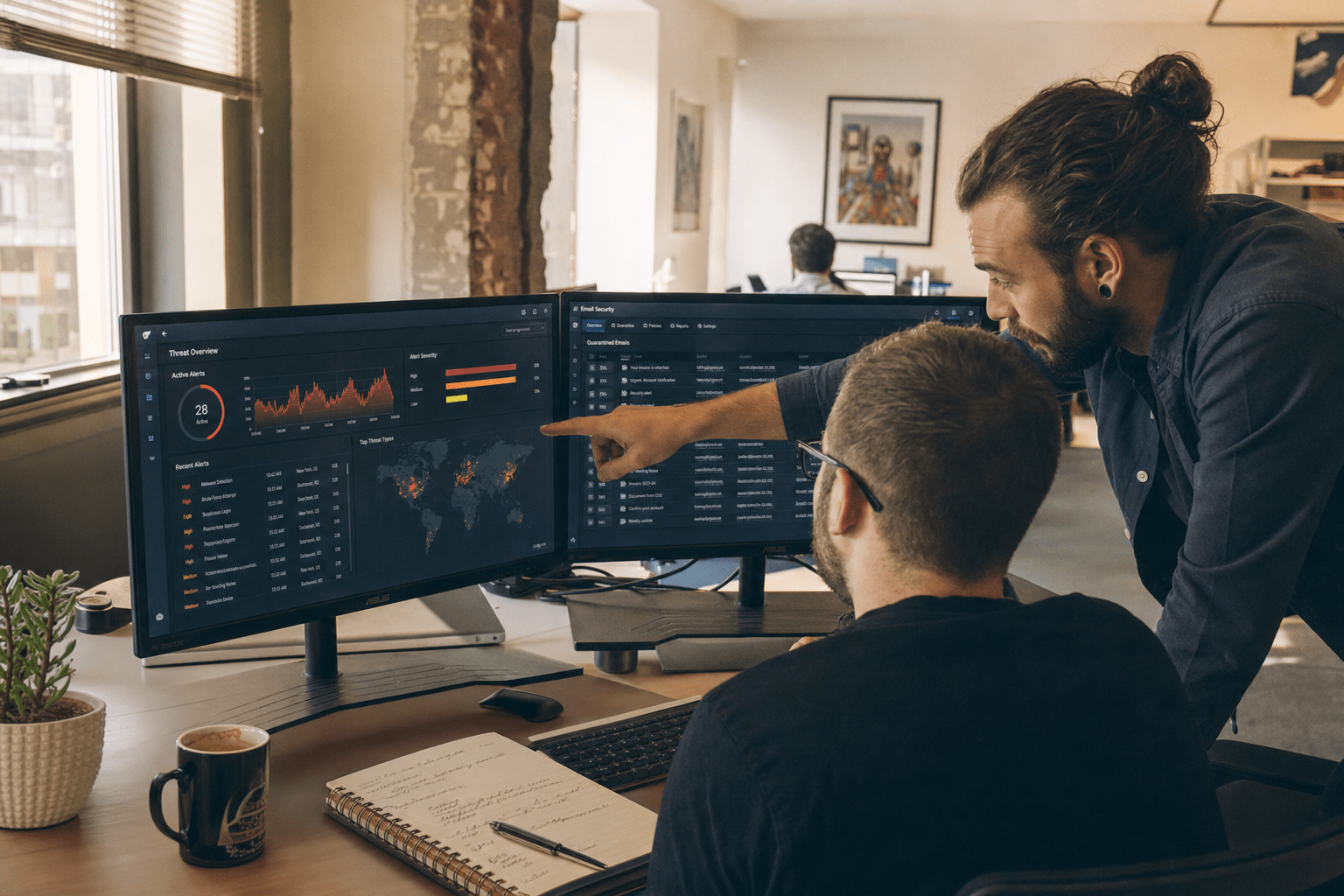
Cybersecurity in New Orleans LA protects small businesses through layered defenses that combine email filtering, endpoint detection, enforced multi-factor authentication, and a tested recovery plan built for a city that already plans around downtime. Attackers treat a 15-person law office off Poydras Street the same way they treat a hospital network: an opening to encrypt files and demand payment. What changes locally is the timing and the recovery math. When a storm can knock out power for days, a ransomware hit stacked on top of an outage is not two problems. It is one crisis with no easy path back. The businesses that recover fast are the ones that treated security as an operating decision, not a line item.
The Five Things Every New Orleans Owner Should Know
We work with owners across Orleans and Jefferson parishes, and the same five points come up in nearly every first conversation. This section gives you the short version before we get into the detail.
- Small businesses are primary targets for Cybersecurity New Orleans attacks, not afterthoughts; automated threats scan weak logins and unpatched software equally across firms of all sizes.
- In Cybersecurity New Orleans, most breaches originate from people rather than firewalls, as phishing and stolen passwords are more effective than hardware exploits; employee training and enforced MFA mitigate the risk.
- Recovery time defines success in Cybersecurity New Orleans; how quickly a business recovers from an incident determines client retention, and hurricane-season outages accelerate the urgency.
- Compliance and security are not the same thing. Meeting a HIPAA or PCI requirement is a floor, not a finish line. We have seen “compliant” firms breached in the same quarter they passed an audit.
- You do not need a full security team on payroll. A managed provider gives you the monitoring, response, and expertise of a department without the headcount, which matters in a market with a thin local talent pool.
Why Cybersecurity in New Orleans LA Demands a Local Lens
Cybersecurity in New Orleans LA carries a risk profile that national checklists overlook, because the threat calendar and the recovery calendar collide here in ways they do not in Denver or Columbus. Every business here builds around hurricane season already. Attackers know that. We have seen intrusion attempts spike in the days a named storm is tracking toward the Gulf, timed to a moment when staff are distracted and IT attention is elsewhere.
That overlap changes the math. A ransomware event during normal operations is bad. The same event while your office is running on generator power, or while your team is scattered after an evacuation, turns a two-day recovery into a two-week one. This is the war-story pattern we watch for: the attack does not have to be sophisticated to be devastating, it just has to land at the wrong moment. Building resilience for that reality is the core of our cybersecurity services, and it is why we treat backup and recovery as security controls, not afterthoughts.
How Ransomware Reaches a Local Business
In Cybersecurity New Orleans, ransomware typically enters through a single clicked link or reused password, not dramatic network breaches; attackers exploit realistic vendor or bank emails to trick employees into granting access.
There is a counterargument worth holding: some owners point out that endpoint software and email filters catch the majority of these attempts, so why worry. That is partly fair. Good tooling does stop most volume. The problem is that ransomware only needs one success, and the payload that gets through is usually the one crafted for your specific business. The honest position is that both sides are right. Filtering reduces the flood, and human-plus-MFA layers catch what leaks. Neither alone is enough, which is why we deploy them together.
Where Small Firms Underinvest
Small firms underinvest most in detection and response, because prevention tools are easy to buy and a plan for the day something gets through is harder to picture. Owners often tell us they have antivirus and a firewall, so they feel covered. The gap is what happens between the moment an attacker is inside and the moment anyone notices.
The opposing view says a lean business cannot justify 24/7 monitoring costs. That concern is real for a firm running on tight margins. But the middle ground is where most of our clients land: a managed detection service watches the environment around the clock without a full in-house team, and our emergency cybersecurity response covers the moment an active incident starts. Detection is not a luxury tier. It is the difference between an event you contain in an hour and one you explain to clients for a month.
How New Orleans Businesses Build a Real Defense
New Orleans businesses build a real defense by layering controls so that no single failure exposes everything, an approach the CISA Cyber Essentials guidance frames as a set of everyday actions rather than a one-time project. We build the same layers for a marketing agency in the Warehouse District as we would for a manufacturer in Kenner, scaled to the size and risk of the business.
The layers that matter most for a small business are practical and affordable. Enforce multi-factor authentication on email and any remote access, because a stolen password becomes useless without the second factor. Keep systems patched on a schedule so known vulnerabilities close before they are exploited. Filter email aggressively, since that is where most attacks begin. Back up data in a way an attacker cannot reach, and test the restore, because a backup you have never recovered from is a guess, not a plan.
The Role of Employee Training
Employee training turns your staff from the softest target into an active layer of defense, which matters because the FBI’s New Orleans field office consistently ties regional business fraud losses to social engineering rather than technical exploits. A well-run training program teaches people to slow down on urgent payment requests and to verify a sender before clicking.
Some owners argue that training fades, that people forget within weeks and revert to old habits. There is truth there, and one annual session does little. The evidence points the other way when training is continuous: short, frequent simulated phishing tests keep the reflex sharp and give you a real measure of who needs more coaching. We run these on a rolling basis for clients, and the click rate drops in a way a once-a-year lecture never achieves.
Backup and Recovery as a Security Control
In Cybersecurity New Orleans, backup and recovery act as critical security controls, since recovery timelines must contend with both cyber threats and local storm conditions; relying on stable office power alone is insufficient for Gulf Coast businesses. We design recovery so it works when the office does not.
The debate here is about cost versus speed. Immutable, offsite backups and a rehearsed recovery runbook cost more than a nightly copy to a local drive. A skeptical owner reasonably asks whether the premium is worth it. Our answer, drawn from years of watching restores succeed or fail, is that the premium buys you the one thing you cannot manufacture during a crisis: time. This is a theme we cover further in our look at expert IT consulting in New Orleans, where recovery planning drives most of the value.
How Compliance Fits Without Becoming the Whole Plan
Compliance fits into a New Orleans security program as a baseline you clear on the way to real protection, not as the destination itself. A medical practice in Metairie must meet the HIPAA Security Rule, and a defense contractor supporting Belle Chasse operations may face NIST SP 800-171 requirements. Those frameworks give you a structured list of safeguards, which is genuinely useful.
The trap is treating the audit as the goal. We have watched firms pass a compliance review and suffer a breach in the same quarter, because the controls existed on paper but no one was watching the alerts. Compliance proves you built the safeguards. It does not prove they are working today. Our cybersecurity compliance services close that gap by keeping the required controls live and monitored, so the paperwork and the reality stay aligned.
Frequently Asked Questions
How much does cybersecurity cost for a small business in New Orleans?
Cybersecurity for a small business in New Orleans typically runs as a predictable monthly service rather than a large upfront purchase, scaled to your headcount and risk. Most small firms spend far less than the cost of a single ransomware recovery. A free strategy call gives you a real number based on your systems rather than a generic estimate.
Do small businesses really get targeted by hackers?
Small businesses get targeted constantly because most attacks are automated and scan for weak logins and unpatched systems regardless of company size. Attackers often prefer small firms precisely because their defenses are thinner. Size is not protection, and assuming otherwise is the most common mistake we correct.
What is the first step to improving our security?
The first step is a security assessment that shows where your real gaps are, since fixing the wrong thing wastes budget. We start by mapping how your business actually works, then prioritize the controls that reduce the most risk for the least disruption. That order matters more than any single tool.
How fast can we recover if we get hit by ransomware?
Recovery speed depends almost entirely on whether you have tested, isolated backups and a rehearsed response plan before the incident. Businesses that prepare recover in hours; those that improvise often lose days. In a city that plans around storm outages, building that recovery capacity early pays off twice.
Can a managed provider replace an in-house IT team?
A managed provider gives a small business the monitoring, response, and expertise of a full security team without the payroll, which fits a market where local security talent is scarce. For most firms under a few hundred employees, this model delivers stronger coverage than one or two in-house generalists could. Larger firms often keep a small internal team and use us for depth.
Talk to a New Orleans Cybersecurity Partner
Protecting a small business in New Orleans is not about buying the most expensive tools or chasing every headline threat. It is about building layers that hold when something goes wrong, and making sure the recovery plan works on the worst day, not just a calm one. The firms that stay standing after an incident are the ones that decided ahead of time what they would do, tested it, and had a partner who answered the phone. That preparation is affordable, and it is far cheaper than the alternative. We help New Orleans businesses put those layers in place and keep them working, so a breach or a storm becomes a bad week instead of the end of the business. If you want a clear picture of where you stand and what to fix first, book a free strategy call and we will walk through it with you.

