

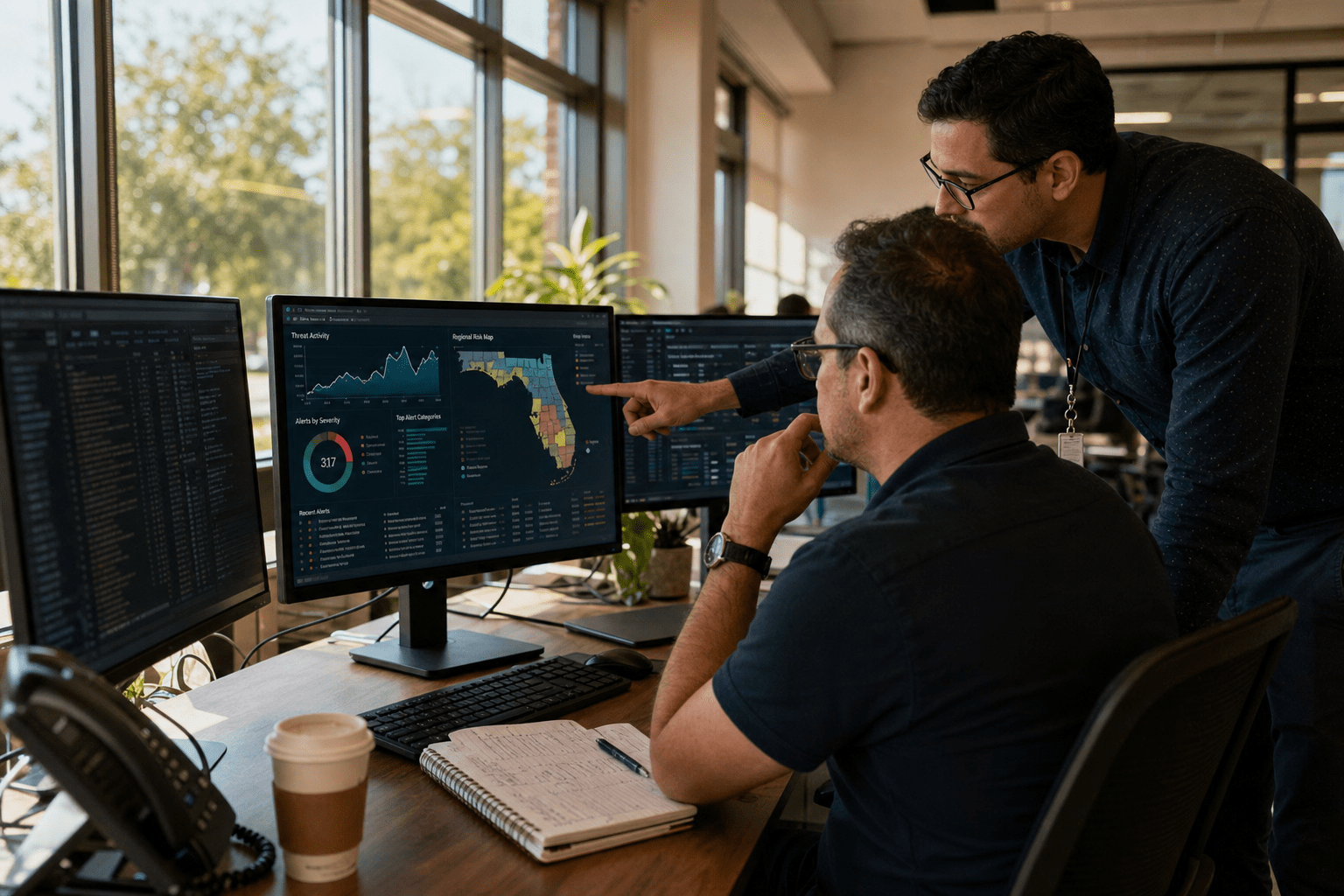
Buying cybersecurity Florida means matching a provider to three pressures most national vendors gloss over: the state’s 30-day breach-notification clock under the Florida Information Protection Act, a hurricane season that forces disaster recovery and incident response to share the same playbook, and a business mix heavy on finance, defense, and healthcare that puts even a 40-person firm on an attacker’s target list. We wrote this buyer’s guide for owners and IT managers who are done reading generic checklists and want to know what actually changes when the work happens in Florida.
The 5 Things That Decide a Good Florida Buy
Before you compare quotes, get clear on the five factors that separate a provider who fits Florida from one who sells the same package everywhere:
- State law is not optional. Florida Statute 501.171 requires notice to affected residents within 30 days of a confirmed breach. Your provider has to be able to detect, scope, and document an incident inside that window.
- Weather is a security event. A named storm that knocks out power or connectivity is a business-continuity problem and an attacker’s opportunity in the same week. Your defense and recovery plans have to be one plan.
- Small does not mean invisible. Florida’s concentration of financial services, aerospace, and defense supply-chain firms means SMB vendors get probed for a way into a larger target.
- Compliance frameworks stack. Many Florida SMBs owe more than one regime at once, HIPAA, PCI-DSS, CMMC, and now FIPA. A good provider maps controls once and reuses the evidence.
- Local response time matters. When an incident hits, you want people who can be on site in Fairfield-adjacent hours or Boca hours, not a ticket queue three time zones away.
Keep these five considerations in mind when evaluating Cybersecurity Florida providers. Most purchasing errors occur when one of these key factors is overlooked
Why Cybersecurity in Florida Carries a Different Risk Profile
The threat landscape for Cybersecurity Florida is unique, driven by the state’s economy and industry mix rather than merely following national trends. The finance corridors around Miami and Palm Beach, the defense and aerospace work along the Space Coast, and one of the country’s largest concentrations of retirees managing wealth online all make Florida a rich hunting ground. The Cybersecurity and Infrastructure Security Agency tracks ransomware and business-email-compromise campaigns that hit exactly these sectors, and Florida firms show up on the receiving end at a rate that outpaces the state’s share of national payroll.
How attackers pick Florida SMBs as targets
Cybercriminals target SMBs in Florida as the easiest entry points, making Cybersecurity Florida strategies essential to protect against indirect attacks through connected high-value clients. We see the same pattern in the wild: a defense subcontractor or a wealth-management practice runs solid perimeter tooling, so the intruder goes after the 25-person accounting firm or the managed IT vendor that touches their data. The counterargument is fair, that plenty of Florida SMBs sit far from any high-value chain and face the same commodity phishing everyone does. Both are true at once. What decides your exposure is not your zip code, it’s whether your customer list includes anyone worth pivoting toward. A firm serving law offices, medical groups, or government contractors carries inherited risk it rarely prices in.
Why hurricane season changes the calculus
Hurricane season changes the calculus because it collapses two problems into one window. A storm that forces staff to remote work on personal devices, reroutes traffic through consumer connections, and stresses your backup power is precisely when credential-stuffing and fake-IT-support calls spike. Some argue this is overstated, that modern cloud failover makes weather a non-event for security. In our experience that holds only for firms that already rehearsed it. The ones who bolt on remote access the night before landfall are the ones who get compromised the week after. Treat storm readiness and incident readiness as the same drill.
Where Florida’s compliance load stacks up
Florida’s compliance load stacks up faster than most owners expect because the state layer sits on top of federal ones. A medical billing company near Orlando may owe HIPAA and PCI-DSS federally, then FIPA at the state level for any Florida resident’s data. There’s a view that this is just paperwork a lawyer handles once. The reality is that each regime wants evidence your technical controls are live and monitored, not just written down. A provider who maps cybersecurity compliance controls once and reuses that evidence across frameworks saves you from rebuilding the same audit trail three times.
How to Vet a Cybersecurity Provider in Florida
Evaluating Cybersecurity Florida providers should focus on evidence that they operate effectively under local regulations and Florida-specific conditions, not just generic compliance frameworks. Ask for specifics and watch how fast the answers come. A provider who has done real work in the state will name the statute, the notification clock, and the frameworks their other Florida clients carry without reaching for a brochure.
What to ask about breach-notification readiness
Ask any provider to walk you through the first 72 hours of a breach against the 30-day statutory clock. Florida Statute 501.171 starts that clock at the point of determination, so detection and scoping speed decide whether you notify calmly or scramble. A strong answer covers how they detect, how they preserve evidence, who drafts the resident notice, and how they coordinate with the Department of Legal Affairs when a breach touches 500 or more people. A weak answer treats notification as your lawyer’s problem. It’s a shared problem, and the technical side owns the clock.
How to test their disaster-recovery and continuity fit
Test disaster recovery by asking what happens to your monitoring when a hurricane takes a data center or an office offline. The NIST Cybersecurity Framework treats Recover as a core function alongside Protect and Detect, and in Florida that function gets exercised for real most years. A provider that fits will describe geographically separated backups, tested failover, and a plan that keeps threat detection running while your team works from wherever the storm pushed them. If their continuity story stops at “we back up your files,” they have not thought about the security side of a weather event.
How to confirm real local presence and response
Confirm local presence by asking where their responders actually sit and how fast a person can reach your site. Remote-first support handles most tickets fine, and there’s a reasonable case that cloud tooling makes physical location less relevant than it used to be. But a live incident, a seized workstation, or a compromised on-prem server still benefits from someone who can be there in hours. Our own footprint runs from Fairfield and Boca Raton through Orlando, and we built Florida coverage around exactly that mix of remote speed and local reach. Ask for a named regional contact, not a general queue.
Matching the Service Model to Your Size and Sector
Match the service model to your size and sector rather than buying the biggest package on offer. A 15-person firm with no compliance load needs different coverage than a 200-person defense subcontractor under CMMC, and paying for controls you can’t operationalize is as risky as under-buying. We usually steer buyers toward a managed cybersecurity model when they lack in-house security staff, since a co-managed model only works if you already have someone to co-manage with. Sector drives the rest: healthcare and legal buyers weight compliance and breach response, while professional-services firms often weight email security and identity protection first. If you serve regulated clients, prioritize a provider who has passed those audits before, the way we documented in our work with Florida law firms and in a cloud security engagement that aligned protection with growth rather than fighting it.
Frequently Asked Questions
Does Florida have a specific data breach notification law?
Yes. The Florida Information Protection Act, codified at Statute 501.171, requires businesses to notify affected Florida residents within 30 days of determining a breach of personal information. Breaches affecting 500 or more residents also require notice to the Florida Department of Legal Affairs. The 30-day clock makes fast detection and scoping a core buying criterion for any provider.
How much should an SMB in Florida budget for cybersecurity?
Most Florida SMBs land between roughly 3 and 8 percent of their IT budget on security, with regulated firms at the higher end. The right number depends on your compliance load and the sensitivity of client data you hold rather than headcount alone. A provider should size the spend to your actual risk, not sell a fixed tier, so ask them to justify the number against your specific exposures.
Do small Florida businesses really get targeted by cybercriminals?
Yes, and often as a path to a larger target. Florida’s concentration of finance, defense, aerospace, and healthcare firms means SMB vendors and partners get probed for a way into those chains. Commodity phishing and ransomware hit everyone, but firms serving regulated or high-value clients carry inherited risk that raises their priority for attackers.
How does hurricane season affect cybersecurity planning in Florida?
Hurricane season forces disaster recovery and incident response to share one plan. Storms push staff to remote work on strained connections and stress backup power, exactly when phishing and fake-IT-support attacks spike. A Florida provider should keep threat monitoring running through a weather event and rehearse failover before the season, not during a warning.
What compliance frameworks apply to Florida businesses?
It depends on your sector, and they stack. Federal regimes like HIPAA, PCI-DSS, and CMMC apply by industry, and the state-level Florida Information Protection Act applies to any Florida resident’s personal data. A capable provider maps controls once and reuses the evidence across frameworks so you’re not rebuilding the same audit trail multiple times.
Talk Through Your Florida Buy With a Strategist
Buying cybersecurity in Florida works best when you start from the pressures that are specific to operating here, the 30-day notification clock, the hurricane-season overlap between recovery and response, and the inherited risk that comes from serving regulated clients. Get those three right and the rest of the comparison, tooling, pricing tiers, response SLAs, falls into place around a real picture of your exposure. The buyers who struggle are the ones who compare feature lists first and only discover the state-specific gaps after an incident forces the issue. You don’t have to make that trade. Our team works with SMBs across Fairfield, Boca Raton, and Orlando to build security programs that hold up under both Florida’s regulators and its weather. If you want a straight read on where your current setup stands and what a right-sized program looks like for your sector, book a free strategy call and we’ll walk through it with you.

