

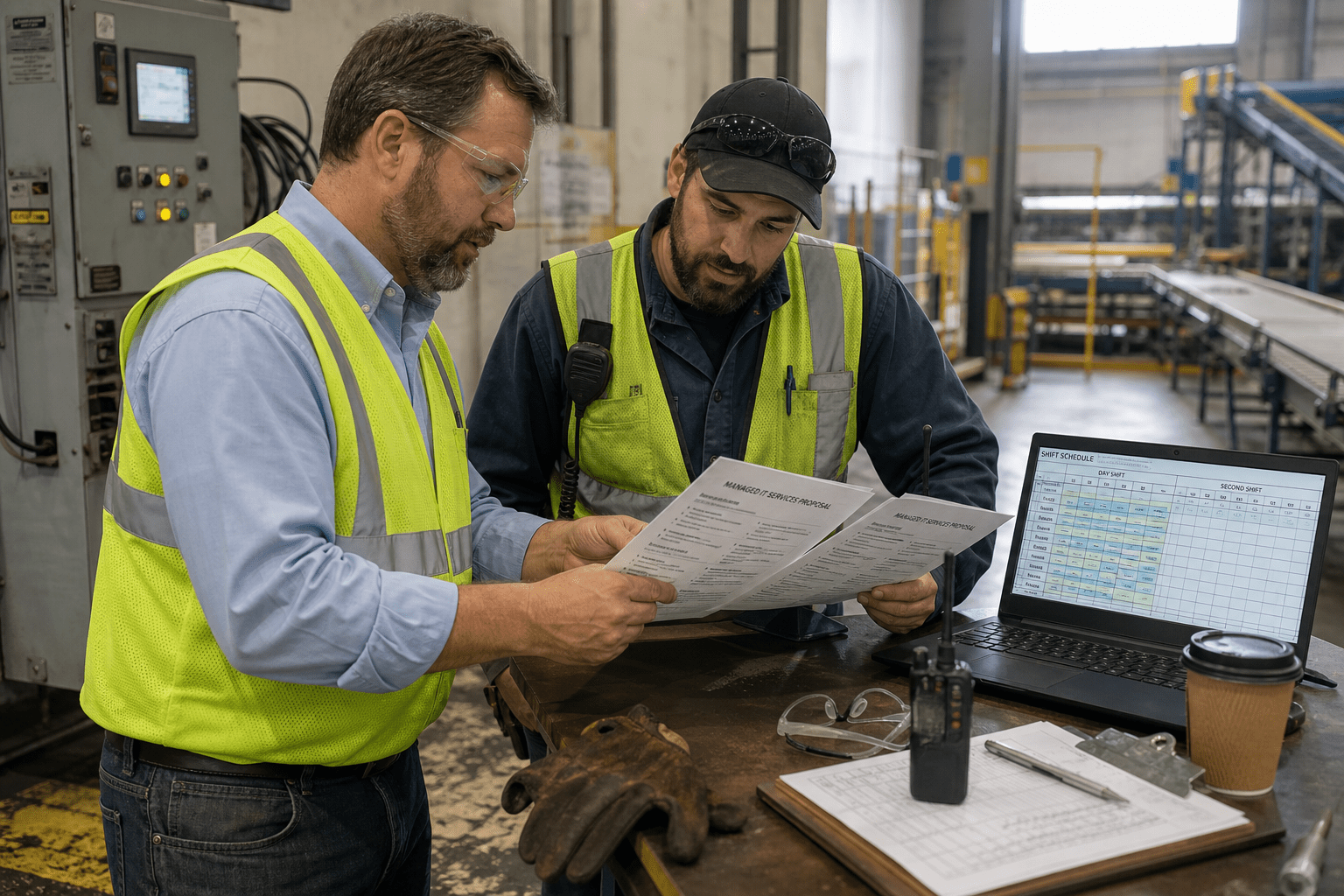
Choosing between in-house IT and outsourced managed IT for manufacturers usually starts from a position most plants do not admit to: somebody on site already does this work informally, often a maintenance technician who learned the controls network by necessity. So the decision is rarely a blank page. It is whether to formalize that person, what depth to put behind them, and who covers second shift. An internal hire brings floor knowledge nobody can replicate quickly. A provider brings security depth and coverage across shifts. Most plants above a certain size need both.
Five Points This Comparison Rests On
Plants tend to compare a salary against a monthly fee, which misses the two things that actually decide the outcome: shift coverage and who understands the equipment network. The points below stay on those. This is written for operations managers, plant managers, and owners at manufacturers of roughly 20 to 500 employees.
- Shifts, not headcount, set the requirement. A plant running two shifts is exposed for sixteen hours a day, and one employee covers eight of them at best.
- The informal arrangement is already the risk. A maintenance technician holding the plant together on undocumented knowledge is a single point of failure nobody has named.
- Equipment network security is a distinct specialty. Isolating unpatchable controllers and controlling vendor access is different work from running a helpdesk.
- Floor knowledge is genuinely local. Which cell is fragile, which vendor connection exists, and which cable run was improvised are facts only presence teaches.
- A stoppage is expensive and loud. Whichever model a plant chooses, the response time that matters is measured against a stopped line, not a service level average.
Where an Internal Person Genuinely Helps a Plant
An internal person helps most with immediacy on the floor and with knowing the plant’s own history, which in manufacturing means knowing what was changed, when, and why nobody reversed it. Our team has worked alongside internal staff and replaced them, and these strengths are consistent.
Hands on the Floor Within Minutes
A stopped line needs somebody physically at the cell, and an internal person is already there. No drive, no dispatch, no explaining which machine. In a plant, that difference is measured in units not produced.
The counterpoint is that a single person covers one shift, and plants that run two or three are uncovered for most of their operating hours. The internal model tends to solve the day shift beautifully and leave nights and weekends to whoever happens to answer a phone.
The honest read is that on-site presence is close to irreplaceable during the covered shift and provides nothing outside it. Plants that make this work usually keep an internal owner for day coverage with managed IT services carrying the remaining hours and the depth.
Knowledge of What Was Actually Built
Plants accumulate history: a controller replaced during a rush with settings nobody recorded, a vendor connection added in 2019, a network run that goes somewhere unexpected. An internal person carries that history and it shortens diagnosis dramatically.
Against it, this history is almost never documented, which means it is one resignation away from being lost. When we take over a plant environment, recovering the technical state is straightforward and recovering the reasoning is not, and the reasoning is what prevents a repeat.
Our position is that floor history is a real asset that only survives if documenting it is part of the job, with a defined format and a review cadence. Engineering-led organizations reach the same conclusion about design data, which our piece on IT services risks for architecture and engineering firms covers from that angle.
Immediate Authority to Act
An internal person can be told to stop what they are doing and get line three running. That authority is simple and it works, particularly during a shift when output is behind.
The fair response is that continuous redirection is why nothing structural gets finished. The network separation project, the vendor access cleanup, and the backup testing all lose to whatever stopped this morning, every week, in every plant we have seen run this way.
Both hold, which is why separating priority control from delivery capacity works better than choosing one model. Keeping the first with the plant and the second outside is what a co-managed arrangement provides.
Where Outsourced Managed IT Wins for a Manufacturer
Outsourced managed IT wins on shift coverage, equipment network security, and the recurring work that never feels urgent, because each depends on having more than one person and on seeing the same problems across plants.
Second Shift and Weekends
A plant running two shifts is exposed for sixteen hours daily, and a weekend run extends that further. One employee covers a fraction of it, and asking them to be on call indefinitely produces resignation rather than coverage.
The reasonable objection is that after-hours incidents are less frequent, so paying for continuous coverage buys something rarely used. For a single-shift operation, that reasoning holds well.
Where it breaks is that a second-shift stoppage with nobody to call becomes a stoppage until morning, which is the most expensive outcome available. What we recommend is deciding coverage against the shift schedule rather than a standard business day, and holding whoever provides it to a stated response for the production-critical list. Plants tracking whether that is real can use the framework in our piece on measuring a managed IT partnership.
Equipment Network Security Is a Specialty
Isolating controllers that cannot be patched, defining the crossings between business and equipment networks, and controlling vendor remote access is a narrow discipline. It is learned across many plants rather than one, and it is not adjacent to helpdesk work.
Some plants argue that their internal person knows the equipment better than any outsider could, and that is true about the equipment. It is usually not true about the attack patterns, because a single plant sees very few.
That pattern exposure is what makes managed security services different from a monitoring tool, and it is why the rule set behind managed firewall services should be written down and reviewable rather than held in one person’s memory. The strongest arrangement we see pairs the internal person’s equipment knowledge with outside security depth, because neither substitutes for the other.
The Recurring Work Nobody Asks For
Backup verification, restore testing, patch status for the systems that can be patched, vendor access review, and network documentation are monthly obligations that never feel urgent against a production schedule.
A fair objection is that a disciplined internal person keeps up with these, and some genuinely do. The difficulty is that the discipline is personal rather than structural, and it disappears with them.
What we recommend either way is that these tasks exist in writing with a cadence and a record, so the plant can confirm they happened rather than assume. That is the same discipline seasonal businesses apply to their own recurring obligations, which our accounting firm guide describes in a different setting.
The Cost Comparison, Counted Fairly
Count the same categories on both sides. For an internal hire: salary, payroll taxes, benefits, recruiting amortized over expected tenure, training, the tools they will need, and the shifts nobody covers. For a provider: monthly fee, out-of-scope billing, onboarding, on-site call-out charges, and the internal time spent managing the relationship.
For a single-shift plant with one site the numbers usually land close, and the deciding factor becomes security depth rather than price. For a two-shift or multi-site operation the internal-only model rarely competes, because the uncovered hours are where the expensive failures happen. Plants should count operating hours before counting dollars, since the hours are what the models actually differ on.
Documentation Is the Deliverable Either Way
The single most valuable thing a plant can require, from an employee or a provider, is current documentation of what exists: a network diagram showing where the equipment side separates from the business side, an inventory of controllers with their patch status, a list of vendor connections with who authorized each one, and the isolation rules protecting anything unpatchable.
Plants often treat this as paperwork that competes with real work, and during a production crunch that view is understandable. Nobody has ever stopped a line to update a diagram.
What changes the calculation is what happens without it. Every plant takeover we have done starts with two weeks of discovery that the previous arrangement could have written down in an afternoon, and during those two weeks the plant is carrying risk nobody can quantify. Requiring documentation with a review date is the cheapest protection available in either model, and it is the requirement most often left out of both job descriptions and service agreements.
How Plants Usually Decide
Plants decide this well by counting operating hours and naming the informal dependencies, because both are concrete and neither requires trusting a proposal.
Count Operating Hours Against Covered Hours
Write down the hours the plant runs across all shifts, including any weekend production. Compare that to one employee’s realistic 36 to 40 hours a week.
Most plants find the gap is larger than they assumed, particularly once a second shift is included. That number does not settle the question by itself, and it does move the conversation from cost to coverage, which is the more useful frame when a stopped line is the unit of loss. Professional-services organizations run the same calculation for different reasons, which our piece on managed IT services for law firms frames from the deadline side.
Name the Informal Dependencies Out Loud
List every task that depends on one person or one undocumented arrangement. In most plants this list includes a maintenance technician who is not in an IT role, one or two vendor connections nobody can explain, and at least one system whose password lives in a drawer.
That list is usually the most valuable output of the whole exercise, because it describes the plant’s actual exposure rather than its org chart. It is also uncomfortable reading, which is part of why it rarely gets written: naming a dependency implies somebody should own closing it. Plants that push through that discomfort usually find two or three entries can be closed the same month for very little money, and that the remainder is what the staffing decision should actually be judged against. Co-managed exists because most manufacturers have items on both lists at once: real floor knowledge that should stay inside, and security and coverage depth that is not practical to build internally.
Frequently Asked Questions
Does a single-shift manufacturer need an internal IT hire?
Often not as a dedicated role, since the work is real but intermittent and the specialist needs sit outside a generalist’s range. Many single-shift plants do better formalizing a part-time internal owner and putting a provider behind them.
At what point does an internal hire clearly make sense?
Usually with multiple shifts or multiple sites, where the volume and the travel justify a full-time role. Even then, plants generally keep outside depth for equipment network security and after-hours response.
Who should own the machine vendor relationships?
Either party can hold the relationship, and the agreement should still name who owns an incident through restoration regardless of fault. Plants that keep the relationship internally while assigning escalation ownership to a provider tend to get the best of both.
What about the maintenance technician who already does this work?
Formalize the arrangement rather than leaving it informal, with the scope written down and the knowledge documented. That person is often the right internal owner, and the risk is not their competence, it is that nothing they know is recorded anywhere.
What recurring tasks belong in writing whichever model we choose?
Backup verification with a periodic restore test, vendor access review, patch status for patchable systems, an isolation list for what cannot be patched, and current network documentation, each with a cadence and a record.
Who Is Behind This Advice
Our team spends a lot of time on production floors, and it changes how this comparison reads. The plants that are happiest with their arrangement are not the ones that spent the most or the least. They are the ones that counted their operating hours honestly, wrote down which dependencies were sitting in one person’s head, and then chose with both facts visible. That exercise takes an afternoon and a walk of the floor, and it is a much better basis than a proposal comparison.
Mindcore is led by Matt Rosenthal, who focuses on making coverage and security commitments measurable for operating businesses, so a plant manager can compare options without a technical background.
Talk Through the Comparison for Your Plant
Two counts make this decision clearer: the hours your plant actually runs across all shifts, and the list of tasks that depend on one person or one undocumented arrangement. Cost belongs in the analysis and rarely decides it, because the uncovered hours are where the expensive failures happen and they do not appear on either quote.
If you would like help running the comparison, we are glad to walk the floor with you. Bring whatever arrangement exists today, your shift schedule, a list of equipment you know cannot be updated, and any vendor connection nobody can fully explain. We will lay out what each model would look like for your plant, including the co-managed middle, and we will say plainly if what you have now already fits. You can book a free strategy call and we will work through it together.

