VMware licensing now charges a floor of sixteen cores per CPU socket, which means a small server estate pays for processor cores it does not physically own. Take a two-socket host fitted with eight-core processors. That machine holds sixteen real cores and is billed as thirty-two, because each socket is rounded up to the floor before anything is counted. At the market rates advisors are quoting for 2026, roughly 150 to 190 dollars per core per year, those sixteen imaginary cores cost between two and three thousand dollars annually on one server. We have sized a lot of these renewals this year, and small estates are typically carrying ten to twenty-five percent phantom cores.
The Five Numbers Behind Your Renewal Quote
Before you argue with a quote or accept one, get these five facts about your own estate straight.
- Sixteen cores per socket is a floor, not a count. Sockets are rounded up individually, so a lightly populated host is billed as though it were full.
- Perpetual is over. The model is subscription only, anchored on bundles, so an estate that bought once and paid support now rents the whole stack annually.
- Two to three times the old support cost is a normal quote. Five to ten times happens, usually where an estate was heavily discounted historically.
- You are billed for the bundle, not your usage. The subscription covers the full stack whether you run one component of it or all of them.
- Audit letters are going to perpetual holders. Sitting still is now an action with a consequence rather than a way of avoiding one.
Our note on the cost of managed IT and how to budget it covers the wider planning frame this drops into.
Why VMware Licensing Punishes a Well-Sized Estate
The core floor charges most aggressively against exactly the estates that were designed carefully, which is why the increase feels arbitrary to the teams hit hardest. For a decade the accepted advice was to buy fewer, faster cores. Database licensing was per core, so a lower core count with higher clock speed was the economical shape, and plenty of firms bought eight-core or ten-core processors deliberately for that reason. Under a per-core model with a sixteen-core floor, that decision is now a penalty. A host with two ten-core processors pays for thirty-two and uses twenty. The estate that over-bought cores it never needed pays for what it has. Nobody did anything wrong, and the shape that was prudent under one pricing model became expensive under the next, which is worth saying plainly to whoever approved that hardware.
Do the Count Before the Conversation
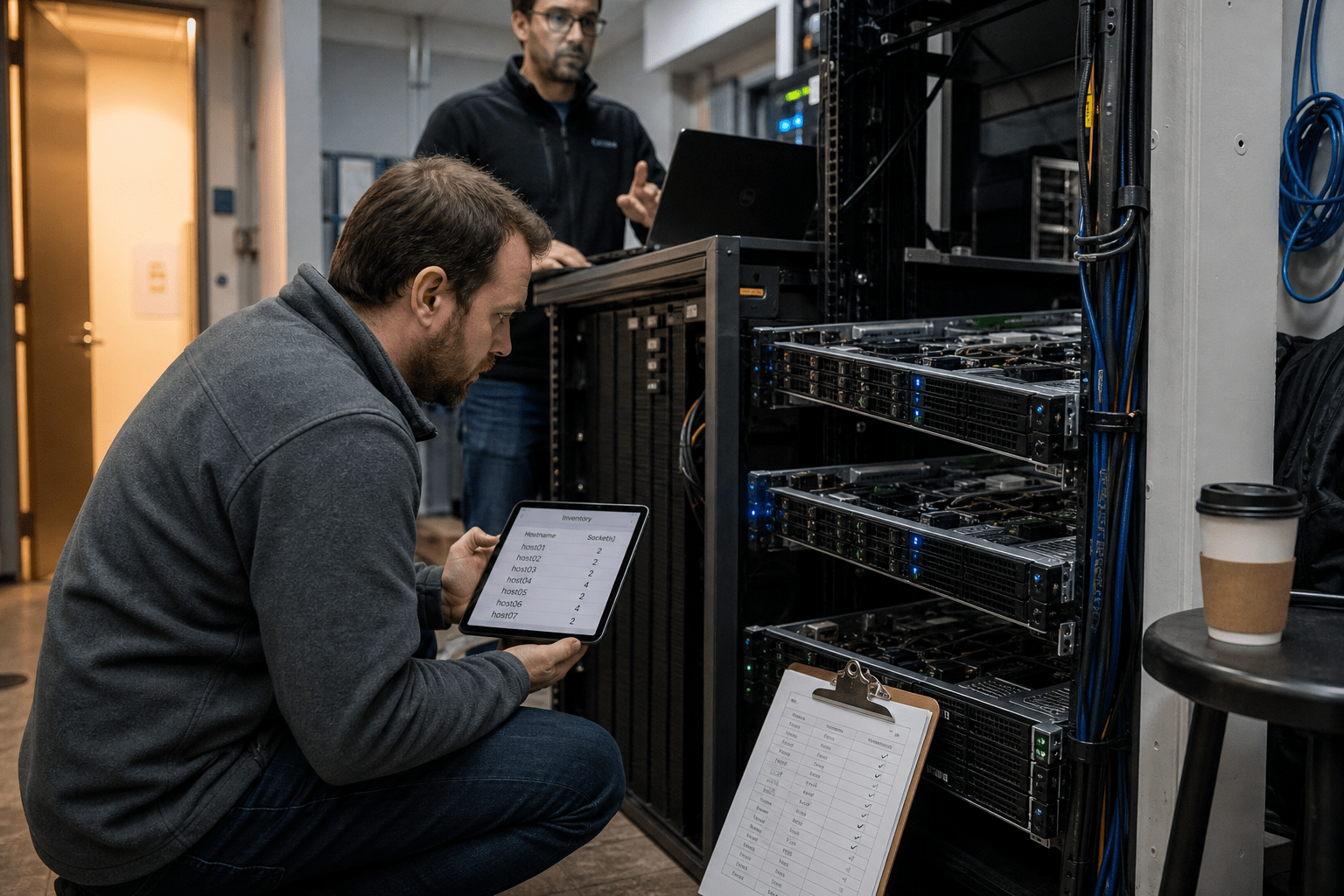
Walk your hosts and record sockets, physical cores per socket, and what each host is actually running, because that table is the only thing that makes a renewal conversation concrete. Most teams can produce it in an afternoon and most have not. The count tells you your phantom-core percentage immediately, and that single number reframes the negotiation from a vague complaint about price rises into a specific statement about what you are being asked to pay for. The counterargument is reasonable enough: a vendor is entitled to price its product however it likes, and a customer arguing that the unit of measure is unfair rarely gets far. True. The count is not for winning an argument about fairness, it is for deciding your own next move, and you cannot compare consolidation or migration against renewal without it. Our overview of what server virtualization actually buys you is a useful baseline if the people making this decision are not the ones who built the estate.
Consolidation Is the Lever Most Firms Have Not Pulled
Fewer, denser hosts can cut a per-core bill substantially, because the floor is charged per socket and consolidation removes sockets. An estate of six lightly loaded two-socket hosts is paying twelve socket minimums. The same workload on three properly sized hosts pays six. That is a real saving available without changing vendor, and it is the first thing to model because it is the least disruptive. The honest counterpoint is that consolidation reduces failure domains and raises the cost of losing a single host, so a firm that consolidates purely for licensing can end up with a resilience posture it never chose. Model the failure case alongside the saving. If losing one host now takes out half your workload, the licensing saving has bought you an availability problem, and our note on infrastructure service gaps that cost SMBs covers where that usually shows up first.
What the Alternatives Actually Cost
Every alternative to renewal carries a migration cost that firms underestimate, so compare total effort over three years rather than annual license lines. The options in practice are staying and negotiating, consolidating to reduce sockets, moving to a different hypervisor, or moving workloads into public cloud. Each has a real case and each has a failure mode we have watched play out. What decides it is rarely the license price on its own, it is how many workloads you have, how unusual they are, and whether you have the staff time to do a migration properly alongside everything else. The different types of IT infrastructure services is a reasonable primer if you are weighing these with a mixed audience in the room.
Migration Is Cheaper Than the Quote and Harder Than It Looks
Moving hypervisor is genuinely viable for a straightforward estate and genuinely painful for a complicated one, and the difference is in your edge cases rather than your virtual machine count. A hundred standard Windows and Linux servers move without much drama. Five appliances from vendors who only certify one hypervisor, a backup product licensed against the old platform, and a monitoring stack built on its API are what turn a clean project into a long one. Inventory the things that touch the hypervisor directly rather than the things running on it. The case for going anyway is strong where the estate is simple and the renewal multiple is high, since a one-time project beats a permanent increase. The case against is equally real where the team is already at capacity, because a half-finished migration running two platforms costs more than either option alone.
Public Cloud Changes the Question Rather Than Answering It
Moving workloads to public cloud removes the licensing problem and replaces it with a different cost structure, which suits some workloads and badly suits others. Steady, predictable, always-on servers are usually the worst candidates on pure cost, because you lose the advantage of hardware you already own and paid for. Variable or seasonal workloads, anything approaching end of hardware life, and anything you would rather not refresh are better candidates. Our write up on application virtualization in cloud computing covers the delivery patterns worth understanding first. The argument for going all in is that it ends the hardware refresh cycle and the licensing negotiation together, which has real organizational value beyond the spreadsheet. The argument against is that a lift and shift of virtual machines into cloud instances is the most expensive way to run them, and firms that move under renewal pressure rarely have time to do anything more considered than a lift and shift.
How to Negotiate From a Position That Exists
A renewal conversation goes better when you can describe a credible alternative, which means the modeling has to be done before the call rather than during it. That does not mean bluffing about leaving. It means knowing your phantom-core percentage, your consolidation saving, and roughly what a migration would take, because those three numbers let you talk about specifics rather than express dissatisfaction. Firms that walk in with a spreadsheet get a different conversation from firms that walk in with a complaint, and the difference is not leverage so much as clarity about what you are actually buying.
Time the Work Against Your Hardware Cycle
The cheapest moment to change platform is when the hardware is due for replacement anyway, so align the decision with your refresh cycle rather than with the renewal date if the two differ. A firm three years into a five-year hardware life is choosing between renewal and a migration it will pay for twice. A firm facing a refresh next year can fold the platform decision into a project it was already funding, which changes the arithmetic more than any negotiated discount. The objection is that renewal dates do not wait for hardware cycles, and a subscription lapsing puts you in an unsupported position that is difficult to defend to an auditor or an insurer. That is correct, and the practical answer is usually a short bridging term rather than a full multi-year commitment, which keeps the decision open without leaving anything unsupported.
Decide Who Owns This Before the Quote Arrives
Platform licensing sits awkwardly between finance, infrastructure, and whoever signs contracts, and the quotes that get accepted badly are the ones where nobody owned the analysis. Name the person who will produce the core count, the person who will model the alternatives, and the person who decides. Give them the renewal date working backward with enough room to actually model something, which is months rather than weeks. There is a fair pushback that a small team cannot spare that effort for one vendor negotiation. Our answer is that the sums involved now justify it in a way they did not three years ago, and that the same analysis serves the hardware refresh, the resilience review, and the budget, as our work with a country club’s infrastructure and the virtualization savings at Jersey City schools both show.
Read What the Bundle Includes Before You Call It Expensive
A fair comparison prices the bundle against what you would otherwise buy separately, and a surprising number of estates are already paying for two of its components under different vendors. The subscription is anchored on a stack rather than a single hypervisor license, which is the source of most of the sticker shock, but it is also the source of the only honest argument in its favor. If you run a separate software-defined storage product, a separate management layer, or a third-party tool doing work the bundle now covers, those line items belong in the comparison. We have run this exercise with clients who arrived convinced the renewal was indefensible and left having found two subscriptions they could retire, which did not make the increase disappear but did change its size by a third.
The objection is that being handed capability you did not ask for and did not budget for is not a benefit, it is a bundle, and paying for components you will never deploy is exactly the complaint. That is a reasonable position and we would not argue a customer out of it. The narrower point is about accuracy rather than fairness: if you are going to present a renewal increase to a board, present it net of whatever it displaces, because the first question a finance director asks is what else changes, and arriving without that answer costs you the credibility you need for the rest of the conversation. Do the subtraction even when the remaining number is still bad, since a number somebody has checked lands differently from one somebody has quoted.
Frequently Asked Questions
What exactly is the 16-core minimum?
Each CPU socket is licensed at a floor of sixteen cores regardless of how many cores the processor physically has. A socket holding an eight-core processor is billed as sixteen, so a two-socket host with eight-core chips is billed as thirty-two cores rather than sixteen.
Can we keep our perpetual licenses?
You can keep running them, but the model has moved to subscription and audit letters are going to perpetual holders. Staying put is a decision with consequences now rather than a way of deferring one.
How much more should we expect to pay?
Two to three times the old support cost is a common renewal multiple, with higher figures where an estate held deep historical discounts. Model your own rather than relying on a market average.
Does consolidation actually reduce the bill?
Yes, because the floor is charged per socket. Fewer, denser hosts means fewer socket minimums. Model the resilience impact at the same time, since consolidation concentrates your failure domain.
Is moving hypervisor realistic for a small team?
It depends on your edge cases, not your server count. Standard workloads move readily. Appliances certified against one hypervisor, and backup or monitoring tooling built on its interfaces, are what extend the timeline.
Who You Are Taking This Advice From
Mindcore has sized, consolidated, and migrated virtualization estates for mid-sized businesses long enough to have done it under three different pricing models, which is why we treat a licensing change as an infrastructure decision rather than a procurement one. We count cores, model consolidation against failure domains, and tell clients plainly when staying put is the right answer, and the figures above come from renewals we have worked through this year rather than from a vendor briefing. Matt Rosenthal, who leads Mindcore, keeps the firm pointed at infrastructure a business can afford to run for its full life rather than one that looks efficient on the day it is built. You know your workloads. Our job is to make sure the bill reflects them.
Your Next Move on Your Renewal
Count your cores first, because every other conversation depends on it. Record sockets, physical cores per socket, and what each host actually runs, then work out what percentage of your bill covers cores that do not exist. If that number is above ten percent, consolidation is worth modeling before anything else, since it needs no vendor change and no migration risk. Put your renewal date on a calendar with a working-backward plan that starts months rather than weeks ahead, and check whether your hardware refresh lands near enough to fold the two decisions together. Name the person who owns the analysis now, while it is a planning task, rather than in the week a quote lands and it becomes an emergency. The firms we see come through this well are not the ones with the most leverage, they are the ones who knew their own numbers before the conversation started. If you want somebody to run the core count and model the alternatives with you, book a free strategy call and we will start with your host list.