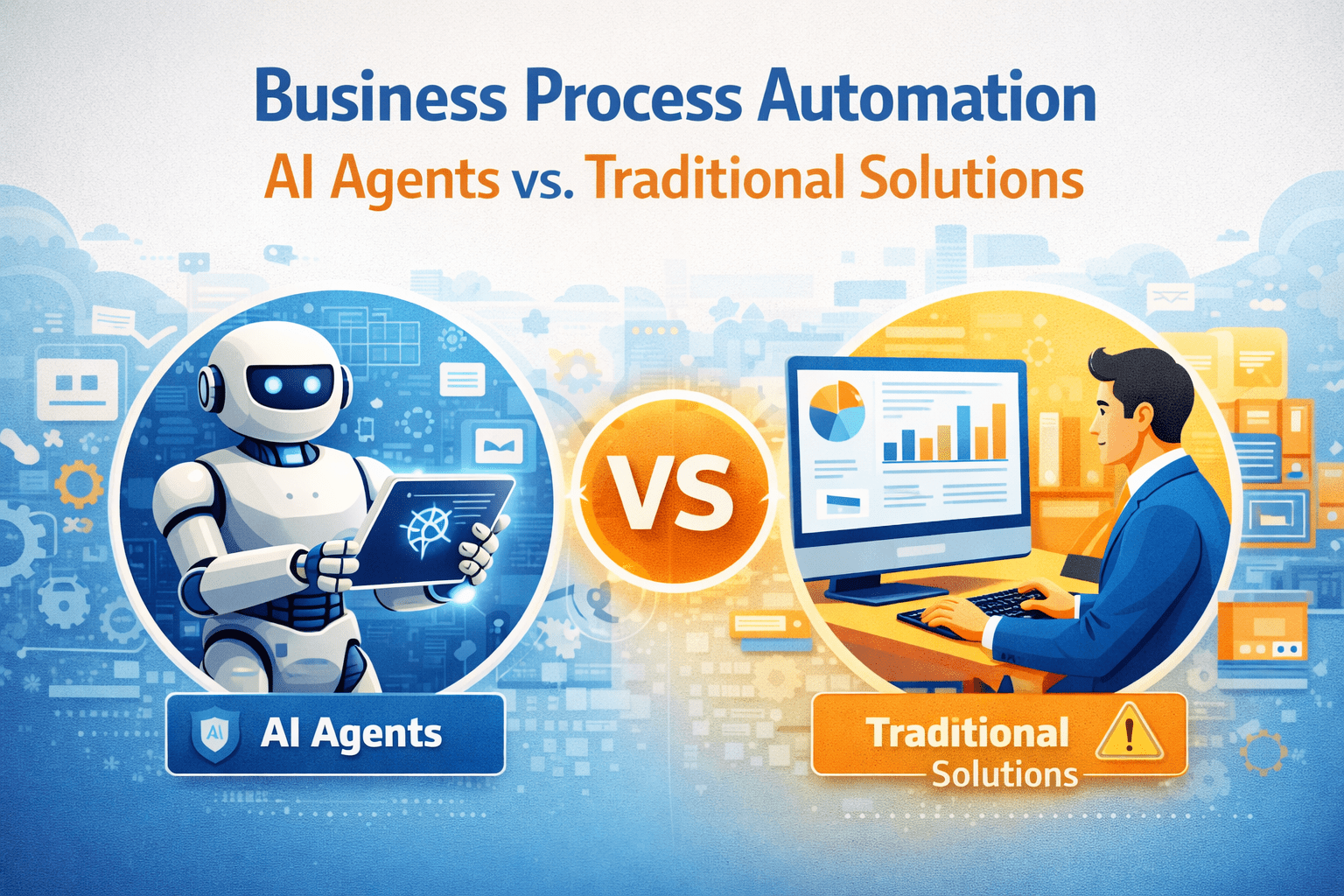
Business automation has existed for decades. Scripts, macros, workflow engines, and rule-based triggers have helped organizations eliminate repetitive tasks. But traditional automation was designed for static processes. Modern business operations are dynamic. Customer behavior changes. Market conditions shift. Internal workflows evolve.
AI agents introduce a new layer of adaptability.
The broader operational framework is introduced in AI Process Automation for Business: Complete Guide to Operational Excellence, where automation is positioned as the foundation of structured efficiency.
Understanding the difference between AI-driven automation and traditional tools is critical before investing.
What Traditional Automation Looks Like
Traditional business process automation relies on predefined rules.
Common characteristics include:
• Fixed “if-this-then-that” logic
No adaptability beyond programmed rules.
• Single-system workflow execution
Limited cross-platform coordination.
• Manual rule updates
Requires technical adjustments when processes change.
• Static reporting triggers
No contextual intelligence.
Traditional automation still works for stable, predictable processes.
However, it struggles when workflows become conditional or multi-system dependent.
Selection considerations are expanded in How to Choose AI Process Automation for Your Business Operations.
What AI Agents Introduce
AI-driven process automation enhances flexibility and intelligence.
Key capabilities include:
• Conditional decision logic
Adapt workflows based on context.
• Multi-system orchestration
Synchronize CRM, ERP, accounting, HR, and reporting tools.
• Anomaly detection
Identify process inconsistencies automatically.
• Real-time reporting generation
Reduce manual dashboard consolidation.
• Automated documentation logging
Improve compliance visibility.
Implementation sequencing is detailed in AI Agent Implementation: Reducing Business Operational Overhead.
Where Traditional Automation Still Works
Traditional tools are sufficient when:
• Workflows are simple and repetitive
• Only one or two systems are involved
• Processes rarely change
• Integration requirements are minimal
For small businesses with very stable processes, traditional automation may be adequate.
Scalability planning is discussed in AI Automation Challenges in Business: Executive and Small Business Solutions.
Where AI Agents Outperform Traditional Tools
AI automation becomes valuable when:
• Multiple departments are involved
Cross-functional workflow coordination required.
• Decision-making thresholds vary
Conditional logic improves accuracy.
• Reporting requires real-time data aggregation
Manual consolidation becomes inefficient.
• Compliance documentation must be logged
Automated audit trails improve accountability.
Provider evaluation for scalable AI solutions is covered in Business AI Automation Providers: Comparing Enterprise and Local Options.
Cost Comparison: Traditional vs AI Automation
Traditional automation:
• Lower initial setup cost
• Limited scalability
• Requires manual updates over time
AI automation:
• Slightly higher setup investment
• Scalable orchestration
• Reduced long-term maintenance
• Stronger reporting and oversight
ROI measurement frameworks are expanded in The Business AI Automation Checklist for Leaders and Owners.
Workforce Impact Differences
Traditional automation:
• Removes basic repetitive tasks
• Still requires manual supervision
• Reduce repetitive workload
• Provide contextual guidance
• Assist with training and support
• Improve workflow consistency
Workforce enablement is further explored in Employee Training AI: Automating Staff Support and Guidance.
Common Mistakes When Comparing Solutions
• Assuming AI is always necessary
• Overlooking integration complexity
• Choosing traditional tools for multi-system workflows
• Ignoring long-term scalability
• Evaluating cost without considering efficiency gains
Eliminating manual bottlenecks is addressed in How to Eliminate Manual Business Processes with AI Agents.
Key Takeaways
Traditional business process automation works effectively for stable, single-system, rule-based workflows, while AI agents provide adaptive, multi-system orchestration with conditional logic, real-time reporting, and automated documentation capabilities. Organizations must evaluate workflow complexity, scalability requirements, reporting needs, and long-term maintenance considerations before selecting between traditional and AI-driven solutions. When chosen strategically, AI automation enhances operational flexibility, reduces overhead, and strengthens business resilience beyond what static rule-based tools can provide.